
UPSC Essay Writing Guide with Topics, Outlines and a Model Essay
This UPSC essay guide explains how the essay paper of the Civil Services Mains works and how to write a strong essay for UPSC in English. It covers the paper format, the syllabus, a simple structure, brainstorming, the use of examples and the mistakes that cost marks.
After the guide you will find 30 practice topics, two model outlines and a 500 word sample essay to study and improve upon. Exam rules can change, so always check the latest official notification issued by the Union Public Service Commission before you plan your preparation.
UPSC Essay Syllabus and Paper Format
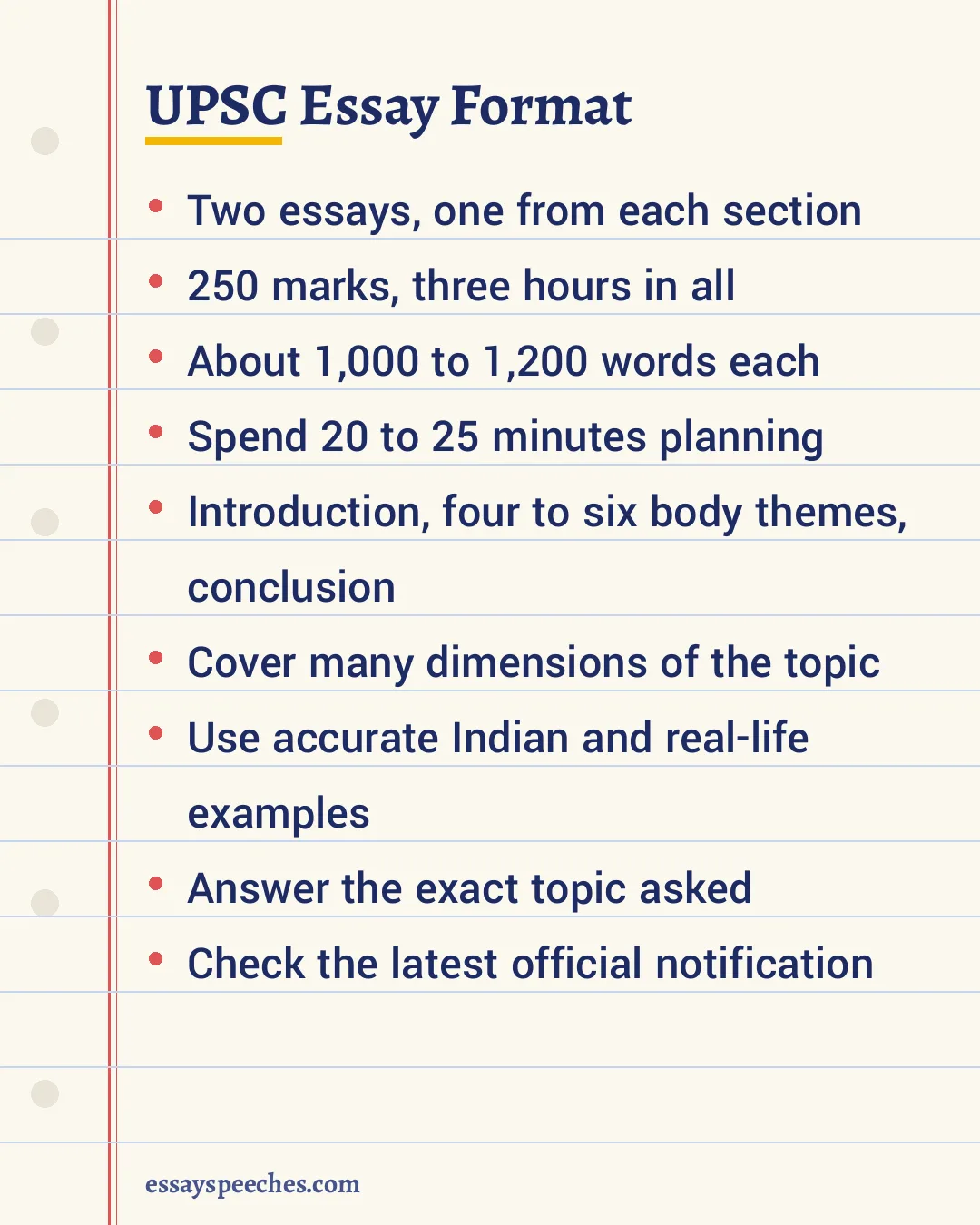
The essay paper is one of the papers of the Civil Services (Main) Examination conducted by the Union Public Service Commission. As commonly known, it carries 250 marks and lasts three hours. The question paper is divided into two sections, and each section offers a choice of topics. A candidate writes two essays in all, one from each section, and each essay is usually expected to be about 1,000 to 1,200 words long.
The official syllabus for the essay is very short. It says that candidates may be asked to write essays on multiple topics, that they should keep close to the subject, arrange their ideas in an orderly fashion and write concisely, and that credit is given for effective and exact expression. There is no fixed list of subjects, so a topic can come from ethics, society, economy, science, environment, governance or simple human experience.
| Feature | What aspirants commonly know |
|---|---|
| Number of essays | Two, one from each section |
| Total marks | 250 |
| Time | Three hours for both essays |
| Suggested length | About 1,000 to 1,200 words per essay |
| Kind of topics | Philosophical thoughts and quotes, plus social, economic, scientific and governance themes |
| Medium | The medium the candidate is allowed to choose under the exam rules |
Essay marks in UPSC: the essay counts towards the written total of the Mains, and so it affects the final merit list as much as any General Studies paper. Marks vary from year to year, and there is no official figure for the highest marks in essay. Instead of chasing a number, aim for an essay that answers the exact topic, flows logically and stays balanced.
UPSC essay PYQ: the previous year question papers released by the Commission are the best guide to the style of topics. Read at least five years of them before you begin regular practice.
Details such as sections, marks and timing can change, so always confirm them in the latest official notification before you plan your preparation.
How to Structure an Essay for UPSC Mains
A good UPSC essay is not a list of facts. It is a single argument that grows from paragraph to paragraph. Most aspirants use a simple three-part shape and spend real time on planning before they write a single line. For school-level basics, see our essay writing guide.
Introduction (about 120 to 150 words)
- Open with a short story, a real situation from Indian life, a contrast or a question that leads straight to the topic.
- Explain what the topic means in your own words, especially if it is a quote or a metaphor.
- End the introduction with one or two lines that show the direction your essay will take.
Body (about 750 to 900 words)
- Divide the body into four to six themes, each one a clear paragraph or a pair of paragraphs.
- Move from the individual to society, then to the nation and the world, or from past to present to future.
- Give space to the other side of the argument and answer it fairly. Examiners reward balance.
- Add a way forward with practical, realistic suggestions rather than slogans.
Conclusion (about 100 to 120 words)
- Return to the opening story or idea so that the essay feels complete.
- Sum up the main line of thought without repeating whole sentences.
- Close on a hopeful, forward-looking note that connects to the topic.
Suggested time plan for each essay
| Stage | Time | What to do |
|---|---|---|
| Read and choose | 5 minutes | Read every topic in the section and pick the one you understand best |
| Brainstorm and outline | 20 to 25 minutes | Note ideas, examples and the order of paragraphs |
| Write | 55 to 60 minutes | Write neatly in clear paragraphs |
| Revise | 5 minutes | Check spelling, missing words and the conclusion |
UPSC Essay Writing: Brainstorming, Examples and Common Mistakes
Brainstorming is where UPSC essays are won or lost. Write the topic in the middle of a rough page and ask what it means, why it matters, who it affects and what can be done about it. Then test the topic against a set of dimensions so that the essay does not stay narrow.
- Individual and family: values, habits, choices, relationships.
- Social: caste, gender, community, education, health, migration.
- Economic: jobs, farming, industry, inequality, informal work.
- Political and administrative: institutions, local bodies, rights, accountability.
- Ethical and philosophical: duty, truth, freedom, compassion.
- Science and environment: technology, climate, water, cities.
- Historical and international: lessons from the freedom struggle, examples from other countries.
Using examples well
Examples make an abstract essay believable. Use a mix: a scene from a village or city, a constitutional idea, a historical figure such as Mahatma Gandhi or Dr B. R. Ambedkar, a government scheme described neutrally, and a short line from your own observation. Choose facts you are completely sure of. One accurate example is worth more than three doubtful statistics.
Common mistakes in UPSC essay writing
- Writing on the general area instead of the exact topic, for example writing about technology in general when the topic asks whether technology has made us lonelier.
- Turning the essay into a General Studies answer with bullet points, headings and lists of schemes.
- Starting the first paragraph without any outline and losing the thread halfway.
- Taking an extreme, one-sided stand or using harsh words about any group or institution.
- Stuffing the essay with quotes, so that the candidate's own voice disappears.
- Leaving the conclusion rushed or unfinished because the time plan was ignored.
Five Ways to Start an IAS Essay
The first paragraph decides how the examiner reads the rest of the essay. Here are five ways to open, shown for the practice topic "Comfort is the enemy of growth".
- A short scene: A young engineer in Pune turns down a safe job offer and moves to a small town to run a water project. Her parents worry, yet she says she wants to learn what she does not yet know.
- A question: Why do so many people feel stuck in jobs and routines that they once worked hard to reach?
- A contrast: A seed that stays dry in a packet is safe, but it never becomes a tree.
- A historical moment: When Mahatma Gandhi returned to India in 1915, he chose to travel across the country in third class railway compartments to understand ordinary lives.
- A plain definition: Comfort is the state in which nothing asks us to change, and growth is exactly the opposite.
Whichever opening you choose, link it to the topic within the next two sentences.
UPSC Essay Questions for Practice: Philosophical Topics
These practice topics follow the style of thought-based essays. Each one can be read at the personal, social and national level.
- Comfort is the enemy of growth.
- A question asked honestly is half the answer.
- The loudest voice is not always the truest one.
- Freedom without responsibility is only noise.
- We see the world not as it is, but as we are.
- Patience is a form of action.
- Every map is smaller than the land it describes.
- Kindness costs nothing but builds everything.
- What we measure, we start to value.
- Silence can be a strong reply.
- Tradition is a lamp, not a chain.
- The present is a gift we often fail to open.
- Doubt is the beginning of wisdom.
- Small habits build great nations.
- A mind that is stretched never returns to its old size.
UPSC Mains Essay Practice Topics: Society, Economy and Governance
These themes need a balanced view, real examples and a practical way forward.
- Cities should be built for people, not only for vehicles.
- Technology connects us, yet loneliness is rising.
- Water security is the foundation of food security.
- Education must teach how to think, not what to think.
- Women's work at home is the invisible engine of the economy.
- Local self-government is the true school of democracy.
- Farming in India needs science as much as it needs rain.
- Climate change is a question of justice.
- Good health begins outside the hospital.
- Ethics in public life starts with small decisions.
- Migration builds cities but strains families.
- Data is the new raw material of development.
- Sports can unite a divided society.
- The digital divide is the new form of inequality.
- A strong nation rests on trust between citizens and institutions.
Model Essay Outline 1: Comfort Is the Enemy of Growth
Topic: Comfort is the enemy of growth
Introduction
- Scene of a person who leaves a secure routine to learn something new.
- Meaning of comfort and growth; the thesis that some comfort is needed, but too much stops progress.
Individual level
- Learning a skill always feels hard at first; students who avoid difficult subjects stay weak in them.
- Fear of failure keeps talent hidden.
Society and economy
- Communities that resisted new farming methods or girls' education fell behind.
- Firms that enjoyed protected markets often lost the urge to improve.
Nation and institutions
- Reform needs leaders and officials who are willing to leave old habits.
- The freedom struggle as an example of people giving up personal comfort for a larger goal.
The other side
- Rest, security and a safety net are necessary; nobody grows while hungry or exhausted.
- Basic comfort is a platform for growth; complacency is the real enemy.
Way forward and conclusion
- Build habits of small, regular challenges; schools that reward curiosity; policies that protect people while pushing improvement.
- Return to the opening scene and end on the idea that growth begins at the edge of comfort.
Model Essay Outline 2: Cities for People, Not Only Vehicles
Topic: Cities should be built for people, not only for vehicles
Introduction
- A parent walking a child to school on a road without footpaths.
- Thesis: a city is judged by how easily its weakest residents can move.
Present situation
- Rapid urban growth, crowded roads, long travel times, air and noise pollution.
- Pedestrians, cyclists, the elderly and persons with disabilities often ignored in planning.
Why people-first design matters
- Health: walking and cycling, cleaner air, fewer accidents.
- Economy: better public transport helps workers reach jobs cheaply.
- Equity: women's safety, access for children and older citizens.
Challenges
- Limited land, weak coordination between agencies, encroachment of footpaths.
- Aspirations linked to owning a vehicle.
Way forward
- Continuous footpaths, safe crossings, bus priority lanes, last-mile links, mixed-use neighbourhoods.
- Citizen participation through ward committees and local bodies.
Conclusion
- Return to the parent and child; a city built for people is better for vehicles too.
Sample Essay for UPSC: Small Habits Build Great Nations (500 Words)
Introduction
On a winter morning in a small town, a shopkeeper sweeps the patch of road in front of his shop before he opens the shutter. Nobody asks him to do it, and nobody thanks him. Yet the street is cleaner because of him, and within a few months the shopkeeper next door quietly copies the habit, and then the tea stall across the road. Nations are rarely changed by one dramatic act. They are shaped by millions of quiet habits repeated every day.
Habits as the Foundation of Character
A habit is a choice that has stopped feeling like a choice. When a child learns to wait in a queue, return a borrowed book on time or switch off an empty room's fan, these acts look tiny. Over years they become character. A society is simply the sum of such characters. Mahatma Gandhi understood this when he gave so much attention to sanitation, spinning and simple living. He believed that self-rule had to begin with rule over oneself.
From Private Habits to Public Culture
Private habits slowly turn into public culture. Where people follow traffic signals even at midnight, roads become safer for everyone. Where citizens pay taxes honestly and officials clear files on time, trust grows, and trust is the cheapest form of governance. Dr B. R. Ambedkar warned that constitutional morality is not a natural sentiment and has to be cultivated. In other words, the best laws need daily habits of respect, fairness and restraint to work.
The opposite is also true. Small acts of carelessness, such as littering, jumping a queue or paying a little bribe to save time, look harmless one at a time. Together they create a culture in which rules seem optional, and honest people feel foolish.
Habits in a Changing India
India today is young, mobile and increasingly connected. Each of these changes creates room for new habits. A farmer who checks soil health before buying fertiliser saves money and protects the land. A college student who verifies a forwarded message before sharing it slows the spread of rumours. A family that separates wet and dry waste at home makes the work of the municipal worker easier and safer. None of these acts needs a new law. Each needs awareness, a little patience and the belief that personal conduct matters to the country.
The Limits of Habit
Habits alone cannot build a nation. A family without clean water cannot practise good hygiene, and a worker with no safe footpath cannot walk to work. Public systems must make good habits easy. Campaigns like Swachh Bharat Abhiyan, launched in 2014, show that building toilets and spreading awareness work best when they move together.
Conclusion
The shopkeeper with his broom will never appear in a history book. But a country where millions behave like him, punctual, honest, careful with shared spaces, becomes strong in a way no single policy can achieve. Great nations are built brick by brick, and every brick is a habit.
How to Practise UPSC Essay Writing
- Write one full essay every week under a strict three-hour clock for two essays, or ninety minutes for one, so that timing becomes natural.
- Before writing, list at least six dimensions of the topic on a rough page and choose the four strongest for the body.
- Keep a small notebook of examples: stories from Indian villages and cities, constitutional ideas, events from the freedom struggle and lines from your own observation.
- Read good editorials and long-form articles for structure and tone, but write in your own simple words rather than copying phrases.
- Ask a friend or mentor to read your essay and tell you in one sentence what your main argument was. If they cannot, your essay needs a clearer thread.
- Use the previous year question papers to practise picking topics quickly, because a wrong choice in the first five minutes is hard to fix later.
Questions students ask
How many essays are written in the UPSC essay paper?
As commonly known, candidates write two essays, one from each of the two sections of the paper. Each section offers a choice of topics. Check the latest official notification for the exact pattern.
How many words should a UPSC essay be?
Each essay is usually expected to be about 1,000 to 1,200 words. Writing far less looks thin, while writing far more eats into the time for the second essay. Aim for complete, well-shaped paragraphs within this range.
What is the UPSC essay syllabus?
The syllabus does not list subjects. It asks candidates to write on given topics, keep close to the subject, arrange ideas in an orderly way and write concisely, with credit for effective and exact expression. In practice, topics range from philosophy and ethics to society, economy, science and governance.
Should I copy toppers' essays to prepare?
No. Reading many sample essays can help you see structure, but copying lines makes your writing sound memorised and stiff. Examiners value a clear, honest voice. Practise your own essays and get them reviewed instead.
Can I use quotes in a UPSC essay?
Yes, one or two short quotes can add weight if you are sure of the exact words and the speaker. Do not build the whole essay around quotes. Your own reasoning and examples should carry the argument.
Every essay and speech on this page is written and checked by the Essay Speeches team. Spotted a mistake? Tell us. How we write.