
Paragraph Writing: Format, Types, Examples and Topics
Paragraph writing is one of the first skills every English teacher checks, from class 1 tests to class 12 board papers. This page explains the paragraph writing format with a labelled example, the four types of paragraphs, the right length for each class and the errors students make most often.
Below the guide come 17 English paragraph samples on everyday topics, including descriptive paragraph examples for class 9, narrative and persuasive paragraphs and a short paragraph for handwriting practice. At the end there are 40 paragraph writing topics sorted by class. Read a sample, notice how it is built, and then write your own paragraph on a new topic.
Paragraph Writing Format, Rules and Types
A paragraph is a group of sentences about one single idea. In good paragraph writing, every sentence supports that idea, so the reader always knows what you are talking about. A well-built English paragraph has three parts.
- Topic sentence: usually the first sentence. It tells the reader what the paragraph is about.
- Supporting sentences: four to six sentences that give details, examples, reasons or a short incident.
- Concluding sentence: the last sentence. It closes the idea with a feeling, a lesson or a suggestion.
Paragraph Writing Format for School Exams
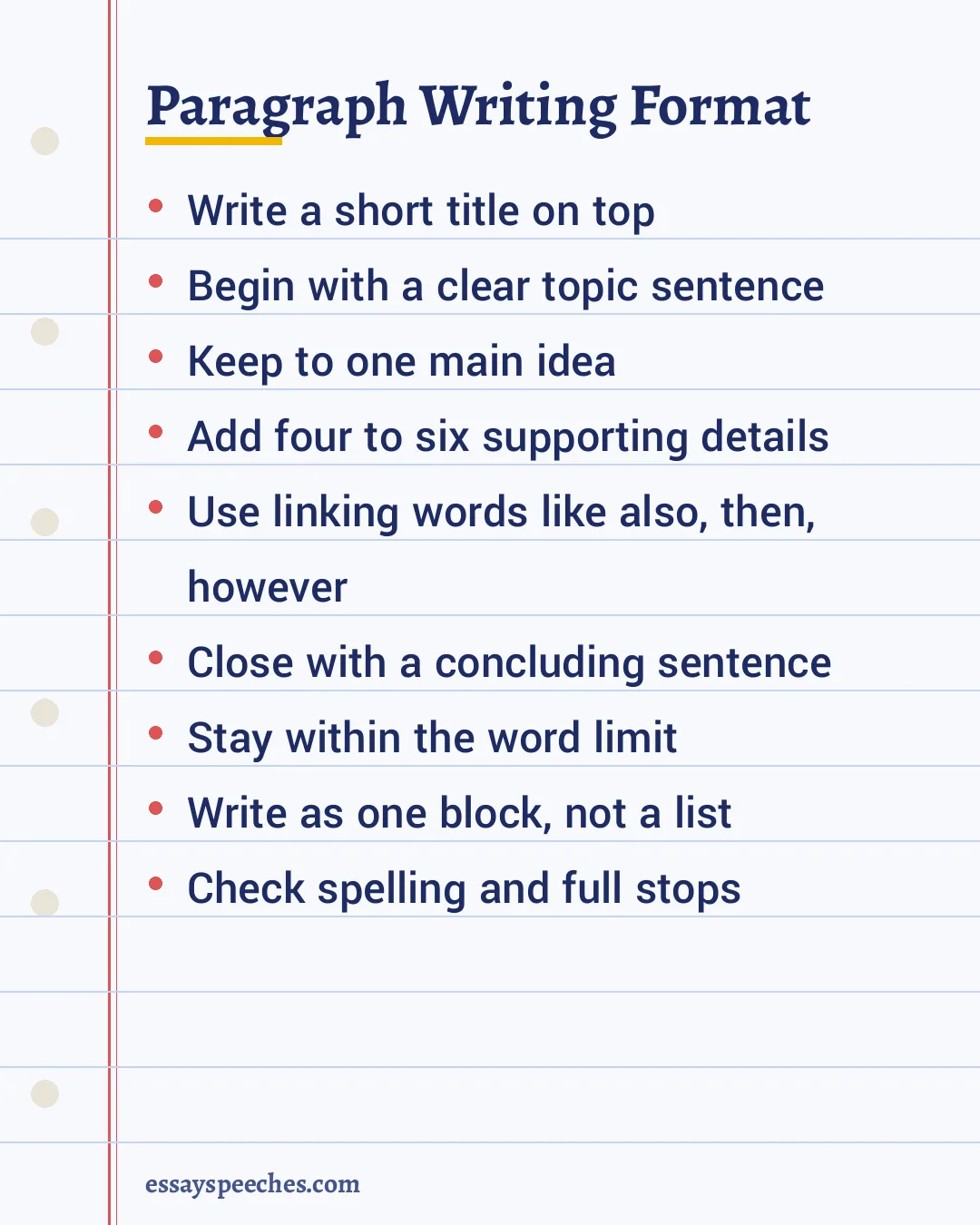
- Write the title in the centre of the first line, for example "My Favourite Toy".
- Leave a small space (an indent) at the start of the first line.
- Write all the sentences together in one block. Do not begin a new line for each sentence.
- Keep to the word limit given in the question, usually 80 to 150 words.
- Use the last minute to check spelling, capital letters and full stops.
A Labelled Example
Helping at Home
Topic sentence: I like to help my parents with small jobs at home. Supporting sentences: Every morning I fold my blanket and arrange my school bag. On Sundays I water the plants on our balcony and wipe the dining table after lunch. When my mother returns from the market, I carry the lighter bags to the kitchen and put the fruit in the basket. My father lets me hold the torch when he fixes a loose switch. Concluding sentence: These small jobs make me feel grown up, and they give my parents a little more time to rest.
Types of Paragraphs
| Type | What it does | Example topic |
|---|---|---|
| Descriptive paragraph | Paints a picture with sights, sounds, smells and feelings | A crowded railway platform |
| Narrative paragraph | Tells a short incident in the order it happened | The day I got lost at a fair |
| Expository paragraph | Explains a fact or idea with reasons and examples | Importance of sports |
| Persuasive paragraph | Gives an opinion and tries to convince the reader | Say no to junk food |
The descriptive paragraph format is the same as any other paragraph, but the supporting sentences use the five senses and strong describing words instead of facts and reasons.
How Long Should a Paragraph Be?
| Class | Length | Sentences |
|---|---|---|
| Classes 1 to 3 | 40 to 60 words | 5 or 6 short sentences |
| Classes 4 and 5 | 60 to 100 words | 6 to 8 sentences |
| Classes 6 to 8 | 100 to 120 words | 7 to 9 sentences |
| Classes 9 to 12 | 120 to 150 words | 8 to 10 sentences with richer words |
A short paragraph sticks to one point. If you need much more than 150 words, you are really writing an essay, so read our essay writing guide. For the class 10 chart question, see the analytical paragraph page.
Common Mistakes to Avoid
- Beginning with "This paragraph is about..." instead of a real topic sentence.
- Jumping between two or three ideas in the same paragraph.
- Writing every sentence on a new line, which turns the paragraph into a list.
- Using the same word again and again, such as "good", "nice" or "very".
- Stopping suddenly without a concluding sentence.
- Going far over or under the word limit.
Looking for a paragraph on a popular topic? Each of these pages has one: my school, my mother, the rainy season, my hobby and pollution. For Hindi, open our Hindi paragraph page.
Short Paragraph on My Pet Rabbit
We have a white rabbit named Snowy. She has long ears, pink eyes and a tiny nose that keeps twitching. Snowy lives in a wooden hutch in our backyard, and we let her hop around the lawn every evening. She loves carrots, cabbage leaves and fresh grass. When she is happy, she jumps high in the air and twists her body. I clean her hutch every Sunday and fill her water bowl each morning. She lets me stroke her soft fur while she nibbles her food. Snowy is the gentlest friend I have.
Short Paragraph for Handwriting Practice: Kindness
Kindness means caring about others and helping them without expecting anything back. A kind person speaks gently, shares lunch with a hungry classmate and holds the hand of an old person crossing the road. We can be kind to animals by keeping a bowl of water outside our gate in summer. Even a smile or a simple thank you can brighten someone's day. Kindness costs nothing, yet it makes the world a happier place.
Paragraph on My Little Sister
My little sister Riya is four years old, and she is the noisiest member of our family. She has round cheeks, short curly hair and a loud giggle. Every evening she waits at the door for me to come back from school. She loves drawing with crayons, but she draws on the walls more than in her book. When I do my homework, she sits beside me and pretends to read. Sometimes she takes my pencils and hides them under the sofa. Even so, I cannot stay angry with her for long. Our home feels empty whenever she goes to stay with our grandmother.
Paragraph on a Visit to a Park
Last Sunday, my father took my brother and me to the big park near our colony. The gate opened onto a wide green lawn edged with rose and marigold plants. Children were playing on the swings, slides and see-saw, and some older boys were flying kites. We bought roasted peanuts from a cart and sat under a neem tree to eat them. In one corner, a group of grandparents was laughing loudly as part of their exercise. Before leaving, we fed bread crumbs to the ducks in the small pond. I came home tired, dusty and very happy.
Paragraph on My Bicycle
On my ninth birthday, my parents gifted me a red bicycle with a silver bell. At first I kept falling, so my elder brother held the seat and ran behind me around our lane. After a week of practice, I could ride on my own. Now I ride my bicycle to my tuition class and to the dairy to buy milk. I wipe it clean every Sunday and check the air in the tyres. Cycling keeps my legs strong and does not pollute the air. I feel proud and free whenever I pedal down the road on it.
Paragraph on Our School Library
The library is the quietest room in our school and also my favourite. It is on the first floor, with tall wooden shelves along every wall. The books are arranged by subject, and a small label on each shelf tells us where to find stories, science, history or poems. Our librarian, Mrs Mathur, helps us choose books that suit our age. We have one library period every week, and we may take one book home for seven days. Large windows let in plenty of light, and a few posters remind us to keep silent. Newspapers and children's magazines lie on a separate table near the door. Whenever I enter the library, I feel I can travel anywhere in the world without leaving my chair.
Paragraph on a Day at the Beach
During the winter holidays, my family spent a day at the beach in Puri. We reached early in the morning, when the sand was still cool under our feet. The sea was a deep blue, and the waves rushed in with white foam on top. My cousins and I built a sandcastle with towers and a moat, but a big wave washed half of it away. We collected shells of many shapes and colours in a plastic box. Nearby, fishermen were pulling their boats onto the shore with the morning catch. For lunch we ate hot puris and potato curry under a large umbrella. In the evening the sun sank into the water like an orange ball, and none of us wanted to leave.
Descriptive Paragraph on a Winter Morning
A winter morning in North India has a charm of its own. When I wake up, a thick fog hides the houses across the road, and the street lights still glow faintly. My breath turns into small clouds as I step out to catch the school bus. Vendors sit around small fires to warm their hands, and the tea stall at the corner is crowded with people holding steaming glasses. Dew drops shine on the grass like tiny pearls. By ten o'clock the sun breaks through, and everyone looks for a warm spot to stand in. Woollen caps, mufflers and paper cones of hot groundnuts make these mornings my favourite part of the year.
Narrative Paragraph: My First Day at a New School
When my father was transferred to Pune, I had to join a new school in the middle of class five. On the first morning, my hands were cold and I hardly spoke a word in the car. The classroom was full of children who already had their own groups of friends. The class teacher introduced me and gave me a seat next to a boy named Arjun. During the lunch break, he shared his poha with me and showed me the library and the playground. By the last period, two more children had asked me to join their football game. I went home smiling and told my mother that a new school is not so frightening after all.
Paragraph on the Importance of Sports
Sports are as necessary for students as books and lessons. When we run, jump or play a team game, our heart and lungs grow stronger and our body stays fit. Games like football, kabaddi and basketball also teach us to work as a team and to follow rules. A player learns to accept defeat calmly and to keep trying after a loss. Regular play reduces exam stress and helps us sleep well at night. This is why most schools keep a games period in the timetable. Even a short game of badminton in the evening can refresh a tired mind. A student who balances study and sports grows up healthy, confident and disciplined.
Paragraph on the Habit of Reading
Reading is a habit that rewards us for the whole of our life. A good book lets us visit faraway countries, meet interesting people and live through adventures while sitting at home. Story books improve our vocabulary, spelling and sentence building, which helps in every subject. Newspapers keep us aware of what is happening around us. A student who reads daily also learns to concentrate for longer. Instead of looking at a screen before bed, we can read ten pages of a novel. School libraries, book fairs and old books passed on by cousins make reading easy for everyone. Once the habit is formed, a book becomes a friend that is always ready to talk.
Narrative Paragraph: The Day I Got Lost at a Fair
I still remember the evening I got lost at the annual fair in our town. I was eight years old and was holding my uncle's hand near the giant wheel. A seller passed by with a bunch of colourful balloons, and I let go to look at them. When I turned around, my uncle had disappeared into the crowd. My heart began to pound and tears filled my eyes. Then I remembered my mother's advice: stay in one place and ask a policeman for help. I walked to a police booth near the entrance and told the constable my name and my father's phone number. Within fifteen minutes, my worried uncle came running towards me. Since that day, I always fix a meeting point with my family whenever we visit a crowded place.
Persuasive Paragraph: Say No to Junk Food
Burgers, chips, instant noodles and fizzy drinks may taste good, but we should keep them out of our daily diet. Junk food contains too much salt, sugar and oil and very little of the vitamins and fibre our growing bodies need. Children who eat it often feel tired, gain extra weight and fall ill more easily. It also harms our teeth and makes us lose interest in healthy home food. Our grandparents stayed fit on dal, roti, seasonal vegetables, fruit and buttermilk. Instead of a packet of chips at recess, we can carry roasted chana, a fruit or a homemade sandwich. A treat once in a while is fine, but it should never become a habit. Let us choose food that makes us strong, not food that only fills the stomach.
Persuasive Paragraph: Every School Should Have a Garden
Every school, big or small, should have a garden that the students look after themselves. A garden is a living classroom where children can see how a seed becomes a plant, how bees help flowers and how compost is made from kitchen waste. Working with soil and water teaches patience, because nothing grows overnight. Students also learn to share duties, since one group waters the beds while another pulls out weeds. Green spaces cool the campus in summer and give tired minds a calm place to sit. A school garden can even supply spinach, tomatoes and beans for a cooking activity. Very little is needed to begin: a corner of land, a few tools and some seeds. If every school started one, our children would grow up caring for nature.
Descriptive Paragraph for Class 9: A Crowded Railway Platform
At seven in the evening, platform number three of our city station is a world of its own. Loudspeakers announce arrivals in a calm voice that nobody seems to hear. Porters in red shirts balance heavy suitcases on their heads and shout for people to make way. Families sit on spread-out bedsheets, guarding bags tied with rope, while children dart between the pillars. The smell of fried samosas and strong tea drifts from the stalls, mixed with the sharp odour of diesel. When a train rumbles in, the whole platform seems to rise at once and rush towards the doors. Within minutes the coaches swallow the crowd, the guard waves his flag and the train pulls away. The platform falls silent, but only until the next announcement crackles through the speakers.
Descriptive Paragraph Class 9: My Grandmother's Kitchen
My grandmother's kitchen in our village is the warmest room I have ever known. It is small and low-roofed, with a clay stove in one corner and brass vessels gleaming on a wooden shelf. Glass jars of mango pickle stand in a row near the window, catching the afternoon sun. The air always carries some smell: mustard seeds crackling in hot oil, jaggery melting for sweets, or fresh rotis puffing over the flame. Grandmother sits on a low wooden stool, her bangles clinking as she kneads the dough. She never measures anything, yet every dish tastes perfect. On winter evenings, the whole family crowds into this room, sitting on mats and chatting while the food cooks. To me, that kitchen is not just a place to cook but the heart of the house.
Descriptive Paragraph Example: An Evening Vegetable Market
The vegetable market near our colony comes alive just as the sun begins to set. Long rows of carts are lit by yellow bulbs hanging from bamboo poles. Heaps of red tomatoes, purple brinjals, green chillies and white cauliflowers make the lane look like a painter's palette. Vendors call out loudly, each one claiming that his spinach is the freshest. Shoppers bend over the baskets, pressing gourds and sniffing melons before they decide. A cow wanders slowly between the carts, hoping for a fallen cabbage leaf. Cloth bags fill up, coins clink and small arguments over weight end in smiles. By nine o'clock the carts are covered with sacks, and only crushed leaves remain on the road.
Paragraph Writing Topics for Class 5 and Below
Easy topics for short paragraphs of 40 to 100 words. Write about what you see and do every day.
- My School Bag
- My Favourite Toy
- My Pet Rabbit
- My Little Sister
- My Bicycle
- A Visit to a Park
- My Favourite Fruit
- Our Garden
- The Moon at Night
- My Grandparents
- A Rainy Day
- My Birthday Party
- My Classroom
- The Sun
- My Favourite Colour
- A Visit to the Zoo
- Our Neighbourhood
- My Lunch Box
- Helping at Home
- Kindness
Paragraph Writing Topics for Class 6 to 10
Topics for paragraphs of 100 to 150 words, with a mix of descriptive, narrative, expository and persuasive ideas.
- A Crowded Railway Platform
- My Grandmother's Kitchen
- An Evening Vegetable Market
- A Winter Morning
- A Day at the Beach
- The Day I Got Lost at a Fair
- My First Day at a New School
- An Unforgettable Journey
- A Power Cut at Night
- The Importance of Sports
- The Habit of Reading
- Say No to Junk Food
- Every School Should Have a Garden
- Road Safety for Students
- Uses of a Library
- Good Manners
- Learning a New Skill
- A Visit to a Historical Monument
- Life in a Big City
- Why We Should Plant More Trees
Tips for Better Paragraph Writing
- Read the question twice and underline the topic and the word limit before you write a single word.
- Make a quick list of four or five points in the margin, then put them in a sensible order: by time for a story, by place for a description, by importance for reasons.
- Start with a lively topic sentence such as "The vegetable market near our colony comes alive at sunset" rather than a dull definition.
- Join sentences with linking words like first, then, also, however, because and finally so the paragraph flows.
- For a descriptive paragraph, use at least three senses: what you see, hear and smell, and add one feeling.
- Finish with a concluding sentence that gives a lesson, a wish or your own feeling about the topic.
- Count your lines: in most exam answer sheets, about 10 to 12 lines of handwriting equal 100 to 120 words.
Questions students ask
What is paragraph writing?
Paragraph writing means writing a group of connected sentences about one main idea. A good paragraph starts with a topic sentence, gives supporting details and ends with a concluding sentence. It is written as one block of text under a title.
What is the format of paragraph writing?
Write the title in the centre, indent the first line, begin with a topic sentence, add four to six supporting sentences and finish with a concluding sentence. Keep everything in one block and stay within the word limit given in the question.
How many words should a paragraph have?
Students of classes 1 to 3 usually write 40 to 60 words, classes 4 and 5 write 60 to 100 words, and classes 6 to 10 write 100 to 150 words. Always follow the limit given in your question paper, as it may differ.
What is a descriptive paragraph?
This kind of paragraph shows the reader a scene, a person or an object instead of explaining facts. It relies on the five senses and vivid describing words so the reader can imagine being there. The railway platform and grandmother's kitchen samples on this page are good descriptive paragraph examples for class 9.
What is the difference between a paragraph and an essay?
A paragraph develops one idea in a single block of about 50 to 150 words. An essay covers a topic from several angles in many paragraphs, with an introduction, body and conclusion, and is usually 150 words or longer.
Every essay and speech on this page is written and checked by the Essay Speeches team. Spotted a mistake? Tell us. How we write.