
Essay on My Favourite Festival for Students (10 Lines, Short and Long Essays)
This essay on my favourite festival page gives you a different festival in almost every piece, so you can pick the one you actually love. There are 10 lines on Diwali and Christmas, short essays on Eid, Holi and Onam, a paragraph on Pongal, an essay on Indian festivals, an essay on national festivals, a long 500 word essay, a speech on Independence Day and 10 lines in Hindi (mera priya tyohar).
Go for the piece that fits your class and the length your teacher wants. You can swap in your own festival and keep the same plan: when it comes, how your family gets ready, what you eat and wear, and what the festival teaches. Then write it in your own words.
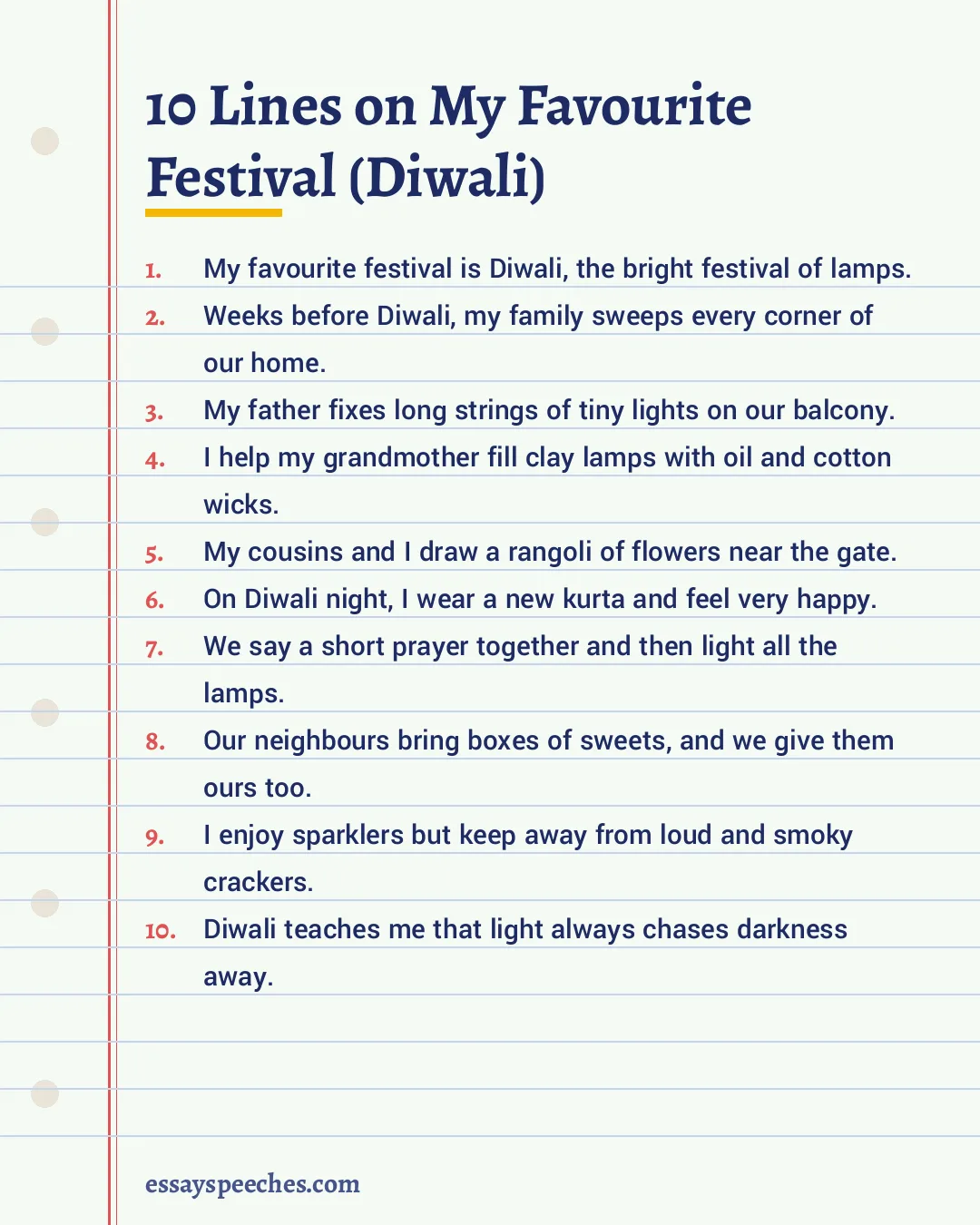
10 Lines on My Favourite Festival (Diwali)
- My favourite festival is Diwali, the bright festival of lamps.
- Weeks before Diwali, my family sweeps every corner of our home.
- My father fixes long strings of tiny lights on our balcony.
- I help my grandmother fill clay lamps with oil and cotton wicks.
- My cousins and I draw a rangoli of flowers near the gate.
- On Diwali night, I wear a new kurta and feel very happy.
- We say a short prayer together and then light all the lamps.
- Our neighbours bring boxes of sweets, and we give them ours too.
- I enjoy sparklers but keep away from loud and smoky crackers.
- Diwali teaches me that light always chases darkness away.
My Favourite Festival Essay 10 Lines: Christmas (Set 2)
- Christmas is my favourite festival, and it is celebrated every year on 25 December.
- Christians all over the world remember a holy birth on this day, and people of every faith join the fun.
- In the first weeks of December, families put up a Christmas tree and decorate it with bells, ribbons and coloured balls.
- A paper star is hung outside many homes, and it glows softly through the winter nights.
- On chilly evenings, carol singers visit the homes of friends and neighbours with guitars and songs.
- On Christmas Eve, many families attend a special midnight service at the church.
- Children hang socks near their beds and hope to find small gifts from Santa Claus in the morning.
- Mothers bake rich plum cake and make kulkuls, rose cookies and other treats to share with friends.
- At school, we hold a Christmas party, exchange cards and play the secret friend game.
- Christmas reminds me that giving to others brings far more joy than receiving.
My Favourite Festival Essay in 100 Words (Eid)
Eid ul-Fitr is the festival I wait for all year. It comes at the end of Ramzan, the month in which Muslims fast from dawn to sunset. When the thin new moon is seen in the sky, everyone hugs and says Eid Mubarak.
In the morning, my friend Ayaan and his father wear new white kurtas and go for Eid prayers. They also give food and money to the poor. Later, their home fills with guests. His mother serves sheer khurma and sewaiyan, and the children get Eidi from elders. Eid teaches kindness and sharing.
My Favourite Festival Essay 150 Words (Holi)
Of all the festivals in our calendar, I like Holi best. It usually arrives in March, just as the winter cold disappears and the mango trees begin to flower.
The fun starts a day early. On the evening before, our colony gathers around a big pile of wood and lights it. We clap, sing and watch the sparks fly into the dark sky. My grandfather says the fire burns away all that is bad.
Next morning, I put on my oldest T-shirt and run out with a bucket of coloured water. Within minutes, my friends turn pink, blue and green. Even our strict maths teacher, who lives next door, smiles when we put a little gulal on his forehead.
After a long bath, we eat my aunt's crisp gujiya and drink cold thandai. Holi is my favourite festival because it makes everyone laugh, forgive and play together like one big family.
Paragraph on My Favourite Festival (Pongal)
My favourite festival is Pongal, the harvest festival of Tamil Nadu, which falls in the middle of January at the start of the Tamil month of Thai. It is celebrated for four days. On Bhogi, the first day, people throw old things into a bonfire and welcome a fresh start. On the main day, families boil new rice with milk and jaggery in a decorated pot in the open courtyard. When the milk bubbles over, everybody shouts Pongalo Pongal, which is a sign of plenty. Doorsteps are covered with white kolam designs, and sugarcane stands in every corner. On Mattu Pongal, cows and bullocks are bathed and their horns are painted. Pongal teaches us to thank the sun, the soil and the farmers who feed us.
Festival Essay in English 200 Words: Onam
Kerala has many festivals, but none is as loved as Onam. It is a ten-day harvest festival that falls in the Malayalam month of Chingam, around August or September, when the monsoon rains ease and the paddy fields turn green and gold. Onam is celebrated by people of every community in the state.
The festival is linked to an old legend about a kind and generous king whose rule was so fair that nobody was poor or unhappy. People believe he comes back once a year to see his subjects, and Onam is their way of welcoming him.
Every morning during the festival, girls and women make a pookalam, a round carpet of fresh flower petals, in front of the house. The design grows bigger each day. On Thiruvonam, the main day, families wear new clothes, often cream sarees and mundus with golden borders.
The highlight is the Onasadya, a grand lunch of more than twenty dishes served on a banana leaf, ending with sweet payasam. Snake boat races on the backwaters, the Pulikali tiger dance and the graceful Thiruvathira dance add to the joy. Onam truly celebrates equality and togetherness.
Essay on Indian Festival in 250 Words
A calendar in an Indian home is never short of red circles. Hardly a month passes without some festival, and that is why India is often called a land of festivals. With so many religions, languages and regions living side by side, our festivals are as varied as our food and clothes.
Indian festivals can be grouped in a simple way. Some are religious festivals, such as Diwali, Eid, Christmas, Navratri and Gurpurab. Some are harvest festivals, like Pongal in Tamil Nadu, Onam in Kerala, Bihu in Assam, Lohri and Baisakhi in Punjab and Makar Sankranti in many states. A third group is our national festivals: Republic Day, Independence Day and Gandhi Jayanti.
Though each festival has its own story, most of them share the same spirit. Houses are cleaned and decorated. People wear new clothes, prepare special dishes and visit relatives. Fairs, music and dance fill the streets. Many festivals also follow the farming year, thanking nature for rain, sunshine and a good crop.
Festivals are important because they bring a break from routine and give families a reason to come together. They keep our arts, crafts and recipes alive, and they give work to potters, tailors, sweet makers and flower sellers. Most of all, they teach respect for one another, since neighbours of different faiths often celebrate together.
We must also celebrate wisely, without noise, waste or harm to the environment. Then every Indian festival becomes a true festival of joy.
Essay on National Festivals of India (300 Words)
Most festivals belong to a particular faith or region, but a few belong to every Indian equally. These are our national festivals: Independence Day, Republic Day and Gandhi Jayanti. On these days, offices, schools and banks remain closed, and the whole nation celebrates as one family.
Independence Day falls on 15 August. On this date in 1947, India became free after nearly two hundred years of British rule. Every year, the Prime Minister hoists the national flag at the Red Fort in Delhi and speaks to the nation. In schools, students sing patriotic songs, perform skits about the freedom struggle and receive sweets after the flag is raised.
Republic Day is celebrated on 26 January. It was on this date in 1950 that our Constitution took effect, making India a republic. A grand parade is held in New Delhi, where the President takes the salute. Soldiers march in step, and colourful tableaux show the culture of different states. Awards for bravery are announced on the eve of the day.
Gandhi Jayanti, on 2 October, marks the birthday of Mahatma Gandhi. Born at Porbandar in Gujarat in 1869, he went on to lead the freedom struggle with truth and non-violence. On this day, people pay tribute at Raj Ghat, sing his favourite bhajans and take part in cleanliness drives.
National festivals are not about sweets and holidays alone. They remind us of the sacrifices made by freedom fighters and the values written in our Constitution: justice, liberty, equality and fraternity. They unite people of all religions, languages and states under one tricolour.
As students, we can celebrate these days by learning about our history, respecting the flag and keeping our surroundings clean. A good citizen is the best gift we can give the nation.
Essay on My Favourite Festival in 500 Words (Diwali)
Introduction
Some festivals are loud, some are quiet, and some are simply full of light. For me, the festival that feels like home is Diwali. Each autumn, on the dark new moon night of the month of Kartik, millions of small flames turn the whole country golden. I have celebrated many festivals with friends from different communities, yet none fills my heart quite like Diwali.
Why Diwali Is Celebrated
Diwali, or Deepavali, means a row of lamps. Many families link it to an old story from the epics about a prince who returned home after fourteen years of exile, while the people lit lamps to welcome him. In other regions, it marks the start of a new business year or the end of the harvest. Jains and Sikhs also observe the day for their own reasons. Whatever the story, the meaning is the same: light wins over darkness, and good wins over evil.
Getting Ready
In our house, Diwali begins almost a month early. Old newspapers are sold, cupboards are emptied and the walls get a fresh coat of paint. My mother makes a list of relatives to visit, and my father brings home new curtains. A few days before the festival, the market near our street is so crowded that you can hardly walk. Stalls sell clay diyas, paper lanterns, marigold garlands and heaps of dry fruits.
The kitchen is my favourite place at this time. My grandmother fries chakli and shankarpali, and the smell of ghee and cardamom fills the house. I am allowed to shape the karanji, though mine never look as neat as hers.
The Day of Lights
On the evening of Diwali, we all bathe early and put on new clothes. My sister and I make a large rangoli at the entrance with powder colours and flower petals. As the sun sets, the family sits together for a prayer at home. Then comes the moment I love most: lighting the diyas one by one and placing them on the windows, the stairs and the boundary wall. When I look down from our terrace, the whole lane seems to be smiling.
Later, we walk to our neighbours' houses with plates of sweets. Nobody leaves empty-handed. Even the watchman, the milkman and the lady who helps my mother receive gifts and greetings.
A Greener Diwali
A few years ago, our class learnt how firecrackers fill the air with smoke and frighten birds and street dogs. Since then, my family celebrates with lamps, lanterns and music instead. We also buy diyas from local potters, so that their families have a happy Diwali too.
Conclusion
Diwali is my favourite festival because it is about more than light. It teaches me to clean not only my house but also my mind, to share what I have, and to keep hope alive even on the darkest night.
Speech on My Favourite Festival: Independence Day (2 Minutes)
Good morning to our respected Principal, teachers and my dear friends.
When people ask me about my favourite festival, they expect me to say Diwali, Eid or Christmas. I love those festivals too. But the festival that makes my heart beat fastest is a national one: Independence Day.
Why do I call it a festival? Because on 15 August, the whole country celebrates together. It does not matter which faith you follow or which language you speak. Everyone, from a farmer in Punjab to a fisherman in Kerala, shares the same joy.
Think of that morning in 1947. After years of struggle, sacrifice and patience, India woke up free. Freedom fighters had faced lathis, jails and hunger so that we could live with dignity. Every 15 August, we thank them.
I love the way our school celebrates. We arrive early in crisp white uniforms. The tricolour rises slowly, the petals fall, and we sing the national anthem together. Then the cultural programme begins: patriotic songs, a skit on the freedom struggle and a march past. Each of us goes home with a laddoo and a small paper flag.
But friends, is Independence Day only about one morning? I do not think so. Freedom is a gift that we must protect every day. We protect it when we study honestly, keep our streets clean, respect every citizen and follow the law. We protect it when we never throw the paper flag on the ground after the function.
So this Independence Day, let us celebrate with pride and with promise.
Our flag flies high because millions of hearts hold it up.
Thank you. Jai Hind.
Mera Priya Tyohar Nibandh 10 Lines in Hindi: मेरा प्रिय त्योहार
- मेरा प्रिय त्योहार दीपावली है, जिसे रोशनी का त्योहार कहते हैं।
- यह त्योहार हर साल अक्टूबर या नवंबर महीने में आता है।
- दीपावली से पहले हम पूरे घर की अच्छी तरह सफ़ाई करते हैं।
- मेरी माँ घर के आँगन में सुंदर रंगोली बनाती हैं।
- शाम को हम मिट्टी के दीयों में तेल डालकर उन्हें जलाते हैं।
- इस दिन सब लोग नए कपड़े पहनकर घर में पूजा करते हैं।
- हम अपने पड़ोसियों और रिश्तेदारों को मिठाई के डिब्बे देते हैं।
- मैं तेज़ आवाज़ वाले पटाखे नहीं जलाता, क्योंकि इनसे धुआँ होता है।
- दीपावली हमें सिखाती है कि अच्छाई की हमेशा जीत होती है।
- यह त्योहार सबके जीवन में ख़ुशी और उजाला भर देता है।
More Festival Essays
If your teacher has asked for one particular festival, read the full page on it. You will find more essays, 10 lines and speeches in our essay on Diwali and essay on Holi pages, along with a Christmas essay, a Dussehra essay and an Independence Day speech.
How to Write an Essay on My Favourite Festival
- Choose a festival you have really celebrated, because your own memories make the essay lively and easy to write.
- Begin with a scene that the reader can almost see, like the smell of sweets in the kitchen or the first lamp of the evening.
- Give the basic facts in the first paragraph: the festival's name, the month or season it falls in, and the state or community that celebrates it.
- In the body, describe the preparations, the main day and the food, clothes and games, using details from your own family.
- Add one paragraph on the meaning of the festival, such as the victory of good over evil, thanks for the harvest or love for the nation.
- For an essay on national festivals, remember the key dates: 15 August 1947, 26 January 1950 and 2 October 1869.
- End with why the festival matters to you and one line on celebrating safely, without noise, waste or harm to animals.
Questions students ask
Which festival should I choose for my favourite festival essay?
Pick any festival you know well, such as Diwali, Holi, Eid, Christmas, Pongal, Onam or Independence Day. Teachers give marks for clear facts and personal details, not for the festival you choose. A festival you have celebrated yourself is always the easiest to describe.
What are the national festivals of India?
India has three national festivals: Independence Day on 15 August, Republic Day on 26 January and Gandhi Jayanti on 2 October. They are celebrated by people of all religions and regions, and they are national holidays across the country.
How do I write 10 lines on my favourite festival?
Write one simple fact or activity in each line. Cover the name of the festival, when it comes, how you prepare, what you wear and eat, what you do on the main day and why you like it. Keep lines for classes 1 to 3 to about 10 to 12 words.
What is the difference between a festival paragraph and a festival essay?
A paragraph is a single block of about 100 to 150 words with one main idea. An essay has several paragraphs: an introduction, a body that describes the celebration and its meaning, and a conclusion. Long essays of 400 words or more also use headings.
How can festivals be celebrated in an eco-friendly way?
Use clay lamps and natural colours, avoid loud firecrackers, and do not waste water or food. Choose decorations made of paper, cloth or flowers that can be reused or composted. Buying from local potters and artisans also helps their families celebrate.
Every essay and speech on this page is written and checked by the Essay Speeches team. Spotted a mistake? Tell us. How we write.