
Speech Writing: Format, How to Start and End, and Examples
Speech writing is the skill of preparing a talk that sounds natural when you say it aloud, whether in the morning assembly, at a competition or in the class 11 and 12 English exam. This page explains the speech writing format step by step, shows how to start and how to end a speech, and gives six full speeches in English for students.
Read the format first, then study one sample that matches your class. Notice the greeting, the name and class line, the short body paragraphs and the thank-you at the end. After that, write a speech of your own on a fresh topic from the practice list.
Speech Writing Format for Class 11 and 12 (With Example)
A speech is a talk given to a group of listeners on one topic. Speech writing means preparing that talk on paper so that it sounds natural when you say it aloud. Whether you speak in the morning assembly, at a competition or answer a question in the writing section of an English exam, a good speech does the same job: it talks directly to the audience, holds their attention and leaves them with one clear message.
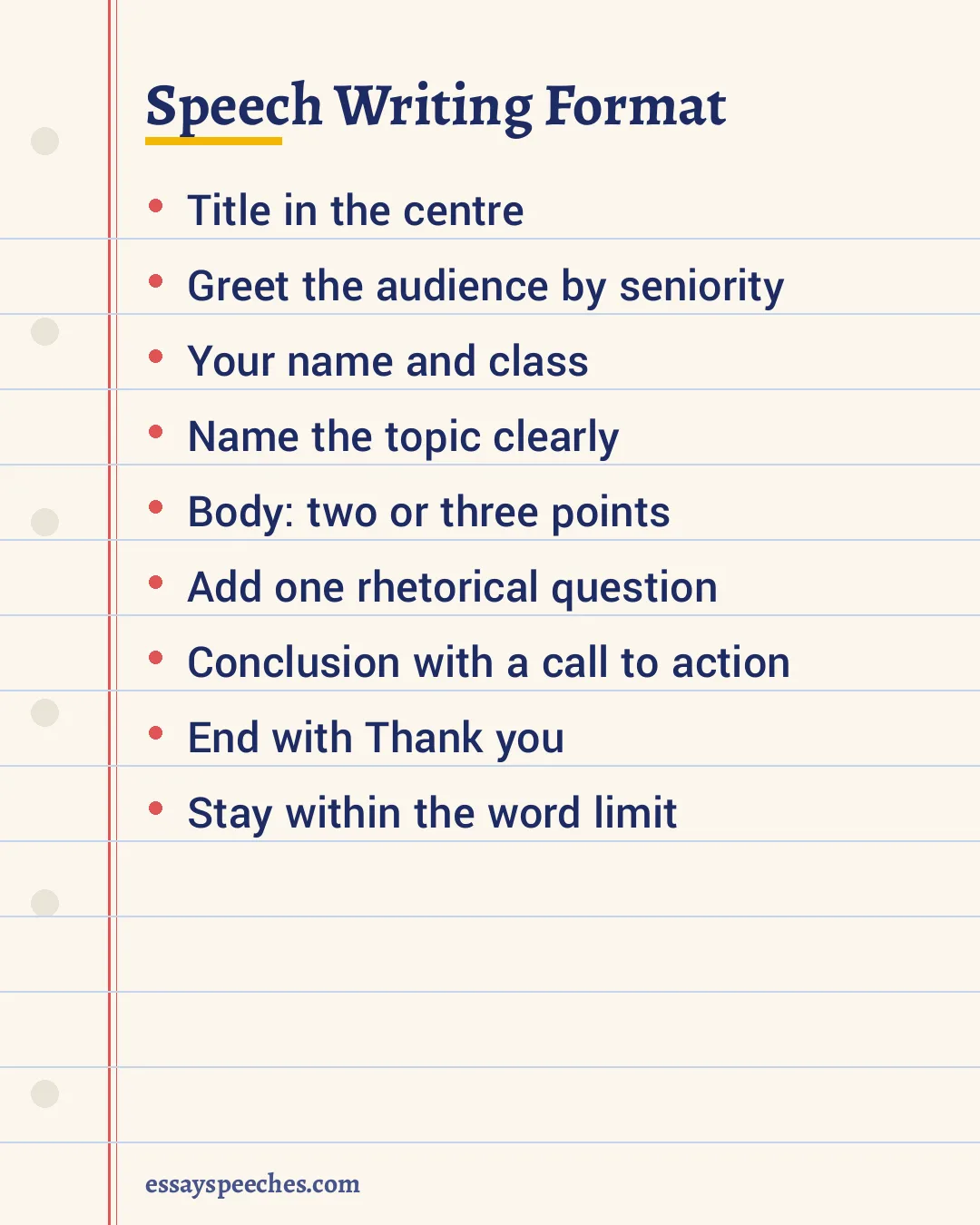
Speech Writing Format
Class 11 and class 12 English papers usually expect this format of speech writing. Follow it even when the question does not list the steps.
- Title: a short heading in the centre, for example "The Joy of Reading".
- Greeting: address the audience in order of seniority: chief guest, principal, teachers, then friends.
- Introduction: give your name and class, then name the topic. Example: "I, Ananya Rao of Class XII B, am here to speak on the joy of reading."
- Body: two or three short paragraphs. Each one makes a single point and supports it with a reason or an example. Add one rhetorical question.
- Conclusion: sum up in a line or two and give a call to action, something the listeners can actually do.
- Thank you: close with "Thank you." on its own line.
Speech Format Example (Labelled)
Title: Say No to Plastic Bags
Greeting: Good morning to our respected Principal, teachers and my dear friends.
Introduction: I, Kabir Mehta of Class XI A, would like to speak on why we must give up plastic bags.
Body: A plastic bag is used for a few minutes but can stay in the soil for hundreds of years. Such bags choke drains in the monsoon and are swallowed by stray cattle looking for food. One cloth bag kept folded in a school bag can replace dozens of them.
Conclusion: So let us carry our own bag every time we go to the market.
Thank you.
Word Limit and Marks
In class 11 and class 12 exams, a speech is often asked in about 120 to 150 words, but papers differ, so always follow the limit printed in the question. Marks are generally given for format (title, greeting, introduction and thank you), content (relevant points with support) and expression (organisation, grammar, spelling and suitable words). A speech that runs far beyond the limit can lose marks for expression.
Speech, Essay and Article: The Difference
| Point | Speech | Essay | Article |
|---|---|---|---|
| Meant for | Listeners in a hall | A reader or examiner | Readers of a newspaper or magazine |
| Opening | Greeting the audience | An introduction paragraph | Heading and the writer's name |
| Tone | Direct, uses "you" and "we" | Formal and balanced | Informative, for the public |
| Ending | Call to action and "Thank you" | Conclusion | Conclusion or suggestions |
For longer written pieces, read our essay writing guide and our paragraph writing guide. To prepare for a stage argument, see debate writing.
Dos and Don'ts
- Do write short sentences that you can say in one breath.
- Do speak to the listeners with "you" and "we".
- Do use at least one example from school or daily life.
- Don't forget the greeting and the thank-you line, since they carry format marks.
- Don't pack in long lists of numbers that nobody in the hall can remember.
- Don't copy a sample word for word; change the examples to your own.
How to Start a Speech, How to End It and How to Deliver It
The first twenty seconds decide whether people listen to you or start whispering to each other. After the greeting and your name, try one of these six openings.
- Ask a question: "How many of you looked at a screen this morning before you even brushed your teeth?"
- Share a surprising fact: "The Eighth Schedule of our Constitution lists twenty-two languages, yet we all stand together for one national anthem."
- Tell a tiny story: "Last winter, at the bus stop near my house, I saw a boy take off his only sweater and give it to his shivering sister."
- Use a quotation: "Swami Vivekananda told young people: arise, awake, and stop not till the goal is reached."
- Paint a picture: "Imagine a classroom with no fan, no light and not a single book."
- Make a bold statement: "Homework is not the enemy of students. Laziness is."
How to End a Speech
- Repeat your main message in one short, strong line.
- Give a call to action: "From tomorrow, let us..."
- Go back to your opening question or story to close the circle.
- Finish with "Thank you." Never end with "That's all I have to say."
Tips for Delivery
- Practise aloud at least three times, once in front of a family member.
- Look at different corners of the hall, not only at your paper.
- Pause for two seconds after a question and before your last line.
- Speak a little slower than you talk with friends, and stress key words.
- Stand straight, keep your hands calm and smile during the greeting.
Looking for a topic? Browse our speech topics and 2 minute speech topics, or read complete examples such as the Republic Day speech and the speech on discipline. If you have to host an event, our anchoring script page shows how to write a script for a compere.
Speech Writing Example: Self Confidence in 150 Words (Class 11)
Good morning to our respected Principal, teachers and my dear friends. I, Riya Kapoor of Class XI C, stand before you today to speak on self confidence.
Have you ever known the right answer in class but stayed silent because you were afraid of being wrong? That small fear is a lack of self confidence. Self confidence is simply trust in your own ability to learn, try and improve. It does not mean you never fail. It means failure does not stop you.
Confidence grows out of preparation. A student who has revised a chapter twice raises a hand without fear. It also grows from small wins: speaking once in the assembly, scoring a little higher in the next test or helping a friend solve a sum.
So prepare well, speak up once every day and stop comparing yourself with others. Your only competition is the person you were yesterday. Thank you.
Speech on Leadership for Students
Good morning to everyone present: our respected Principal, dear teachers and friends. I, Arjun Nair of Class XII A, am here to share my thoughts on leadership.
When we hear the word leader, we often picture someone giving orders from a stage. But think of the best class monitor you ever had. Did that monitor shout the loudest? Most likely not. A real leader listens first, decides fairly and then takes responsibility for the result.
Leadership is not a badge pinned on a blazer. It shows up in ordinary moments. It is the captain who passes the ball to a weaker player so that the whole team improves. It is the student who stays back to tidy the lab after a project while others rush home. It is the child who quietly stops a group from teasing a new classmate.
Our history offers fine examples. After 1947, Sardar Vallabhbhai Patel helped bring more than five hundred princely states into India through patient talks and firm decisions. He showed that a leader thinks of the whole nation, not of personal glory.
Each of us can practise leadership from today. Take charge of one small task: organise the class library, plan a cleanliness drive or guide a junior with homework. Keep your promises, admit your mistakes and give credit to others.
A leader is not someone who walks ahead of everyone. A leader is someone others are happy to follow. Thank you.
Speech on Respect for Elders in English
A very good morning to our Principal, our teachers and all my friends. My name is Sneha Patil from Class VII B, and today I will speak on respect for elders.
Who taught you to tie your shoelaces? Who held your hand the first time you crossed a busy road? It was an elder in your family. Our grandparents, parents, teachers and neighbours have lived longer than us. They carry stories, lessons and experience that no textbook can give.
Respect is not only about touching feet or saying namaste. It means listening patiently when Dadi repeats an old story for the third time. It means offering your seat to an elderly passenger on the bus. It means helping Nanaji read the tiny print on his medicine strip, and not rolling your eyes when he asks how to make a video call.
Many elders feel lonely when children stay glued to screens. Just twenty minutes of chatting with them each day makes them feel valued, and we pick up recipes, games and family history along the way.
Remember, one day we will grow old too. The respect we give today is the respect we will receive tomorrow. Thank you.
Speech on Importance of Sports (2 Minutes)
Respected Principal, teachers and my dear classmates, good morning. I am Aditya Singh of Class VIII A, and I am going to speak on the importance of sports in a student's life.
When the last bell rings, where do your feet want to run? For many of us, the answer is the playground. Yet in many homes we hear the same line every evening: stop playing and go and study. Today I want to show you that sports and studies are not enemies. They are partners.
First, sports keep the body fit. Running, jumping and stretching make the heart strong, keep weight in check and help us sleep soundly. A fit child falls ill less often and misses fewer school days.
Second, sports train the mind. A chess player learns to plan several moves ahead. A kabaddi raider learns to stay calm under pressure. A footballer learns to decide in a split second. These same skills help us when we sit for exams.
Third, sports teach values for life. We learn teamwork when we pass the ball. We learn discipline when we turn up for practice at six in the morning. Above all, we learn to lose with grace and win with humility. Shaking hands after a defeat is a lesson no classroom can fully teach.
So let us give at least one hour a day to a game we love, whether it is cricket in the colony, badminton on the terrace or skipping in the courtyard. A healthy body carries a sharp mind. Thank you.
Short Speech on Kindness to Animals for Kids
Good morning, respected Principal, loving teachers and my dear friends. I am Meher Khan of Class V A, and my speech is about kindness to animals.
Every morning, a brown puppy waits near our school gate. Some children pat it gently. Some throw stones at it. Which group would you like to be in?
Animals cannot speak our language, but they feel hunger, pain and fear just as we do. In summer, birds and street dogs struggle to find water. We can keep a bowl of clean water on the balcony or outside the gate. We can share a roti with a hungry dog instead of throwing leftovers in the bin. If we see an injured animal, we can tell an adult, who can call a vet or an animal shelter.
Being kind also means not teasing animals, not pulling a cat's tail and not bursting crackers near cows and dogs.
A kind heart does not choose who deserves kindness. Let us be gentle with every living being, big or small. Thank you.
Speech on Technology in Schools in 300 Words
Good morning to the respected Principal, the teachers and my fellow students. I, Tanvi Deshpande of Class X B, would like to speak on the role of technology in schools.
Think of how our parents studied. They copied notes from the blackboard, hunted for a single reference book in the library and waited weeks for a letter from a pen friend. Today a student can watch a three-dimensional model of the human heart on a smart board, take a practice quiz on a tablet and email a doubt to a teacher the same evening. Few changes in education have come this fast.
The benefits are real. Visual lessons help difficult ideas stick. Digital libraries give a village school the same books as a city school. Online classes kept learning alive when schools had to stay shut for long periods. Shy students can send questions privately, and teachers can quickly see who needs extra help.
But every tool has two edges. Too much screen time strains the eyes and shortens attention. Copying answers from the internet is easy, and it kills real learning. Not every child has a device or a steady connection at home, so careless use of technology can widen the gap between rich and poor students.
So what is the answer? Not less technology, but wiser use. Schools can set screen-time limits, teach students to check whether a source is reliable, and keep computer labs open after hours for children without devices at home. We students must use technology to learn, not to escape learning.
A smart board cannot replace a good teacher, and a tablet cannot replace a curious mind. Used well, though, technology can make both of them stronger. Thank you.
Speech Writing Topics for Practice
Pick any of these topics and write a 150 word speech in the format above. For more ideas, see our full list of speech topics.
- The power of a smile
- Why every student should learn first aid
- Reading books versus watching videos
- The value of saying sorry
- Exam stress and how to beat it
- Why we must respect traffic rules
- The joy of helping others
- Learning from failure
- Why girls and boys deserve equal chances
- Plastic-free school campus
- The importance of a good breakfast
- Should homework be limited?
- The role of libraries in a digital age
- Friendship and loyalty
- Why we should learn our mother tongue
- Fitness through yoga and games
- The habit of saving money
- Courtesy in daily life
- Clean neighbourhood, healthy neighbourhood
- Dreams worth chasing
How to Write a Speech: Quick Tips
- Write the greeting and your name and class line first, so you never lose format marks in the exam.
- Decide your one main message before you write anything else, and make every paragraph support it.
- Use 'we' and 'you' often. A speech talks to people; it does not lecture them.
- Put one rhetorical question in the opening or body, such as 'Have you ever wondered why...?'
- Choose examples your listeners know: the school canteen, the bus stop, the cricket ground, the exam hall.
- Count your words. If the limit is 150, aim for 140 to 160 and cut repeated ideas.
- End with a short, memorable line, then 'Thank you'.
Questions students ask
What is the format of speech writing for class 12?
Write a title, greet the audience, introduce yourself with your name and class, and state the topic. Then write two or three body paragraphs with points and examples, a conclusion with a call to action, and end with 'Thank you'. Always follow the word limit in your question paper.
How many words should a speech have in class 11 exams?
A limit of roughly 120 to 150 words is common, though it varies between boards and from one paper to the next. The number printed in the question is the one that counts. Staying close to it shows control over your writing.
What is the best way to start a speech?
After the greeting, open with a question, a short story, a surprising fact, a picture in words or a bold statement. Avoid starting with a dictionary meaning of the topic. Your first line should make listeners curious about what comes next.
How is a speech different from an essay?
A speech is written to be heard, so it greets the audience, speaks to them directly with 'you' and 'we', and ends with a thank-you. An essay is written to be read, has no greeting and uses a more formal, balanced tone.
How long is a 2 minute speech in English?
At a steady stage pace of 130 to 150 words each minute, two minutes of speaking comes to around 250 to 300 words. Practise with a timer and add pauses, since nervous speakers tend to rush.
Every essay and speech on this page is written and checked by the Essay Speeches team. Spotted a mistake? Tell us. How we write.