
Essay Writing Format, Tips and Sample Essays in English
Essay writing is a skill you need from primary school right up to college entrance tests and essay writing competitions. This page explains what an essay is, the standard essay format, how to plan an essay in five minutes, word limits for each class and the points examiners check while marking.
You will also find tested ways to begin and end an essay, a list of dos and don'ts, and eight complete sample essays in English on topics like unity in diversity, gender equality, my role model, morning walk, my house and Indian culture. Study how each sample is organised, then use the same plan for your own topic.
Essay Writing Format and Rules
An essay is a piece of writing that explains a topic in an organised way through several connected paragraphs. The word comes from the French "essai", which means an attempt. Essay writing in English is tested in almost every school exam because it shows how well a student can think, arrange ideas and express them in correct language.
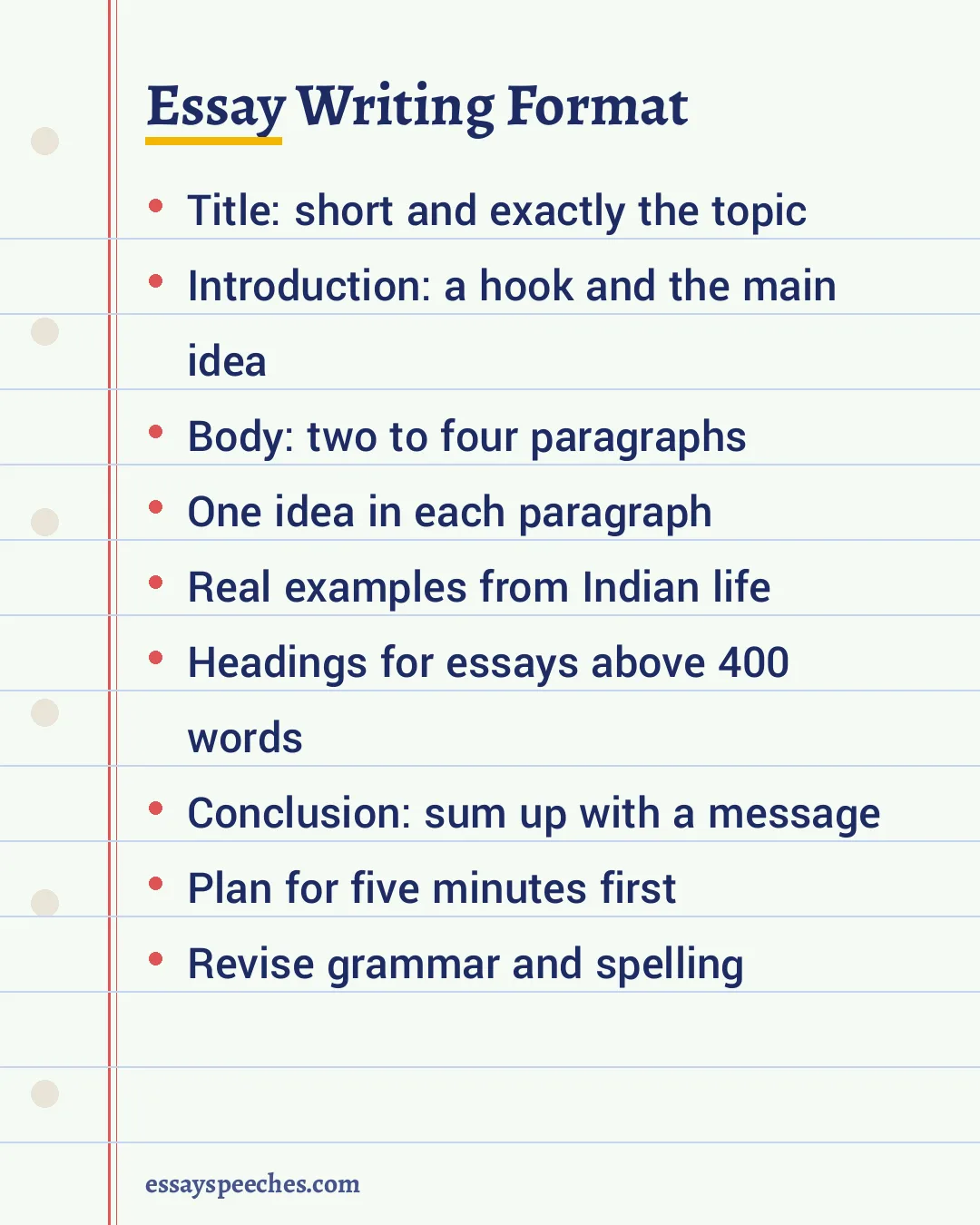
Essay Writing Format
| Part | What to write | Share of the essay |
|---|---|---|
| Title | Short, clear and exactly the topic given | One line |
| Introduction | An interesting first line and what the essay will discuss | About one tenth |
| Body | Two to four paragraphs, each with one main idea and examples | About three quarters |
| Conclusion | A short summary with a message, hope or suggestion | About one tenth |
In a short essay of 100 to 150 words, the introduction and conclusion can be one sentence each. In a long essay of 400 words or more, give each body part a heading such as Causes, Effects or Solutions. Our topic pages, for example the essay on pollution and the my school essay, follow this format at every length.
How to Plan an Essay in 5 Minutes
- Minute 1: Read the topic and decide what kind of essay it needs: describing, narrating, explaining or arguing. Our page on types of essays explains each kind.
- Minutes 2 and 3: Jot down every point that comes to mind: facts, causes, effects, examples from daily life and your own experience.
- Minute 4: Group the points into two to four body paragraphs and number them in a sensible order.
- Minute 5: Choose your opening line and your closing message. Now begin writing.
Word Limits by Class
| Class | Usual length |
|---|---|
| Classes 1 to 3 | 10 lines or 50 to 80 words |
| Classes 4 and 5 | 100 to 150 words |
| Classes 6 to 8 | 150 to 250 words |
| Classes 9 and 10 | 250 to 400 words |
| Classes 11, 12 and college | 400 to 600 words or more |
These ranges are common in Indian schools, but the limit printed on your question paper always comes first.
What Examiners Look For
Most CBSE-style and state board papers judge an essay under four heads. The marks for each head vary from paper to paper, but the heads stay the same.
- Content: relevant ideas, facts and examples that cover the topic fully.
- Organisation: a clear introduction, well-ordered body paragraphs and a proper conclusion, joined by linking words.
- Vocabulary: suitable and varied words, without forcing difficult ones.
- Accuracy: correct grammar, spelling and punctuation.
How to Start an Essay
Your first line decides whether the examiner reads on with interest. Try one of these openings instead of a plain definition:
- Paint a picture: "At six in the morning, the lake near our house is wrapped in mist and birdsong."
- Ask a question: "What would our classrooms look like if every child had exactly the same chance to learn?"
- Share a fact: "Light from the Sun takes about eight minutes to reach the Earth."
- Tell a tiny incident: "The day our water tank ran dry, I finally understood how much water we waste."
- Use a proverb: "An old proverb says that health is wealth, and a daily walk proves it true."
How to End an Essay
- Give a message: "If each of us plants one tree a year, our cities will breathe easily again."
- Express a hope: "I hope that one day no girl in our country leaves school because she is a girl."
- Return to the opening: if you began with the misty lake, end with the same lake in sunshine.
- Make a personal promise: "From today, I will switch off every fan and light when I leave a room."
Dos and Don'ts
| Do | Don't |
|---|---|
| Plan before you write | Start writing without knowing your points |
| Keep one idea in each paragraph | Repeat the same point in different words |
| Use examples from Indian life | Fill space with vague lines like "it is very important" |
| Leave a line between paragraphs | Write the whole essay as one long block |
| Keep five minutes to revise | Use slang or short forms like "u" and "pls" |
For shorter answers, read our guide to paragraph writing. For hundreds of ideas sorted by class, browse our essay topics page, and for essays in Hindi, see Hindi nibandh.
Srinivasa Ramanujan Essay in 100 Words
Srinivasa Ramanujan was one of the greatest mathematicians India has ever produced. He was born on 22 December 1887 in Erode, Tamil Nadu, and grew up in Kumbakonam. As a boy he filled notebooks with his own formulas, though he had very little formal training in higher mathematics.
While working as a clerk in Madras, he wrote to the Cambridge mathematician G. H. Hardy, who invited him to England. There he did remarkable work on numbers and infinite series and became a Fellow of the Royal Society. He died young, at the age of 32. India celebrates his birthday as National Mathematics Day.
My House Essay in 150 Words
I live in a two-storey house on a quiet street in Jaipur. It is painted cream with a brown gate, and a bougainvillea creeper covers the front wall with pink flowers.
On the ground floor there is a drawing room, a kitchen and my grandparents' bedroom. Upstairs, my parents have one room and my brother and I share the other. Our room has a study table near the window, so we can watch the street while doing homework.
The best part of the house is the terrace. In the evenings we fly kites there, and on hot summer nights the whole family sleeps on it under the stars. My mother grows tulsi, chillies and mint in pots along the railing.
Our house is not very big, but it is always full of laughter, guests and the smell of good food. To me, it is the most comfortable place in the world.
Morning Walk Essay in 200 Words
A morning walk is one of the simplest ways to stay healthy. It needs no money, no equipment and no special skill. All one has to do is wake up a little early and step outside.
I go for a morning walk with my father every day at six o'clock. We walk to the lake near our house and take two rounds of the path around it. At that hour the air is cool and fresh, and the roads are almost empty. Birds chirp in the trees, milkmen ride past on their cycles and shopkeepers begin sweeping the fronts of their shops. Near the lake we meet a group of elderly people doing breathing exercises and a few college students jogging.
A morning walk has many benefits. It strengthens the heart, keeps body weight in control and improves digestion. The fresh air and soft sunlight make the mind calm and alert, so I can concentrate better in class. Doctors often advise a brisk walk to people of every age.
After our walk, I return home with a fresh mind and a good appetite. A morning walk is the best gift we can give ourselves each day.
My Role Model Essay in 250 Words
Everyone needs someone to look up to. Many students choose scientists or freedom fighters as their role models, but mine lives under the same roof as me. He is my grandfather, who worked as a postman for thirty-five years.
Every morning, in the heat of May and the heavy rain of July, Grandfather cycled from village to village with a khaki bag full of letters, money orders and parcels. Many villagers could not read, so he would sit with them, read their letters aloud and sometimes write their replies. He never accepted anything in return except a glass of water or buttermilk.
What I admire most about him is his honesty and discipline. In all his years of service, not a single letter in his bag went missing. Even today, at seventy-two, he wakes at five, does his exercises, reads the newspaper from the first page to the last and keeps a neat diary of the household accounts.
He is also the kindest person I know. In the evenings he teaches maths to the children of our neighbourhood free of cost, and he never raises his voice, even when they make silly mistakes.
From my grandfather I have learnt that greatness does not need fame. A simple job done honestly can touch hundreds of lives. Whatever work I choose when I grow up, I want to do it with the same sincerity and care that he showed every single day.
Importance of English Language Essay
Walk into any airport, hospital or college in India and you will hear English spoken alongside Hindi and the regional languages. Over the last two centuries, English has become a bridge language for our country and a window to the wider world.
In a land of many languages, English helps people from different states talk to one another. A student from Assam and a student from Kerala may not share a mother tongue, but they can chat easily in English in a university hostel. English is also used along with Hindi for the official work of the central government, and the Supreme Court carries out its work in English.
The language is equally important for education and careers. Most textbooks in science, medicine, engineering and law are written in it, and a large share of the knowledge available online is in English. Jobs in banking, tourism, information technology and international trade expect good English skills, and many Indians who speak it well have built careers abroad.
Learning English does not mean forgetting our own languages. A person can love Hindi, Tamil or Marathi and still use English with confidence. The best way to learn it is to read English newspapers and story books, listen carefully to good speakers and talk without fear of making mistakes.
English is a tool, not a status symbol. Used wisely, it opens doors to knowledge, jobs and friendships across the world.
Unity in Diversity Essay in 300 Words
Introduction
Travel from Kashmir to Kanyakumari and you will feel you have crossed several countries. Food, clothing, language and even the way people greet you change every few hundred kilometres. Yet all these people proudly call themselves Indians. This remarkable feature of our country is called unity in diversity.
Diversity in Every Form
Followers of almost every major faith in the world live in India, and temples, mosques, churches, gurudwaras and monasteries often stand within walking distance of one another. The Constitution lists 22 languages in its Eighth Schedule, and hundreds of dialects are spoken across the land. A family in Punjab eats makki ki roti with sarson ka saag, while a family in Kerala enjoys appam and stew. Dresses range from the Rajasthani ghagra to the Assamese mekhela chador, and dances from Bharatanatyam to Bhangra. Even the land changes, with snowy mountains, deserts, forests and long coastlines.
What Holds Us Together
Despite these differences, many threads bind us. We share a common history, including the long freedom struggle in which people of every region fought side by side. The Constitution gives every citizen the same rights, and the national flag and national anthem stir the same pride everywhere. Festivals are no longer limited to one community: neighbours of different faiths exchange sweets at Diwali, Eid and Christmas. Long train journeys, cricket matches and shared songs connect people across states.
Conclusion
At times this unity is tested by quarrels over language, region or religion. Such moments remind us that every citizen must protect it through respect and understanding. Our diversity is not a weakness but our greatest treasure. Just as flowers of many colours make a garden beautiful, India's many cultures together make the nation strong.
Indian Culture Essay in 300 Words
Introduction
Indian culture is one of the oldest living cultures in the world. Its roots go back thousands of years to the Indus Valley Civilisation, whose planned cities of Harappa and Mohenjo-daro still amaze historians. Over the centuries, many communities, rulers and travellers came to India, and each added something new to its way of life.
Values and Family Life
At the heart of Indian culture lie respect for elders, love for the family and a warm welcome for guests. Hardly any visitor leaves an Indian home without a glass of water and something sweet. Many families still live together, with grandparents passing on stories, recipes and customs to the children. The namaste, offered with folded hands, shows humility and respect.
Art, Music and Food
India's arts are as varied as its people. Classical dances such as Kathak, Odissi and Kuchipudi, music in the Hindustani and Carnatic styles, and folk arts like Madhubani and Warli painting are admired across the world. Yoga, which began in ancient India, is now practised in almost every country. Indian food, rich in spices, pickles, breads and sweets, changes from region to region but is always meant to be shared.
Indian Culture Today
Modern life has brought many changes. Young people wear jeans, eat pizza and work in cities far from home. Yet they still touch their grandparents' feet, celebrate festivals with the family and dance to folk songs at weddings. Indian culture has survived because it accepts new ideas without losing its core.
Conclusion
Our culture is a precious inheritance. It is our duty to learn about it, practise its good values and pass them on, while letting go of any custom that hurts or excludes people.
Gender Equality Essay in 350 Words
Introduction
Gender equality means that men and women, boys and girls, enjoy the same rights, opportunities and respect. It does not mean that everyone must be alike, only that nobody should be held back because of their gender. The Constitution of India guarantees equality before the law and forbids discrimination on the basis of sex.
Where Inequality Still Exists
Even so, inequality can still be seen in daily life. In some homes, a son's education is given more importance than a daughter's, and girls are asked to help with housework while their brothers play outside. Some girls leave school early or are married before they are ready. At the workplace, women are often paid less for similar work and given fewer chances to lead. Cooking, cleaning and the care of children and elders still fall mostly on women, even when they also work outside the home.
Steps Towards Equality
Things are slowly changing. Laws protect women's right to property, to equal wages and to a safe workplace. The Beti Bachao Beti Padhao scheme, launched in 2015, aims to improve the child sex ratio and encourage the education of girls. Scholarships, separate toilets in schools and free bicycles given in some states have helped more girls finish school. Today women serve as pilots, scientists, army officers, judges and village heads, and they inspire younger girls to dream big.
What Students Can Do
Real equality begins at home and in the classroom. Boys can share chores like cooking, washing dishes and cleaning, and girls can take part in every sport and activity. Teachers can give leadership roles to boys and girls equally. We can stop laughing at jokes that make fun of either gender and speak up when a classmate is treated unfairly.
Conclusion
A society that keeps half its people behind can never move forward fully. When sons and daughters are raised with the same love, freedom and expectations, the whole nation grows stronger. Gender equality is not a favour to women. It is simple fairness for everyone.
Essay Writing Topics in English
Practise the essay format on these topics. For a much longer list sorted by class, open our essay topics page.
- Unity in Diversity
- Gender Equality
- My Role Model
- Morning Walk
- My House
- Indian Culture
- Importance of English Language
- Srinivasa Ramanujan
- My Brother
- A Visit to a Historical Place
- Road Safety
- Importance of Libraries
- Life Without Electricity
- Online Classes: Benefits and Problems
- The Joy of Helping Others
- Wildlife Conservation
- Traffic Problems in Cities
- The Value of Sports in School
- Festivals of India
- If I Were the Principal
- A Journey by Train
- Water Pollution
- Space Exploration
- The Importance of Friendship
Tips for Essay Writing Competitions and Exams
- In an essay writing competition, judges read dozens of entries, so an original opening and a personal example will make yours stand out.
- Underline the key words of the topic and make sure every paragraph answers them; a beautiful essay that drifts off topic loses content marks.
- Use linking words such as firstly, moreover, on the other hand, as a result and finally to move smoothly between paragraphs.
- Add one or two facts you are sure of, like a date, a place or a law, but never invent figures.
- Vary your sentences: mix short, sharp lines with longer ones so the essay reads naturally.
- Write neatly, leave a line between paragraphs and underline headings in long essays.
- Keep the last five minutes to check spelling, tenses, capital letters and the word count.
Questions students ask
What is an essay?
An essay is a short piece of writing on one topic, made up of an introduction, a body of two or more paragraphs and a conclusion. It shows the writer's knowledge, ideas and opinion in an organised way.
What is the format of essay writing?
The essay format has four parts: a title, an introduction, a body and a conclusion. The introduction opens the topic, the body develops two to four main ideas with examples, and the conclusion sums up with a message. Long essays use a heading for each body part.
How do I start an essay in an interesting way?
Begin with a picture, a question, a fact, a small incident or a well-known proverb rather than a dry definition. The opening lines in the guide above show each method with an example.
How many paragraphs should an essay have?
A 150 word essay usually has three or four short paragraphs, while a 300 to 500 word essay has five to seven. Each paragraph should carry one main idea.
Where can I find essay writing in Hindi?
Our Hindi nibandh page explains the Hindi essay format, with प्रस्तावना, विषय विस्तार and उपसंहार, and links to every Hindi essay on the site.
Every essay and speech on this page is written and checked by the Essay Speeches team. Spotted a mistake? Tell us. How we write.