
Rainy Season Essay for Students (with Summer, Winter and Spring Essays)
This rainy season essay page gives you every piece you may need on the monsoon: two sets of 10 lines, a paragraph on rainy season for class 4, essays of 100, 250 and 500 words, a rainy day paragraph and a 2-minute speech. Because teachers often set other seasons too, you will also find a summer season essay and paragraph, a winter season essay with winter vacation, a spring season essay and a my favourite season paragraph.
Every town has its own monsoon, so after you pick a piece, add one detail from your street: a flooded underpass, a favourite rainy-day snack or the sound of rain on a tin roof. For the same topic in Hindi, open our Varsha Ritu par Nibandh page.
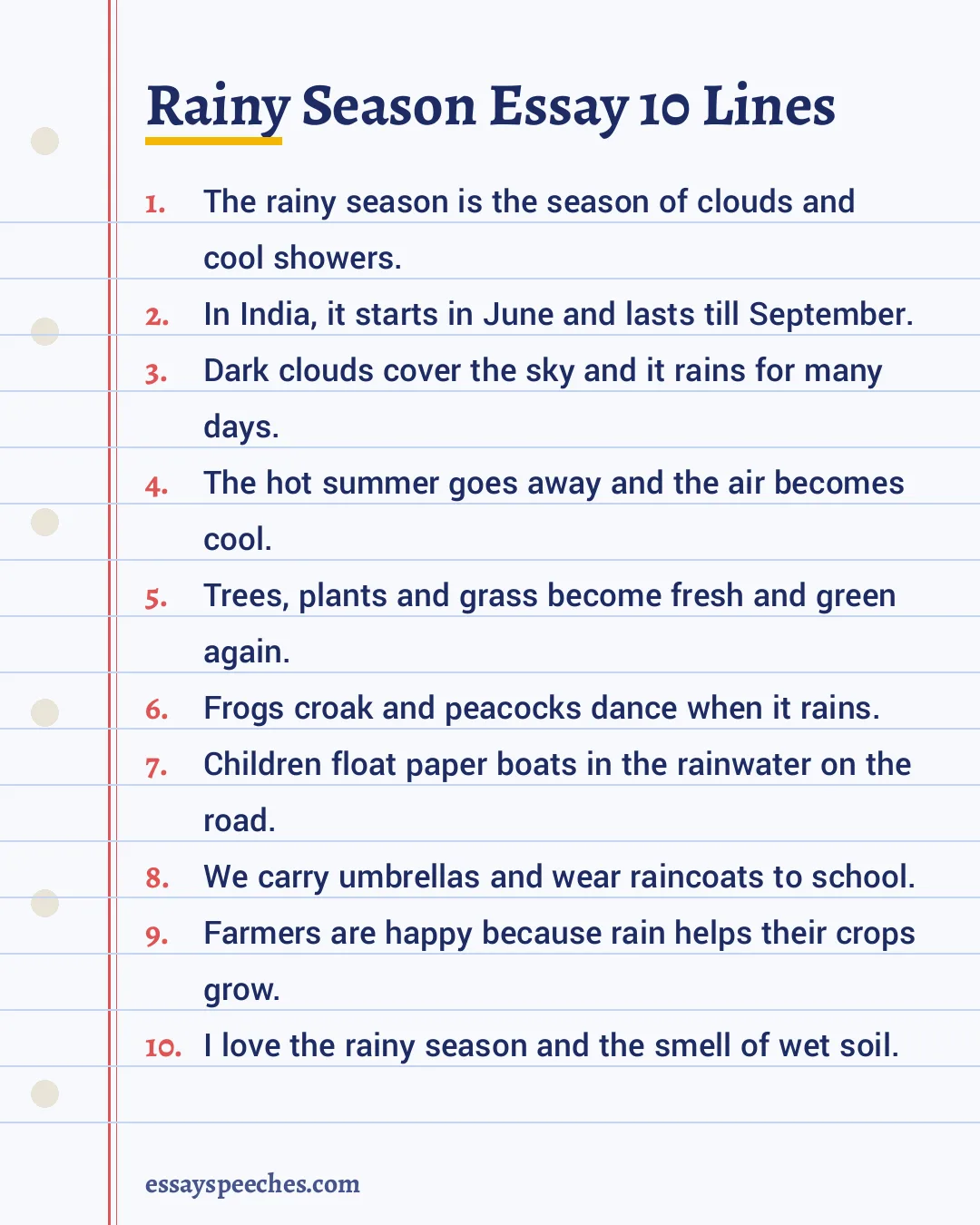
Rainy Season Essay 10 Lines
- The rainy season is the season of clouds and cool showers.
- In India, it starts in June and lasts till September.
- Dark clouds cover the sky and it rains for many days.
- The hot summer goes away and the air becomes cool.
- Trees, plants and grass become fresh and green again.
- Frogs croak and peacocks dance when it rains.
- Children float paper boats in the rainwater on the road.
- We carry umbrellas and wear raincoats to school.
- Farmers are happy because rain helps their crops grow.
- I love the rainy season and the smell of wet soil.
10 Lines on Rainy Season for Class 5 (Set 2)
- The monsoon winds bring the rainy season to India, usually from June to September.
- The rain first reaches the coast of Kerala in early June and then spreads across the country.
- After the scorching heat of May, the first shower brings great relief to people and animals.
- Rivers, lakes, ponds and wells fill up with fresh water during these months.
- Farmers sow kharif crops such as rice, maize, cotton and soybean when the rain arrives.
- Hills, fields and gardens turn green, and many waterfalls start flowing again.
- People enjoy hot tea, pakoras and roasted corn while watching the rain from their windows.
- Heavy rain can also cause floods, waterlogged roads and traffic jams in cities.
- Stagnant water breeds mosquitoes, so we must keep our surroundings clean and dry.
- The rainy season is called the lifeline of India because our farms depend on it.
Rainy Season Essay 100 Words
After weeks of burning heat, the first rain feels like a gift. The rainy season in India begins in June and continues till September. Grey clouds gather, thunder rumbles and cool drops fall on the dry earth. Soon the whole land looks washed and green.
Children love to jump in puddles and sail paper boats. Farmers plough their fields and plant rice. Ponds and wells fill with water again. Too much rain, however, can cause floods and spread diseases through mosquitoes. Still, the rainy season is precious, because it gives us water for the whole year.
Paragraph on Rainy Season for Class 4
The rainy season is my favourite time of the year. It comes after summer, when everyone is tired of the heat. One afternoon the sky suddenly turns dark, a cool wind starts blowing and big drops begin to fall. The smell of wet soil fills the air. Within a few days, the dry brown grass in our colony park becomes green and soft. Frogs croak at night, and snails and earthworms come out in the garden. On the way to school, I wear my yellow raincoat and gumboots. On rainy evenings my mother makes hot pakoras, and we eat them while watching the rain. I enjoy this season a lot, but I also remember to stay away from deep water and open drains.
Rainy Season Essay 250 Words
India has six seasons according to its old calendar, but no season is welcomed as eagerly as the rains. They arrive with the south-west monsoon winds, which pick up moisture from the Arabian Sea and the Bay of Bengal. The rains usually reach Kerala in the first week of June, cover most of the country by early July and last till about the end of September.
The change is magical. Cracked fields soak up water, dusty trees turn bright green and dry riverbeds start flowing again. Peacocks spread their feathers, and the call of the koel mixes with the croaking of frogs. In the hills, mist covers the slopes and waterfalls come alive.
The monsoon matters greatly for our country. Much of India's farmland depends on rain rather than canals. Farmers sow paddy, maize, cotton, groundnut and pulses only after the first good showers. Rain also refills reservoirs, lakes and the underground water we use in the dry months.
Yet the season has its troubles. Very heavy rain floods villages and city streets, damages houses and stops trains and buses. Still water breeds mosquitoes that spread malaria and dengue, while dirty water causes stomach infections. We can stay safe by drinking boiled water, sleeping under mosquito nets and keeping drains clear.
The rainy season gives life to our land. If we save rainwater and respect nature, every monsoon will be a blessing for our fields and our homes.
A Rainy Day Paragraph
It was a Saturday in July, and I was getting ready for cricket practice when the sky suddenly went dark. Within minutes, a strong wind slammed the windows and heavy rain began to pour. Practice was cancelled, so I sat by the window with my little sister. We watched our street turn into a small stream. A man pushed his cycle through ankle-deep water, and two puppies took shelter under a parked scooter. The children next door ran out with paper boats, and soon we joined them. Later, Grandmother fried onion pakoras and made ginger tea for everyone. By evening the rain had stopped, the air smelled fresh and a rainbow stretched over the rooftops. That rainy day turned out to be more fun than any cricket match.
Essay on Rainy Season in English (500 Words)
Introduction
The first shower of the monsoon has a magic that no other moment of the year can match. For weeks, the sun has baked the land, taps have run dry and people have looked up at the sky with hope. Then one evening, clouds roll in, lightning flashes and rain comes down in sheets. Children rush to the terrace, elders smile with relief and the parched earth gives off its sweet, earthy smell. Varsha Ritu, the season of rain, has arrived.
How the Monsoon Comes
The word monsoon comes from the Arabic word mausim, which means season. In summer, the land of India heats up much faster than the ocean around it. Low pressure forms over the hot land, and moist winds blow in from the sea. These south-west monsoon winds move in two branches, one from the Arabian Sea and one from the Bay of Bengal. When they strike the Western Ghats and the hills of the north-east, they shed heavy rain. Mawsynram and Cherrapunji in Meghalaya are among the wettest places on earth. The rains normally last from June to September, after which the winds turn back.
Nature in the Rainy Season
Everything seems to wake up. Paddy fields shine like green mirrors, lotuses bloom in ponds and rivers run full to their banks. Insects buzz around street lights, frogs hold noisy concerts and peacocks dance at the sight of clouds. Hill roads in the Sahyadris and the Himalayan foothills are lined with streams and waterfalls. Indian poets and musicians have long celebrated this season, and Raag Malhar is traditionally linked with the rains.
Why the Monsoon Matters
Our food supply still depends heavily on the monsoon. Rice, cotton, jute, soybean, maize and pulses grow well only when the rain is timely and evenly spread. Good rain fills the dams that supply drinking water and electricity, and it recharges wells and groundwater. A weak monsoon can mean drought, costly vegetables and hardship for millions of farming families.
Problems of the Rainy Season
The same rain that brings life can also bring trouble. Rivers such as the Brahmaputra and the Kosi often flood wide areas, washing away homes and crops. Landslides block mountain roads. In cities, choked drains turn streets into lakes and traffic comes to a halt. Puddles and open containers breed mosquitoes, and cases of malaria, dengue, typhoid and cholera rise. Clean drains, better town planning and simple care at home can reduce much of this harm.
Conclusion
The rainy season shows us that nature is both generous and powerful. We should welcome it with joy and with care: harvest rainwater on rooftops, plant trees that hold the soil, keep our surroundings clean and never waste water. If each of us does a small part, the monsoon will keep India green, fed and smiling for generations to come.
Speech on Rainy Season for Students (2 Minutes)
Good morning to our respected Principal, teachers and my dear friends.
Today I want to talk about a season that changes the mood of the whole country overnight: the rainy season. Do you remember the last time you smelled wet soil after the first shower? That smell is the monsoon saying hello.
In India, the rains usually last from June to September. The monsoon winds carry clouds from the sea, and those clouds pour water on our thirsty land. Ponds fill up, trees turn green, and even the tired street dogs seem happier.
Friends, this rain is not just for fun. It is the lifeline of our farmers. When it comes on time, they sow rice, maize and cotton, and our kitchens stay full. Rain also fills our lakes, wells and dams, which give us water till the next summer.
But the rainy season asks us to be careful too. Have you seen water collecting in old tyres, flowerpots and coolers? That is exactly where mosquitoes lay their eggs. Let us empty such water every week. Let us drink clean water, wash our hands and stay away from flooded roads.
And let us save this gift. Our school can collect rooftop rainwater, and every family can plant one tree before the season ends.
So the next time it rains, enjoy your paper boats and hot pakoras, but remember: every raindrop is precious.
Thank you.
Summer Season Essay (150 Words)
Summer is the hottest season in India. It begins in March and reaches its peak in May and June. The sun shines fiercely from early morning, and by noon the roads feel like a hot pan. In north India, dry, hot winds called loo blow in the afternoons, so people stay indoors.
Summer has its own treats. Markets are full of mangoes, watermelons, muskmelons, lychees and cucumbers. We drink lassi, buttermilk, lemonade and aam panna to keep cool. Schools close for the long summer vacation, and many families visit hill stations or their grandparents' villages.
The heat also brings problems. Ponds dry up, birds search for water, and people can suffer from heatstroke. We should drink plenty of water, wear light cotton clothes and keep a bowl of water for birds. Summer is tough, but it ripens our fruits and prepares the land for the rains.
Paragraph on Summer Season
My summer afternoons follow a simple routine. The ceiling fan whirs, the curtains stay closed and the house smells of mango pulp. Outside, the street is empty except for an ice-cream cart ringing its bell. Around four o'clock, Dadi brings out a jug of chilled buttermilk and a bowl of chopped watermelon. When the sun softens in the evening, the whole colony steps out. Children play badminton, and elders sit on charpais in the breeze. Summer is hard to bear at noon, yet its long evenings, sweet fruits and lazy holidays make me fond of it.
Winter Season Essay 250 Words (with Winter Vacation)
Foggy mornings, steaming cups of tea and woollen sweaters tell us that winter has come. In most of India, the winter season lasts from December to February. In the north, the nights are very cold, and the mountains of Kashmir and Himachal Pradesh are covered with snow. In the south, winter is mild and pleasant.
Winter is a season of good food. Green peas, carrots, cauliflower and mustard greens fill the fields, and markets glow with oranges and guavas. Mothers make carrot halwa, sarson ka saag with makki ki roti, and sweets of sesame and jaggery. Families sit around a fire in the evening and share stories.
Many festivals fall in winter. Christmas comes on 25 December, and the harvest festivals of Lohri, Makar Sankranti and Pongal are celebrated in the middle of January. On Makar Sankranti, colourful kites fill the sky in Gujarat and Rajasthan.
Winter vacation is the best part for students. In many north Indian schools, it falls at the end of December or in early January. Children enjoy late mornings, visit relatives, go on picnics in the soft sunshine and finish their holiday homework by the fireside.
Winter is hard, though, for poor people without warm clothes or shelter, and thick fog causes road accidents and delays trains. We can donate old blankets and sweaters, and drivers must go slowly in fog. With a little kindness, winter can be a cosy season for everyone.
Spring Season Essay in 150 Words
Spring is called the king of seasons, and it is easy to see why. It arrives in February and March, when the cold of winter fades and the heat of summer has not yet begun. The days are bright, the nights are cool and a gentle breeze blows all day.
In this season, nature puts on new clothes. Old leaves fall and fresh green ones appear. Mustard fields turn yellow, mango trees are covered with blossoms and the koel sings from the branches. Gardens bloom with roses and marigolds, while bees and butterflies move from flower to flower.
Spring is also a season of celebration. Basant Panchami and Holi are celebrated at this time, and many people wear yellow clothes and fly kites. Farmers are cheerful because the wheat crop is ripening. Spring fills us with fresh energy and hope.
My Favourite Season Paragraph: Winter
Out of all the seasons, winter is my favourite. I love waking up under a warm quilt and seeing thick fog outside my window. My grandmother knits colourful sweaters and caps for all of us. On Sunday mornings, the whole family sits on the terrace in the sunshine, peeling oranges and cracking peanuts. In the evenings, we drink hot soup and eat gajar ka halwa. Winter is also the time for cricket in the park, because nobody gets tired in the cool air. During the winter vacation, we visit my uncle's farm, where the mustard fields look like a yellow sea. Winter makes me feel fresh, cosy and happy.
How to Write a Rainy Season Essay
- Open with a picture instead of a definition: the smell of wet soil, the first thunder or a paper boat in a puddle.
- Give the basic facts: in India the rainy season comes with the south-west monsoon and lasts from about June to September.
- Write about nature, people and farming: green fields, peacocks and frogs, umbrellas and pakoras, and farmers sowing rice and cotton.
- Be balanced. Add a few lines on floods, waterlogging and diseases such as malaria and dengue, and how to stay safe.
- Give the 500 word essay clear parts: Introduction, How the Monsoon Comes, Importance, Problems and Conclusion.
- For a rainy day paragraph, tell one real event in order: what you were doing, how the rain began, what you saw and how the day ended.
- End with a message, for example saving rainwater or planting trees, instead of repeating your opening line.
Need this topic in Hindi? Read: Varsha Ritu Par Nibandh: वर्षा ऋतु पर निबंध (बसंत, ग्रीष्म, शीत और शरद ऋतु सहित)
Questions students ask
When does the rainy season start in India?
The south-west monsoon usually reaches the Kerala coast around the first week of June. It then moves north and covers most of the country by early July. The rains continue till about the end of September, after which the monsoon withdraws.
Why is the rainy season called the monsoon?
Monsoon is taken from mausim, an Arabic word for season. It refers to seasonal winds that change direction. In summer these winds blow from the sea towards the land and bring heavy rain to India.
How many seasons are there in India?
The traditional Indian calendar has six seasons, or ritus: Vasant (spring), Grishma (summer), Varsha (rainy), Sharad (autumn), Hemant (pre-winter) and Shishir (winter). In everyday school use, we usually talk about summer, rainy season and winter, with spring in between.
How do I write a my favourite season essay?
Name your favourite season in the first line and say when it comes. Then describe the weather, the food, the clothes, the festivals and what you like to do in that season. End with why it makes you happy. You can use our winter paragraph above as a model and change the details to summer, spring or the rains.
What is the difference between a rainy day paragraph and a rainy season essay?
A rainy season essay explains the whole season: when it comes, its importance and its problems. A rainy day paragraph describes one particular day of rain, like a short story, with what you saw, heard and felt.
Every essay and speech on this page is written and checked by the Essay Speeches team. Spotted a mistake? Tell us. How we write.