
Constitution Day Speech in English for Students and Teachers
This Constitution Day speech page has everything a school needs for 26 November, the day India adopted its Constitution in 1949. Inside, you will find a short speech on Constitution Day for the youngest classes, a two minute speech, a five minute speech for classes 9 to 12, a principal or teacher address, 10 lines, an essay on the Constitution of India in 150 words, a My Constitution My Pride essay of 200 words, a longer Constitution Day essay and 10 lines in Hindi.
Pick the speech that suits your class and the time you are given on stage. Practise it aloud a few times, slow down at the important dates, and look at your audience when you read the opening words of the Preamble. A clear voice and correct facts matter more than big words.
Short Speech on Constitution Day (1 Minute)
Good morning to our respected Principal, dear teachers and all my friends.
Today is 26 November, and we celebrate it as Constitution Day. On this day in 1949, our country accepted its own book of rules, the Constitution of India.
Do you know what a constitution is? It is a big book that tells how our country should be run. It gives every Indian the same rights, whether rich or poor, boy or girl.
Dr B. R. Ambedkar led the team that wrote our Constitution. That is why we remember him with great respect today.
The Constitution also tells us our duties. We must respect the National Flag, keep our country clean and live in peace with everyone.
Let us promise to be good citizens and follow the rules of our Constitution.
Thank you.
Constitution Day Speech in English (2 Minutes)
Good morning to our respected Principal, teachers and my dear friends.
Every game has rules. Cricket has its rules, kabaddi has its rules, and even our classroom has rules. Now imagine a country of crores of people with no rules at all. What would happen? There would be confusion everywhere. That is why India has a Constitution, and today, on 26 November, we celebrate Constitution Day, also called Samvidhan Divas.
On 26 November 1949, the Constituent Assembly adopted the Constitution of India. It came into force two months later, on 26 January 1950, which we celebrate as Republic Day. Writing it took nearly three years of careful discussion by the members of the Assembly.
The Drafting Committee was headed by Dr B. R. Ambedkar, and the Assembly was led by its President, Dr Rajendra Prasad. They and many other leaders worked hard to create a document that would protect every Indian.
Our Constitution begins with the words, We, the people of India. These words tell us that the real power belongs to the people. It promises us justice, liberty, equality and fraternity. It gives us Fundamental Rights, like the right to equality and the right to education.
But friends, rights come with duties. The Constitution asks us to respect the flag and the National Anthem, protect public property, care for nature and treat every person with dignity.
So, what can students like us do? We can follow rules at school, respect our classmates, avoid wasting water and electricity, and speak up against unfairness.
Let us remember that the Constitution is not only a book in a library. It lives in the way we behave every day.
Thank you.
Long Speech on Constitution of India for Students (5 Minutes)
Good morning to our respected Principal, honourable guests, dedicated teachers and my dear fellow students.
We have gathered today to observe Constitution Day, the day that gave a newly free nation its guiding framework. On 26 November 1949, the Constituent Assembly of India adopted the Constitution, and on 26 January 1950, it came into effect. Since 2015, the Government of India has officially marked 26 November as Constitution Day. Before that, many people knew it as National Law Day.
Let us go back to those years for a moment. India had just won freedom after a long struggle. The country had been divided, millions had lost their homes, and hundreds of princely states had to be joined into one nation. In such a difficult time, the members of the Constituent Assembly met for the first time on 9 December 1946. Over the next two years, eleven months and eighteen days, they debated every article, line by line.
Dr B. R. Ambedkar, as Chairman of the Drafting Committee, guided this enormous task with his deep knowledge of law. Dr Rajendra Prasad presided over the Assembly with patience and fairness. Leaders, lawyers, social reformers and women members all added their voices. The final document was the longest written constitution of any independent country in the world. The original copies were written by hand in English and Hindi and decorated by artists from Santiniketan.
What makes our Constitution special? First, it declares India a sovereign, socialist, secular, democratic republic. Second, it gives every citizen Fundamental Rights, such as equality before law, freedom of speech, freedom of religion and protection against exploitation. Third, it guides the government through the Directive Principles of State Policy, which ask it to work for the welfare of all. Fourth, it creates a careful balance between the legislature, the executive and the judiciary, so that no single body becomes too powerful.
Our Constitution is also a living document. It can be amended when the needs of the country change. In 1976, Fundamental Duties were added to remind citizens that a democracy cannot run on rights alone.
Friends, we often ask what the nation can do for us. On this day, let us also ask what we can do for the nation. Can we vote wisely when we turn eighteen? Can we respect people of other religions, regions and languages? Can we keep our streets clean and our public property safe? Can we stand against discrimination even when it is uncomfortable? If we can, we are true guardians of the Constitution.
Dr Ambedkar once warned that however good a constitution is, it will turn out badly if the people working it are bad. The responsibility, therefore, lies with us.
Let us read the Preamble not just with our lips, but with our hearts, and live its values every single day.
Thank you.
Constitution Day Speech by Principal or Teacher
Good morning to my dear colleagues, members of the staff and all my wonderful students.
Each year on 26 November, our school pauses to honour a document that shapes the life of every Indian, often without our noticing it. When you sit in a free classroom, when you speak your mind in a debate, when your family votes in an election, you are using the rights given to you by the Constitution of India.
In November 1949, the Constituent Assembly completed its work and adopted this Constitution. Its members came from different regions, religions and backgrounds, and they disagreed on many matters. Yet they listened, argued politely and found common ground. That itself is a lesson for all of us in a school where children of many communities learn side by side.
As teachers, we see the Constitution at work every day. Article 21A gives every child between six and fourteen years the right to free and compulsory education. The principle of equality means that no student in this school should be treated differently because of caste, religion, gender or wealth. The freedom of expression reminds us to encourage your questions, even the uncomfortable ones.
Dear students, I want you to remember three words from the Preamble: liberty, equality and fraternity. Liberty means you are free to think and dream. Equality means everyone around you deserves the same respect. Fraternity means we are all members of one family called India. If you practise these three words in the playground, the canteen and the classroom, you will already be living by the Constitution.
I also urge you to read the Preamble at home with your parents and discuss what each word means. Ask yourselves which of the Fundamental Duties you followed this week.
Let us all, teachers and students together, promise to protect the values of our Constitution with honesty and responsibility.
Thank you, and I wish you all a meaningful Constitution Day.
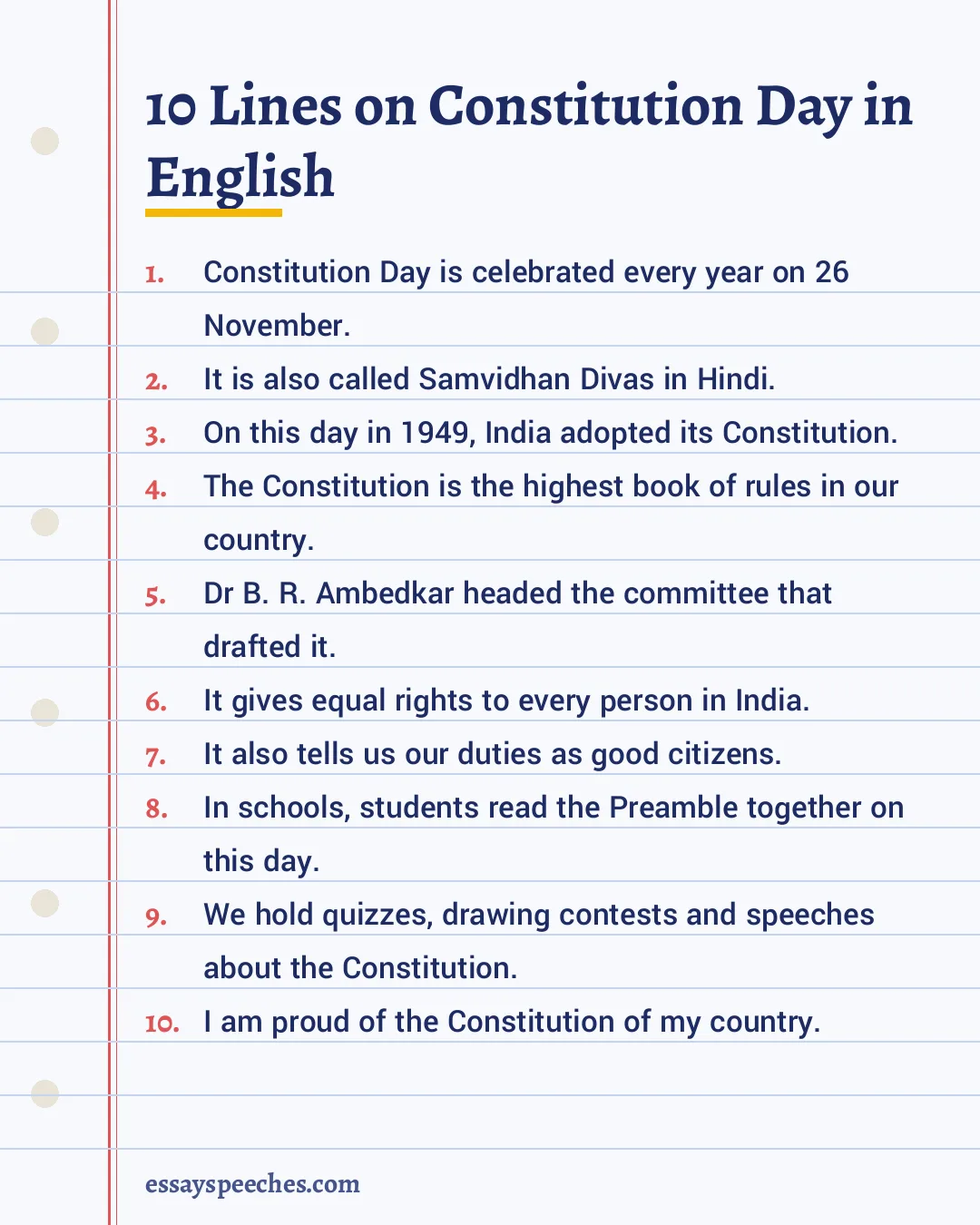
10 Lines on Constitution Day in English
- Constitution Day is celebrated every year on 26 November.
- It is also called Samvidhan Divas in Hindi.
- On this day in 1949, India adopted its Constitution.
- The Constitution is the highest book of rules in our country.
- Dr B. R. Ambedkar headed the committee that drafted it.
- It gives equal rights to every person in India.
- It also tells us our duties as good citizens.
- In schools, students read the Preamble together on this day.
- We hold quizzes, drawing contests and speeches about the Constitution.
- I am proud of the Constitution of my country.
Essay on Constitution of India in 150 Words
Just as a house needs a strong foundation, a nation needs a strong set of laws. For India, that foundation is the Constitution. The Assembly accepted it on 26 November 1949, and it took effect on 26 January 1950.
The Constitution was prepared by the Constituent Assembly. Its Drafting Committee worked under Dr B. R. Ambedkar, who is often remembered as the chief architect of the Constitution. At the time of adoption, it contained 395 articles and 8 schedules, which made it the longest written constitution in the world.
The Constitution makes India a democratic republic, where people choose their own leaders. It gives us Fundamental Rights such as equality and freedom of speech, and Fundamental Duties such as protecting the environment.
We celebrate 26 November as Constitution Day. By obeying laws and respecting others, every citizen can honour this great document.
My Constitution My Pride Essay 200 Words
I feel proud when I hear the words, We, the people of India. These opening words of the Preamble remind me that my country belongs to all of us, and that the Constitution is my own.
The Constitution of India was adopted on 26 November 1949 after careful thought by the Constituent Assembly. Under the guidance of Dr B. R. Ambedkar, it gave a newly free nation a clear path. It turned crores of people, speaking many languages and following many faiths, into equal citizens.
My Constitution gives me the right to study, to speak freely, to follow my beliefs and to be treated fairly by law. It protects me from discrimination and forbids anyone from making children work in factories. When I grow up, it will give me the right to vote.
At the same time, it asks me to be a responsible citizen. I must respect our flag and anthem, protect public property, care for forests and rivers and live in harmony with everyone.
My Constitution is my pride because it treats every Indian with dignity. I will honour it by following its values in my daily life.
Essay on Constitution Day in English (450 Words)
Introduction
Every year on 26 November, schools, colleges and offices across India observe Constitution Day, or Samvidhan Divas. It marks the day in 1949 when the Constituent Assembly adopted the Constitution of India. The day was officially named Constitution Day in 2015, and it reminds citizens of the values on which the Republic stands.
Making of the Constitution
The Constituent Assembly first met on 9 December 1946, even before India became independent. Dr Rajendra Prasad was elected its President. A Drafting Committee, chaired by Dr B. R. Ambedkar, prepared the text, which the Assembly then discussed in detail. The whole process took two years, eleven months and eighteen days.
The members studied the constitutions of many countries, borrowing useful ideas while shaping them to suit Indian conditions. The finished Constitution was handwritten in English and Hindi, with beautiful illustrations on its pages. It came into force on 26 January 1950, the day India became a republic.
Main Features of the Indian Constitution
The Indian Constitution is the longest written constitution of any sovereign nation. Its Preamble describes India as a sovereign, socialist, secular, democratic republic and promises justice, liberty, equality and fraternity to all citizens.
Part III lists the Fundamental Rights, including the right to equality, the right to freedom and the right to constitutional remedies, which lets a citizen go to court if a right is denied. The Directive Principles guide governments in making policies for the welfare of people. In 1976, Fundamental Duties were added under Article 51A. The Constitution also sets up a federal system with a strong Centre, an independent judiciary and a parliamentary form of government.
How Constitution Day Is Observed
On this day, students and employees read the Preamble together. Schools organise quizzes, debates, essay writing and poster making on constitutional values. Lectures are held in colleges and courts to explain the rights and duties of citizens.
Why It Matters to Young Citizens
Students sometimes feel that the Constitution is a subject only for lawyers and leaders. In truth, it touches our lives every day. The free textbooks and midday meals in government schools, the ban on employing children below fourteen, the equal treatment of girls and boys in admission and the freedom to choose our own careers all draw strength from its promises. Knowing our rights helps us stand up against injustice, and knowing our duties helps us become citizens whom others can trust. A young person who understands the Constitution grows into an adult who strengthens democracy.
Conclusion
The Constitution is the soul of Indian democracy. It protects the weak, limits the powerful and gives every citizen an equal voice. Constitution Day reminds us that these rights were won through sacrifice and careful thought. By performing our duties sincerely, we can keep this precious gift safe for the generations to come.
10 Lines on Constitution Day in Hindi: संविधान दिवस पर 10 पंक्तियाँ
- हर वर्ष 26 नवंबर को पूरे भारत में संविधान दिवस मनाया जाता है।
- 26 नवंबर 1949 को संविधान सभा ने भारत का संविधान अपनाया था।
- यह संविधान 26 जनवरी 1950 से पूरे देश में लागू हुआ।
- संविधान का प्रारूप डॉ. भीमराव आंबेडकर की अध्यक्षता वाली समिति ने तैयार किया।
- डॉ. राजेंद्र प्रसाद संविधान सभा के अध्यक्ष थे।
- भारत का संविधान दुनिया का सबसे लंबा लिखित संविधान है।
- यह हर नागरिक को समानता, स्वतंत्रता और न्याय का अधिकार देता है।
- संविधान हमें अपने मौलिक कर्तव्यों की भी याद दिलाता है।
- इस दिन स्कूलों में सभी बच्चे मिलकर प्रस्तावना पढ़ते हैं।
- हमें संविधान का सम्मान करना चाहिए और उसके नियमों का पालन करना चाहिए।
How to Give a Great Constitution Day Speech
- Open with a hook: a question such as what a country without rules would look like, or the first words of the Preamble, We, the people of India.
- Get the key facts right: adopted on 26 November 1949, in force on 26 January 1950, Drafting Committee chaired by Dr B. R. Ambedkar, Assembly presided over by Dr Rajendra Prasad.
- In the body, talk about two or three features only, such as Fundamental Rights, Fundamental Duties and the values of the Preamble, so your speech stays clear.
- Pause for a second after each important date and after a question, so the audience has time to think.
- Keep your pace steady and your voice strong enough to reach the back of the hall, and look up from your paper at least once in every paragraph.
- Link the Constitution to school life: equal treatment, free education, respect for classmates and care for public property.
- Close with one strong line, for example a promise to live by liberty, equality and fraternity, and then thank the audience.
Questions students ask
Why is Constitution Day celebrated on 26 November?
The Constituent Assembly adopted the Constitution of India on 26 November 1949. To honour that day, 26 November is observed as Constitution Day, or Samvidhan Divas. The Constitution itself came into force on 26 January 1950.
What is the difference between Constitution Day and Republic Day?
Constitution Day, 26 November, marks the adoption of the Constitution in 1949. Republic Day, 26 January, marks the day in 1950 when the Constitution came into force and India became a republic.
Who is called the father of the Indian Constitution?
Most people give this title to Dr B. R. Ambedkar. As head of the Drafting Committee, he explained and defended the draft in the Constituent Assembly.
How long should a Constitution Day speech be?
A short speech for young children can be about one minute, or 130 to 150 words. A 2 minute speech needs about 250 to 300 words, and a long speech for senior classes can run to 500 words.
What can students do on Constitution Day?
Students can read the Preamble together, take part in quizzes, debates and poster contests, and learn about their rights and duties. They can also discuss how to practise equality and respect at school.
Every essay and speech on this page is written and checked by the Essay Speeches team. Spotted a mistake? Tell us. How we write.