
Mahatma Gandhi Essay in English (10 Lines, Short and Long Essays)
This Mahatma Gandhi essay page follows Bapu's life from Porbandar to Rajghat in pieces of every size. Young learners get two sets of 10 lines on Mahatma Gandhi in English, while older students can pick from a paragraph, essays of 100, 150, 200 and 300 words, a detailed 500 word essay with headings, and an assembly speech on Mahatma Gandhi.
Dates matter in this topic, so note 1869, 1915, 1930, 1942 and 1948 before you start, and check that each event sits beside the right year. Retell his story in your own sentences rather than copying ours. A Hindi version is on the Mahatma Gandhi essay in Hindi page.
10 Lines on Mahatma Gandhi in English
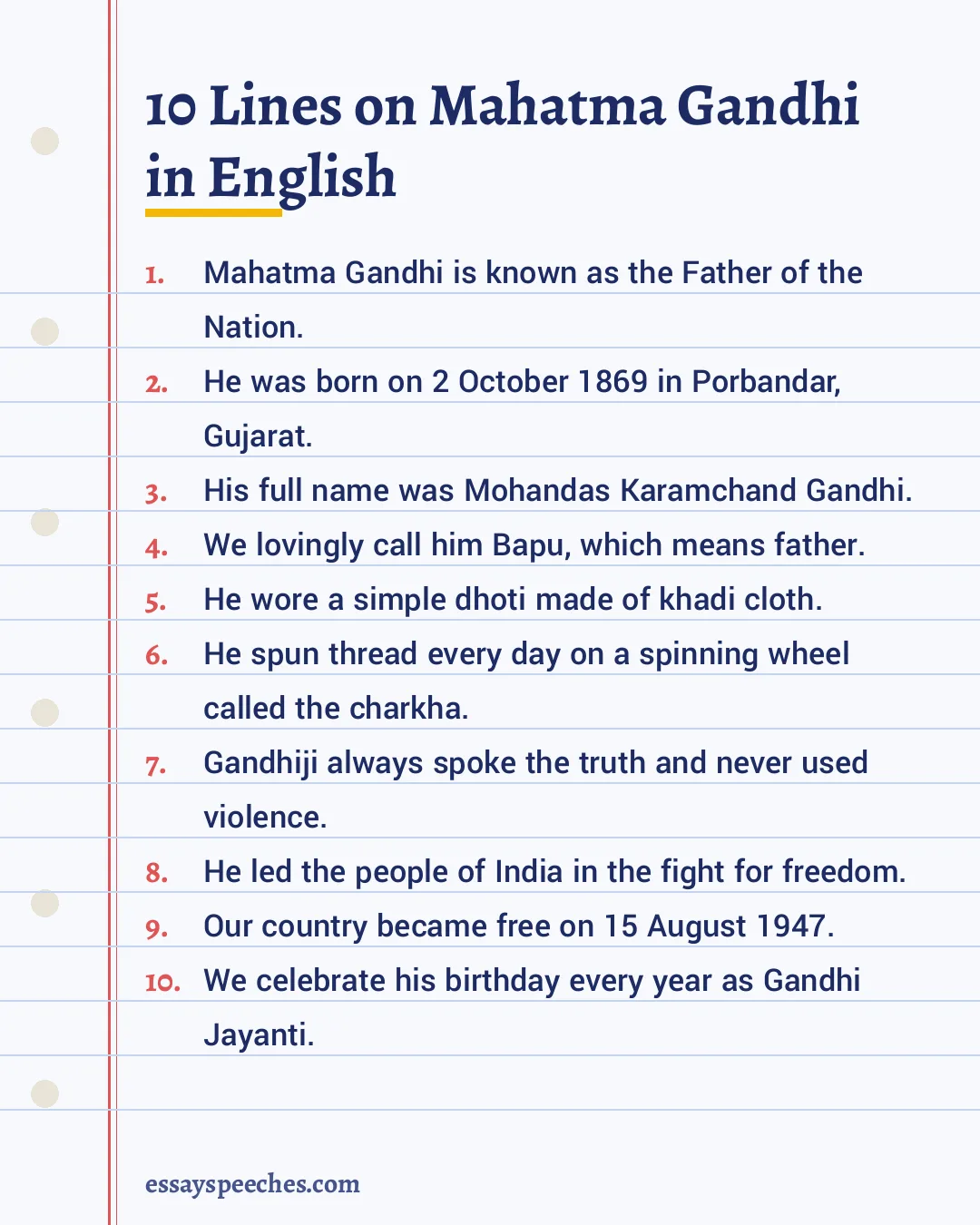
- Mahatma Gandhi is known as the Father of the Nation.
- He was born on 2 October 1869 in Porbandar, Gujarat.
- His full name was Mohandas Karamchand Gandhi.
- We lovingly call him Bapu, which means father.
- He wore a simple dhoti made of khadi cloth.
- He spun thread every day on a spinning wheel called the charkha.
- Gandhiji always spoke the truth and never used violence.
- He led the people of India in the fight for freedom.
- Our country became free on 15 August 1947.
- We celebrate his birthday every year as Gandhi Jayanti.
10 Lines on Mahatma Gandhi for Class 5 (Set 2)
- Mohandas Karamchand Gandhi was born in Porbandar, a coastal town of Gujarat, on 2 October 1869.
- His father, Karamchand Gandhi, was the diwan of Porbandar, and his mother was Putlibai.
- As a young man, he sailed to London to study law and became a barrister.
- In South Africa, he was pushed out of a first-class train compartment because of his skin colour.
- That insult made him decide to fight injustice through peaceful protest.
- He returned to India in 1915 and soon became the leader of the freedom movement.
- His two great weapons were satyagraha, or holding firmly to truth, and ahimsa, or non-violence.
- In 1930, he walked to Dandi with his followers to break the unjust salt law.
- He asked Indians to wear khadi and use swadeshi goods instead of foreign cloth.
- He was shot dead on 30 January 1948, a day India remembers as Martyrs' Day.
Short Essay on Mahatma Gandhi in 100 Words
Every year on 2 October, schools across India remember a thin man in a white dhoti, with round glasses and a walking stick. He is Mahatma Gandhi, the Father of the Nation. Born in 1869 in Porbandar, Gujarat, he studied law in London and later worked in South Africa.
Back in India, Gandhiji led the freedom struggle without weapons. He taught people to fight with truth and non-violence. He spun cloth on his charkha and lived a very simple life. Through his efforts and the sacrifices of many others, India became free in 1947. We lovingly call him Bapu.
Write an Essay on Mahatma Gandhi in 150 Words
Mohandas Karamchand Gandhi, known to the world as Mahatma Gandhi, was born on 2 October 1869 at Porbandar in Gujarat. The word Mahatma means great soul, and Indians fondly call him Bapu.
As a young man, Gandhi went to London to become a lawyer. He then took up work in South Africa, where Indians were treated badly because of their colour. He protested peacefully against these unfair laws and won the respect of his people.
In 1915 he came back to India and joined the struggle for freedom. He led movements such as Non-Cooperation, the Salt March and Quit India. He never asked his followers to pick up a weapon. Instead, he used fasting, marches and peaceful refusal to obey unjust laws.
Gandhiji lived in an ashram, ate simple food and wore khadi. He died on 30 January 1948. His birthday is celebrated as Gandhi Jayanti and as the International Day of Non-Violence.
Paragraph on Mahatma Gandhi
A small man with a big heart, Mahatma Gandhi showed the world that a nation could win freedom without firing a single bullet. He believed that truth was the strongest force on earth and that hatred could only be defeated by love. When the British taxed salt, something even the poorest family needed, he walked with his followers from Sabarmati Ashram to the sea at Dandi and made salt from sea water. Thousands joined him on the road. Gandhiji also fought against untouchability and urged people to keep their homes and villages clean. He wore khadi, spun his own yarn and owned very little. Today his picture appears on Indian currency notes, but his real place is in the hearts of the people.
Short Essay on Mahatma Gandhi in 200 Words
India has produced many brave freedom fighters, but only one is called the Father of the Nation. Mahatma Gandhi led the country's long struggle against British rule and taught millions of ordinary people to stand up for their rights without hurting anyone.
Gandhiji's ideas took shape in South Africa, where he lived for about twenty-one years. There he saw how Indians were insulted and denied basic rights. He organised peaceful protests and called his method satyagraha, the force of truth.
After returning to India in 1915, he first helped the indigo farmers of Champaran in Bihar in 1917. He then led the Non-Cooperation Movement in 1920, the Dandi March in 1930 and the Quit India Movement in 1942. People burnt foreign cloth, left British courts and schools, and went to jail with pride. Gandhiji himself spent many years in prison.
Along with freedom, he dreamt of a fair society. He worked for the dignity of every caste, for village industries and for unity among people of all faiths. India became independent on 15 August 1947. A few months later, on 30 January 1948, he was killed in Delhi. His message of peace lives on.
Mahatma Gandhi Essay in English 300 Words
Some leaders win battles with armies. Mahatma Gandhi won freedom for India with a spinning wheel, a walking stick and an unbreakable belief in truth. Born Mohandas Karamchand Gandhi in Porbandar on 2 October 1869, he grew up as a shy boy and was married to Kasturba at the age of thirteen. Nothing in his childhood suggested that he would one day change the history of the world.
In 1888 he left for London to study law. A few years later, a legal case took him to South Africa. There, one night at Pietermaritzburg station, he was thrown out of a first-class compartment because he was not white. Instead of going home, he decided to stay and fight injustice. He remained there for over two decades, ran a newspaper called Indian Opinion and set up his first communities at Phoenix Settlement and Tolstoy Farm.
Gandhiji returned to India in 1915 and travelled widely to understand the lives of its people. In Champaran and Kheda he stood beside poor farmers. The Non-Cooperation Movement of 1920 and the Salt Satyagraha of 1930 shook British rule, and in 1942 his call of Do or Die launched the Quit India Movement.
His life was his message. He lived at Sabarmati Ashram and later at Sevagram, wore khadi, ate simple vegetarian food and did his own work, including cleaning. He opposed untouchability and stressed cleanliness, self-reliance and village crafts. His autobiography, The Story of My Experiments with Truth, is still read around the world.
Gandhiji was assassinated on 30 January 1948, barely months after independence. Today, 2 October is observed as Gandhi Jayanti in India and as the International Day of Non-Violence across the world. Leaders such as Martin Luther King Jr. in America and Nelson Mandela in South Africa drew strength from his ideas.
Long Essay on Mahatma Gandhi in 500 Words
Introduction
When the news of Mahatma Gandhi's death spread on 30 January 1948, the whole country wept as if every family had lost an elder. Few people in history have been loved by so many. Gandhiji was not a king, a general or a rich man. He was a lawyer who chose to live like the poorest Indian, and in doing so he became the moral leader of the freedom movement.
Early Life and Education
Mohandas was born on 2 October 1869 in Porbandar, a port town on the coast of Gujarat. His father Karamchand served as diwan, or chief minister, of the small state, while his mother Putlibai taught him the value of fasting, prayer and self-control. As a schoolboy in Rajkot he was average in studies and very shy, but he could not bear to tell a lie. At eighteen, he sailed to England to study law and came back as a barrister in 1891.
Years in South Africa
His law practice in Bombay did not go well, so in 1893 he accepted work with an Indian firm in South Africa. The racial insults he faced there woke a fighter inside him. He united the Indian community, opposed a law that forced Indians to register themselves and carry certificates, and developed satyagraha: a way of resisting injustice by peacefully refusing to obey it and calmly accepting the punishment.
Leader of the Freedom Struggle
Gandhiji came home in 1915 and, on the advice of his political mentor G. K. Gokhale, spent time travelling across India by third-class train. His first great success came in 1917 at Champaran, where he took up the cause of indigo farmers who were forced to grow the crop for British planters.
The Non-Cooperation Movement began under his leadership in 1920. Indians were urged to return government titles, leave British-run schools and courts, and stop buying foreign cloth. When a crowd turned violent at Chauri Chaura in 1922, he called the whole movement off, because he would not accept freedom won through bloodshed. In 1930 he began the Civil Disobedience Movement with a 24-day march from Sabarmati to Dandi, where he picked up a handful of salt in defiance of the salt law. In August 1942 he told the British to Quit India and asked his countrymen to do or die. He was jailed many times, yet he never gave up non-violence.
His Ideals and Simple Life
For Gandhiji, truth and non-violence were daily habits, not slogans. He spun yarn on the charkha every day and turned khadi into a symbol of self-reliance. He worked to end untouchability, stood firmly for Hindu-Muslim unity and believed that the real India lived in its villages. He cleaned toilets in his own ashram to prove that no work is low. His belongings were few: a pair of spectacles, sandals, a watch and some simple clothes.
Conclusion
India became free on 15 August 1947, but Gandhiji spent that day in Calcutta, working for peace between communities instead of celebrating. His memorial at Rajghat in Delhi now draws visitors from all over the world. He proved that one person who refuses to give up truth can move an empire. When we stay honest, keep our surroundings clean and treat every human being with respect, we keep his dream alive.
Speech on Mahatma Gandhi in English (2 Minutes)
Good morning to our respected Principal, teachers and my dear friends.
Today I want to talk about a man who had no army, no wealth and no official power, yet he made the mighty British Empire listen. Can you guess who he is? He is Mahatma Gandhi, our beloved Bapu.
Born in the seaside town of Porbandar on 2 October 1869, young Mohandas went to London to become a lawyer. Later he took up work in South Africa, where he was insulted because of the colour of his skin. Did he hit back? No. He chose to fight injustice with truth and non-violence, and he named this method satyagraha.
When he returned to India, he became the voice of farmers, workers and ordinary families. He walked hundreds of kilometres to Dandi to make salt from sea water, because he believed even the poorest Indian had a right to it. He asked us to wear khadi and make our own goods. He told the British to Quit India, and he told Indians to be fearless.
Friends, Gandhiji did not want only political freedom. He wanted a clean India, an India without untouchability, and an India where people of every religion live like brothers and sisters.
So what can we, as students, learn from him? We can speak the truth even when it is difficult. We can keep our classrooms and streets clean. We can settle a quarrel with words, not fists. We can respect every person, rich or poor.
Bapu left us no palace and no treasure. He left us something far greater: the courage to be good.
Thank you.
How to Write an Essay on Mahatma Gandhi
- Open with a picture or a question, such as the image of a thin man with a walking stick leading a march to the sea, instead of only writing his name and birth date.
- Get the key facts right: born 2 October 1869 in Porbandar, returned from South Africa in 1915, Dandi March in 1930, Quit India in 1942, died 30 January 1948.
- Explain his two big ideas in simple words: satyagraha means holding on to truth, and ahimsa means non-violence.
- For a 300 word essay or longer, follow his life in order: childhood, South Africa, the freedom struggle and his ideals.
- Use words linked with Gandhiji, such as khadi, charkha, swadeshi, ashram, Bapu and Father of the Nation.
- End with what Gandhiji means to you today, for example honesty, cleanliness or respect for everyone, rather than repeating your opening.
Need this topic in Hindi? Read: Mahatma Gandhi Essay in Hindi: महात्मा गांधी पर निबंध (10 पंक्तियाँ और निबंध)
Questions students ask
Why is Mahatma Gandhi called the Father of the Nation?
He led the Indian freedom struggle for about three decades and brought people of every region, language and religion together in it. Because he guided the nation towards independence like a parent, Indians gave him the title Father of the Nation and lovingly call him Bapu.
When and where was Mahatma Gandhi born?
Mahatma Gandhi was born on 2 October 1869 in Porbandar, a coastal town in present-day Gujarat. His father was Karamchand Gandhi and his mother was Putlibai.
What were the main movements led by Gandhiji?
The best known are the Champaran Satyagraha of 1917, the Non-Cooperation Movement of 1920, the Salt Satyagraha or Dandi March of 1930 and the Quit India Movement of 1942. All of them were based on non-violence.
How do I write 10 lines on Mahatma Gandhi for class 3?
Use easy lines of about 8 to 12 words each. Mention his full name, where and when he was born, his khadi dhoti, his charkha, his love for truth and non-violence, and the reason for Gandhi Jayanti. Our opening list of 10 lines is pitched at children of classes 1 to 3.
Why is 2 October celebrated as Gandhi Jayanti?
2 October is Mahatma Gandhi's birthday, and India observes it as Gandhi Jayanti, a national holiday. The United Nations also marks this day as the International Day of Non-Violence. Schools hold prayer meetings, cleanliness drives and speech competitions on this day.
Every essay and speech on this page is written and checked by the Essay Speeches team. Spotted a mistake? Tell us. How we write.