
Sardar Vallabhbhai Patel Essay for Students (10 Lines, Essays and Speech)
This Sardar Vallabhbhai Patel essay page tells the story of the Iron Man of India, the leader who joined hundreds of princely states into one nation. It has 10 lines on Sardar Vallabhbhai Patel in English for small children, a second set for middle classes, essays of 100, 150, 300 and 500 words, a paragraph, a speech for National Unity Day and 10 lines in Hindi.
These pieces are useful on 31 October, his birth anniversary, and for any class test on freedom fighters. Pick the length you need, learn the key dates and facts, and then present them in your own sentences.
10 Lines on Sardar Vallabhbhai Patel in English
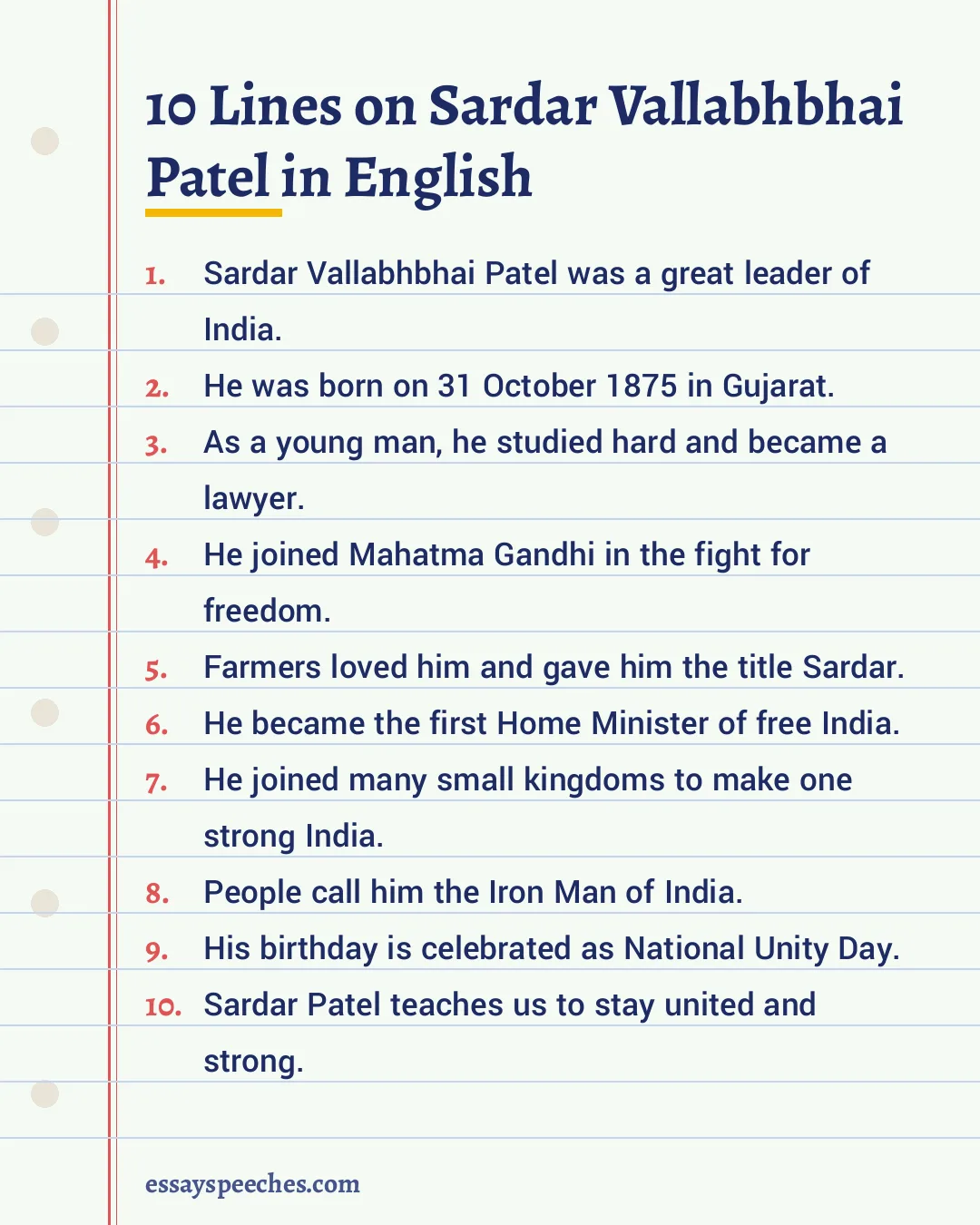
- Sardar Vallabhbhai Patel was a great leader of India.
- He was born on 31 October 1875 in Gujarat.
- As a young man, he studied hard and became a lawyer.
- He joined Mahatma Gandhi in the fight for freedom.
- Farmers loved him and gave him the title Sardar.
- He became the first Home Minister of free India.
- He joined many small kingdoms to make one strong India.
- People call him the Iron Man of India.
- His birthday is celebrated as National Unity Day.
- Sardar Patel teaches us to stay united and strong.
10 Lines on Sardar Patel for Class 5 (Set 2)
- Vallabhbhai Jhaverbhai Patel was born on 31 October 1875 in Nadiad, Gujarat, in a farming family.
- He went to England to study law and returned to practise as a successful barrister in Ahmedabad.
- Inspired by Mahatma Gandhi, he gave up his rich lifestyle and joined the freedom struggle.
- He led farmers in the Kheda Satyagraha of 1918 against unfair land revenue.
- After the Bardoli Satyagraha of 1928, the people of Bardoli honoured him as "Sardar", meaning leader.
- After Independence, he became India's first Deputy Prime Minister and Home Minister.
- He persuaded more than 560 princely states to join the Indian Union.
- His firm will in this huge task earned him the name Iron Man of India.
- He died on 15 December 1950, and India honoured him with the Bharat Ratna in 1991.
- Since 2014, his birth anniversary has been observed as Rashtriya Ekta Diwas, or National Unity Day.
Sardar Vallabhbhai Patel Essay 100 Words
The map of India we see today owes a great deal to Sardar Vallabhbhai Patel. He was born on 31 October 1875 at Nadiad in Gujarat. He became a lawyer, but left his practice to work with Mahatma Gandhi for India's freedom.
When India became free in 1947, it had hundreds of princely states ruled by kings and nawabs. As the first Home Minister, Patel talked to the rulers and brought almost all of them into India. For this, he is called the Iron Man of India. We remember him every year on National Unity Day.
Sardar Vallabhbhai Patel Essay in English 150 Words
Sardar Vallabhbhai Patel was one of the main builders of modern India. Born in Nadiad, Gujarat, on 31 October 1875, he grew up in a simple farmer's family and learnt the value of hard work early.
He studied law in England and became a well-known lawyer in Ahmedabad. After meeting Mahatma Gandhi, he left his comfortable life to serve the nation. He stood by the farmers of Kheda and Bardoli when they were burdened with heavy taxes. The grateful people of Bardoli called him Sardar.
After Independence, Patel became the first Deputy Prime Minister and Home Minister of India. His greatest work was uniting more than 560 princely states with the Indian Union. Because of his strong will, he is remembered as the Iron Man of India.
He died in 1950. Today, the Statue of Unity in Gujarat honours his memory.
Paragraph on Sardar Vallabhbhai Patel
In August 1947, India was free but not yet whole. Hundreds of princely states, big and small, could choose their own path, and the new nation might have broken into pieces. Sardar Vallabhbhai Patel, the first Home Minister, took up this challenge. With the help of his secretary V. P. Menon, he met the rulers, reasoned with them and, where needed, showed firmness. Within a short time, nearly every state had signed to join India. Patel also guided the setting up of the all-India civil services that still run our administration. A farmer's son from Gujarat, he was simple in habits and firm in decisions. His life shows that unity is the true strength of a nation.
Essay on Sardar Vallabhbhai Patel in 300 Words
Every nation has leaders who win its freedom and leaders who hold it together. Sardar Vallabhbhai Patel did both. That is why Indians remember him with deep respect as the Iron Man of India and the unifier of the nation.
Vallabhbhai Patel was born on 31 October 1875 in Nadiad, Gujarat. His father, Jhaverbhai, was a farmer, and his mother, Ladba, was a caring homemaker. Vallabhbhai completed his schooling with determination, often studying on his own. Later he went to England, passed his law examinations and came back to Ahmedabad as a barrister.
His life changed when he came under the influence of Mahatma Gandhi. In 1918, he helped lead the Kheda Satyagraha, in which farmers refused to pay taxes after their crops failed. In 1928, he led the Bardoli Satyagraha against a sharp rise in land revenue. The movement was so well organised and peaceful that the government had to give in. The people of Bardoli then began calling him Sardar. He went to jail many times, including during the Quit India Movement of 1942.
When India became independent in 1947, Patel became the first Deputy Prime Minister and Home Minister. More than 560 princely states were free to decide their future. Patel, with V. P. Menon, convinced the rulers one by one to join India. In the difficult cases of Junagadh and Hyderabad, he acted firmly. Without him, the map of India would look very different.
Sardar Patel passed away on 15 December 1950. He was awarded the Bharat Ratna in 1991. Today, his birthday is observed as National Unity Day, and the Statue of Unity stands tall in Gujarat. His message is clear: a united India is a strong India.
Long Essay on Sardar Vallabhbhai Patel in 500 Words
Introduction
When we look at the map of India today, we see one country stretching from Kashmir to Kanyakumari and from Gujarat to the North-East. Few of us stop to think how this came about. In 1947, it was far from certain. The man who made it possible was Sardar Vallabhbhai Patel, a farmer's son from Gujarat whose courage and practical wisdom earned him the title Iron Man of India.
Early Life and Education
Vallabhbhai Jhaverbhai Patel was born on 31 October 1875 in Nadiad, in the Kheda district of Gujarat. He grew up helping his father in the fields and finished school later than most boys of his age. He was ambitious and saved money to study law. After practising in the district courts of Gujarat, he went to England, studied at the Middle Temple in London and returned as a barrister. Back in Ahmedabad, he soon became one of the most successful lawyers in the city.
Role in the Freedom Struggle
At first, Patel was not interested in politics. Meeting Mahatma Gandhi changed that. He gave up his fine clothes and comfortable life, and began wearing simple khadi.
In 1918, he worked with Gandhiji in the Kheda Satyagraha, supporting farmers who could not pay taxes after a crop failure. His real test came in 1928 at Bardoli, where the government had raised land revenue sharply. Patel organised the farmers village by village. They refused to pay, faced the seizure of their land and cattle, but stayed peaceful. In the end, the government had to set up an inquiry and reduce the increase. The women of Bardoli gave him the title Sardar, meaning chief. He presided over the Karachi session of the Indian National Congress in 1931 and was jailed during the Quit India Movement.
The Unifier of India
Freedom in 1947 brought a huge problem. Besides the provinces of British India, there were more than 560 princely states. Each could, in theory, join India, join Pakistan or try to stay independent. As Home Minister and Deputy Prime Minister, Patel took charge of this task with his secretary, V. P. Menon.
He appealed to the rulers' patriotism, offered them respect and fair terms, and asked them to sign the Instrument of Accession. Most agreed. Where a ruler held out, as in Junagadh and Hyderabad, Patel acted firmly so that the will of the people prevailed. In about two years, a divided land became one nation. He also strengthened the all-India services, which are often described as the steel frame of the country.
Honours and Legacy
Sardar Patel died in Bombay on 15 December 1950. He received the Bharat Ratna in 1991. His birth anniversary is observed as National Unity Day, with Run for Unity events and a unity pledge in schools and offices. The Statue of Unity, 182 metres tall, stands near the Sardar Sarovar Dam on the Narmada river in Gujarat.
Conclusion
Sardar Patel showed that patriotism is not only about speeches but about solving hard problems with patience and resolve. As students, we can honour him by respecting every region, language and community of our country.
Speech on Sardar Vallabhbhai Patel for National Unity Day (2 Minutes)
Good morning to our respected Principal, teachers and my dear friends.
Today, on 31 October, we celebrate National Unity Day, the birth anniversary of Sardar Vallabhbhai Patel. I am grateful for this chance to speak about the man we proudly call the Iron Man of India.
Friends, imagine an India split into hundreds of separate kingdoms, each with its own ruler and its own rules. Would we be one country today? Would we stand together in this assembly as Indians? We can, because of Sardar Patel.
He was born in 1875 in Nadiad, Gujarat, in a farmer's family. He became a brilliant lawyer, but when Mahatma Gandhi called, he left everything to serve the nation. He fought for the poor farmers of Kheda and Bardoli so bravely that the people gave him the title Sardar, which means leader.
When India became free in 1947, Sardar Patel became our first Home Minister. More than 560 princely states had to be brought together. It was a task that looked impossible. With patience, wisdom and, when needed, an iron will, he united them into one India.
Today, the tall Statue of Unity in Gujarat reminds the world of his work. But the real monument to Sardar Patel is the unity of our people.
So, my friends, let us keep that unity alive. Let us respect every language, every religion and every state. Let us run together, study together and grow together.
Sardar Patel gave us one India. It is our duty to keep it one.
Thank you. Jai Hind.
Sardar Vallabhbhai Patel Essay in Hindi: सरदार पटेल पर 10 पंक्तियाँ
- सरदार वल्लभभाई पटेल भारत के महान स्वतंत्रता सेनानी थे।
- उनका जन्म 31 अक्टूबर 1875 को गुजरात के नडियाद में हुआ था।
- वे एक किसान परिवार से थे और पढ़ाई करके वकील बने।
- महात्मा गांधी से प्रेरित होकर वे आज़ादी की लड़ाई में शामिल हुए।
- बारडोली सत्याग्रह के बाद लोगों ने उन्हें सरदार की उपाधि दी।
- आज़ादी के बाद वे देश के पहले गृह मंत्री और उप प्रधानमंत्री बने।
- उन्होंने 560 से अधिक रियासतों को भारत में मिलाया।
- इसी कारण उन्हें भारत का लौह पुरुष कहा जाता है।
- उनका जन्मदिन राष्ट्रीय एकता दिवस के रूप में मनाया जाता है।
- गुजरात में बनी स्टैच्यू ऑफ यूनिटी उनकी याद में बनाई गई है।
How to Write an Essay on Sardar Vallabhbhai Patel
- Begin with a strong picture, such as the map of India in 1947 with hundreds of princely states, rather than only his date of birth.
- Learn the key facts correctly: born 31 October 1875 in Nadiad, Gujarat; died 15 December 1950; Bharat Ratna in 1991.
- Mention the Kheda Satyagraha of 1918 and the Bardoli Satyagraha of 1928, and explain how he got the title Sardar.
- Give the most space to his greatest work: uniting more than 560 princely states as the first Home Minister.
- Use headings like Early Life, Freedom Struggle, Unifier of India and Legacy when you write the 500 word essay.
- For a National Unity Day speech, add the unity pledge, the Run for Unity and a short appeal to stay united.
- Finish with what students can learn from him: discipline, courage and respect for every part of India.
Questions students ask
Why is Sardar Vallabhbhai Patel called the Iron Man of India?
He is called the Iron Man of India because of his strong will and firm decisions. As the first Home Minister, he brought more than 560 princely states into the Indian Union, a task that needed great courage and determination.
When is National Unity Day celebrated?
National Unity Day, or Rashtriya Ekta Diwas, is celebrated every year on 31 October, the birth anniversary of Sardar Patel. It has been observed since 2014. Schools hold speeches, essay competitions, the unity pledge and Run for Unity events.
How did Vallabhbhai Patel get the title Sardar?
In 1928, he led the farmers of Bardoli in Gujarat in a peaceful protest against a steep rise in land revenue. The protest succeeded, and the people of Bardoli, especially the women, began calling him Sardar, which means leader or chief.
What is the Statue of Unity?
The Statue of Unity is a statue of Sardar Vallabhbhai Patel in Gujarat. At 182 metres, it is one of the tallest statues in the world. It stands near the Sardar Sarovar Dam on the Narmada river.
How do I write 10 lines on Sardar Vallabhbhai Patel in English?
Write one fact in each line: his birth, his education, joining the freedom struggle, the title Sardar, becoming Home Minister, uniting the princely states, the name Iron Man, his death and National Unity Day. Keep lines short for classes 1 to 3.
Every essay and speech on this page is written and checked by the Essay Speeches team. Spotted a mistake? Tell us. How we write.