
Debate Writing Format, Meaning and Examples (Class 11 and 12)
Debate writing is a common question in the writing section of class 11 and class 12 English papers, and it also comes up in middle school as a speaking activity. On this page you will learn what a debate is, the exact format examiners look for, the phrases that make your arguments sound confident, and four solved debates written both for and against the motion.
Read the guide first, then study one example for the motion and one against it. Notice how each one greets the audience, states its side in the first lines, gives three clear points, answers the other side and ends with a firm appeal. Once you have the pattern, practise with the topic list near the end.
What Is Debate Writing? Meaning and Format
Debate meaning in simple words
A debate is a formal discussion on a topic in which two sides argue in turn. One side speaks for the topic and the other speaks against it. The topic is called the motion, for example, "Homework should be banned in primary classes". Judges listen to both sides and decide which speaker gave stronger reasons, better examples and a more convincing delivery. In Hindi, a debate is called vaad-vivaad (वाद-विवाद).
So what is the meaning of debate writing? It is the written form of the speech you would give in such a contest. You write it as if you are standing on the stage, so it uses a greeting, the first person ("I strongly believe"), and direct appeals to the audience. A debate is different from an article: an article explains a topic for readers, while a debate takes one side and tries to win the argument.
Debate writing format for class 11 and 12
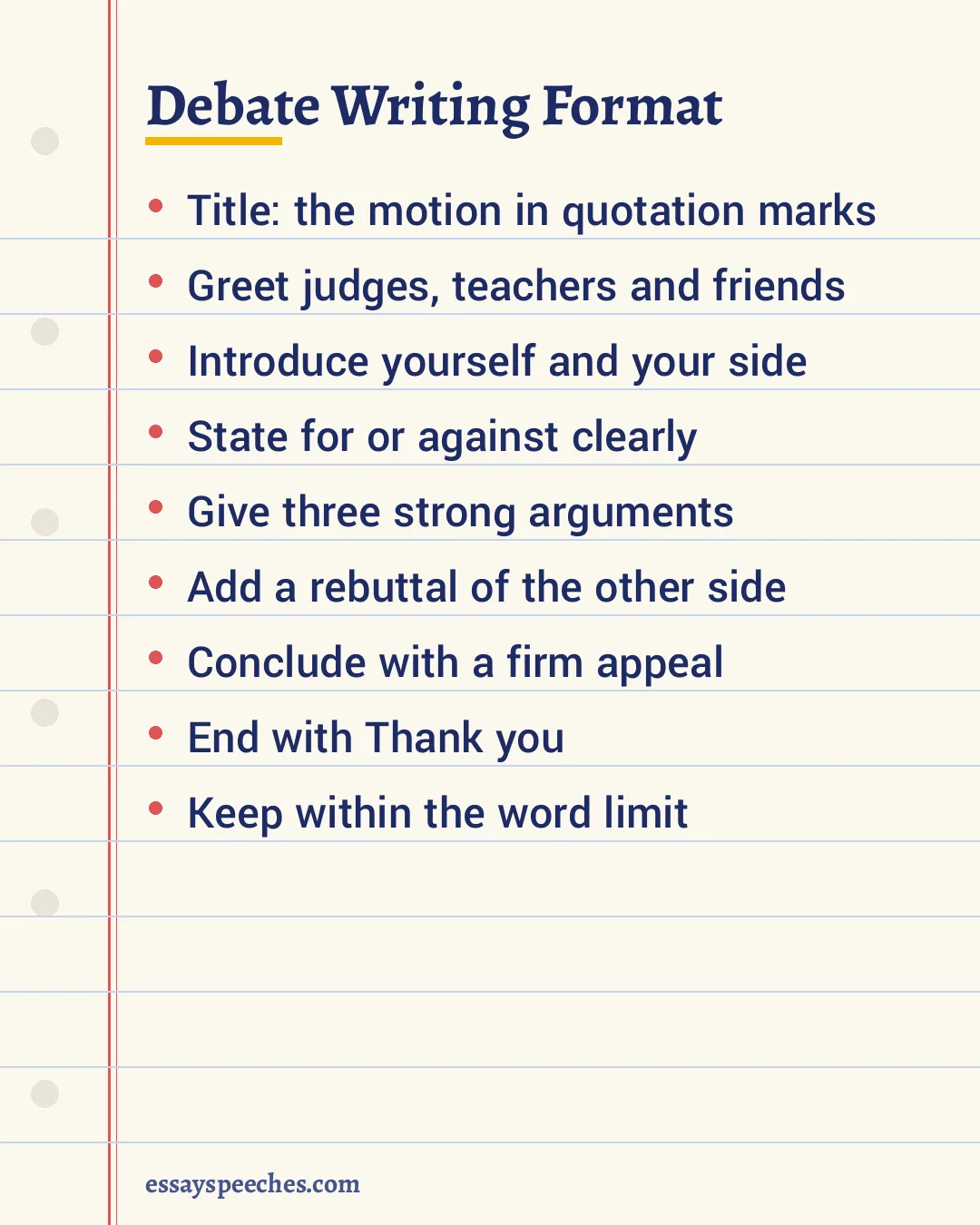
- Title: write the motion at the top, usually in quotation marks.
- Greeting: address the chairperson or judges, teachers and fellow students, for example, "Honourable judges, respected teachers and my dear friends".
- Introduction and stand: give your name if the question asks you to, repeat the motion and say clearly whether you speak for or against it. Add one line explaining why the topic matters.
- Arguments: give three main points, each in its own short paragraph. Support every point with a reason, a fact you are sure of, or an example from everyday life.
- Rebuttal: answer what the other side is likely to say. Use polite but firm language such as "My friends on the other side may argue that... but...".
- Conclusion: sum up your stand in two or three lines and end with a strong appeal or a question for the audience.
- Closing: finish with "Thank you".
Word limit and marks
Many class 11 and class 12 question papers ask for a debate of about 150 to 200 words, though boards and schools may set a different limit. Always follow the limit printed in your question. Marks are usually given for three things: format (title, greeting, stand, closing), content (relevant, well supported arguments) and expression (organisation, grammar, spelling and fluency). A neat format alone will not score well if the arguments are weak, so plan your three points before you start writing.
Useful phrases for debate writing
| Purpose | Phrases you can use |
|---|---|
| Taking a stand | I rise to speak for the motion... / I firmly oppose the motion... |
| Adding a point | Moreover... / Another reason is... / Let me add that... |
| Giving an example | Take the case of... / Look around this hall... / Many of us have seen... |
| Rebuttal | My opponents claim that... but they forget... / With due respect, I disagree... |
| Asking the audience | Is it fair that...? / Can we really accept...? |
| Concluding | To sum up... / I leave it to the wise judges to decide... |
Dos and don'ts
- Do stick to one side from the first line to the last. Never argue both sides in the same answer.
- Do keep each paragraph to one idea so the examiner can count your arguments easily.
- Do use rhetorical questions, but only two or three.
- Don't insult the opposite team or use rude words. Attack the argument, not the person.
- Don't invent statistics. A real example from school or home works better than a made-up number.
- Don't forget the title and the closing "Thank you", since both carry format marks.
For help with stage speeches, read our speech writing guide, and for more motions, see the full list of debate topics.
Debate Writing Example 1: Mobile Phones Should Be Allowed in Schools (For)
"Mobile Phones Should Be Allowed in Schools"
Honourable judges, respected teachers and my dear friends, I, Kavita, stand before you to speak for the motion, "Mobile phones should be allowed in schools". The question is not whether phones are good or bad. The question is whether we can learn to use them wisely, and school is the best place to learn that.
Firstly, a phone is a powerful learning tool. A student can look up the meaning of a hard word, watch a short science demonstration or check a map during a geography lesson. Why should a device that holds a whole library stay locked at home?
Secondly, phones keep students safe. Many children travel long distances by bus or on foot. A quick call to a parent when the bus is late or a class ends early gives the whole family peace of mind.
Thirdly, the modern workplace runs on digital skills. If schools ban phones, students will learn to use them only for games and gossip. If schools allow them with rules, students will learn responsible use under the eyes of their teachers.
My friends on the other side will say that phones distract students. I agree that misuse is possible, but the answer to misuse is discipline, not a ban. Schools can keep phones in silent mode, collect them during tests and allow them only for class work.
So let us not fear technology. Let us teach our students to master it.
Thank you.
Debate Writing Example 1: Mobile Phones Should Be Allowed in Schools (Against)
"Mobile Phones Should Be Allowed in Schools"
Respected judges, teachers and fellow students, I, Arjun, rise to oppose the motion, "Mobile phones should be allowed in schools". A school is a place to build concentration, character and friendship, and I believe the mobile phone quietly takes away all three.
To begin with, phones are a constant distraction. A single buzz in the pocket breaks a student's attention, and it takes several minutes to focus again. Can a teacher really check whether forty students are reading notes or scrolling through videos?
Next, phones increase unfair practices and bullying. Students may share answers during tests, click photographs of classmates without permission or post hurtful comments online. Such harm spreads in seconds and is very hard to undo.
Finally, phones reduce real human contact. Recess used to be a time for games, chatter and shared tiffins. Today, in schools where phones are allowed, groups of children sit silently, each one staring at a small screen.
The speaker for the motion argued that phones help with learning and safety. With due respect, schools already have computer labs, smart boards and libraries for learning, and the school office has a phone for emergencies. Parents can always reach their child through the school.
Let classrooms remain a place where eyes meet eyes, not screens. I urge the judges to reject this motion.
Thank you.
Debate Writing Example 2: Online Classes Can Replace Classroom Teaching (For)
"Online Classes Can Replace Classroom Teaching"
Honourable chairperson, worthy judges and my friends in the audience, I speak in favour of the motion, "Online classes can replace classroom teaching". Learning is no longer tied to four walls, a blackboard and a fixed timetable, and I am here to show why that is a good thing.
My first argument is reach. A student in a remote hill village may not have a physics teacher within fifty kilometres. Through an online class, the same student can learn from an expert sitting in a big city. Distance stops being a barrier.
My second argument is flexibility. Recorded lessons can be paused, replayed and watched again before an exam. A slow learner does not have to feel embarrassed, and a fast learner does not have to wait for others.
My third argument is cost and time. Students save hours of travel every day, and families save money on transport and hostel fees. That time can go into self-study, sport or rest.
The opposition may say that online learning lacks discipline and personal attention. But small online groups, live doubt sessions and regular quizzes already solve these problems in many institutions. The tool is not weak; it only needs to be used properly.
If knowledge can travel to every home, why should we keep it waiting at the school gate?
Thank you.
Debate Writing Example 2: Online Classes Can Replace Classroom Teaching (Against)
"Online Classes Can Replace Classroom Teaching"
Worthy judges, learned teachers and dear friends, I, Meher, strongly oppose the motion, "Online classes can replace classroom teaching". Online lessons are a useful support, but a support cannot become the whole building.
First of all, many students do not have a steady internet connection or a device of their own. In a family with three children and one phone, who attends the class? Replacing schools with screens would leave the poorest learners far behind.
In addition, education is not only about information. In a classroom, a teacher reads faces, notices a confused frown and explains again. She can tell when a child is unwell or unhappy. A camera that is switched off tells her nothing.
What is more, school teaches life skills that no app can teach. We learn to stand in an assembly line, share a bench, work in a team, lose a match gracefully and resolve a quarrel with a friend. These lessons shape our character.
The previous speaker praised flexibility and reach. I agree that online classes help in emergencies and in faraway areas. However, using them as a helpful add-on is very different from replacing the classroom altogether. Long hours before a screen also strain the eyes and leave children isolated.
Let us use technology to strengthen schools, not to close them.
Thank you.
Short Debate Example for Class 8: Homework Should Be Banned (Against)
"Homework Should Be Banned"
Good morning to the judges, my teachers and all my classmates. I am Rohan, and I am speaking against the motion, "Homework should be banned".
Homework helps us remember what we learnt in class. When I solve sums at home, I find out which steps I really understood and which ones I need to ask about the next day.
Homework also builds good habits. It teaches us to sit at a desk, plan our evening and finish a task on time. These habits help us all our lives.
My friends who support the motion say homework leaves no time for play. I agree that too much homework is tiring. But the answer is less homework, not no homework at all.
So please do not throw away a tool that makes us better learners.
Thank you.
Debate Writing Topics for Class 11 and 12
Practise the debate writing format with these motions. Write one answer for and one against for each topic you pick.
- Co-education is better than single-sex schools
- Board examinations should be abolished
- Social networking sites do more harm than good
- School uniforms should be compulsory
- Junk food should be banned in school canteens
- Students should be allowed to choose their own subjects from class 9
- Competitive exams put too much pressure on students
- Plastic bags should be banned completely
- City life is better than village life
- Artificial intelligence will create more jobs than it destroys
- Sports should be a compulsory subject in school
- Television has lost its value for young people
- Every student should learn a vocational skill
- Reality shows have a negative effect on children
- Corporal punishment has no place in schools
Easy Debate Topics for Class 8
Younger students can start with these simple motions. Keep the answer to about 120 to 150 words with two or three points.
- Books are better friends than screens
- Pets should be allowed in apartment buildings
- Children should get pocket money every week
- Summer vacation should be shorter
- Indoor games are as useful as outdoor games
- Every school should have a vegetable garden
- Students should clean their own classrooms
- Cartoons teach children good values
- Exams are the best way to test learning
- Bicycles are better than school buses
How to Write a Debate in Class 11 (Quick Tips)
- Read the question twice and underline whether you must speak for or against the motion. Writing the wrong side loses most of the content marks.
- Spend two minutes noting three arguments and one rebuttal before you write a single line of the answer.
- Open with a short line that grabs attention, such as a question or a picture from daily life, right after the greeting.
- Begin each argument with a clear signal word: firstly, secondly, moreover, finally. This makes your structure easy to follow.
- Use examples from school, home and your town. They sound more natural than big numbers you are not sure about.
- Keep the tone confident and polite. Words like "I firmly believe" and "with due respect" show strength without rudeness.
- Count your words at the end and cut repeated ideas if you have crossed the limit.
Questions students ask
What is a debate?
A debate is a formal contest of arguments on a topic called the motion. One speaker or team supports the motion and the other opposes it. Judges decide the winner based on the strength of the arguments and the delivery.
What is the format of debate writing for class 11?
Write the motion as the title, greet the judges and audience, introduce yourself and state your stand, give three arguments in separate paragraphs, add a rebuttal, conclude with an appeal and end with Thank you.
How many words should a class 11 debate have?
Many papers ask for about 150 to 200 words, but the limit can differ from board to board and school to school. Always follow the word limit given in the question.
What is the difference between debate writing and speech writing?
A speech can inform, welcome or inspire, and it does not need to take sides. A debate always takes one side of a motion, argues for it and answers the opposite view through a rebuttal.
Can I write a debate for and against in the same answer?
No. In an exam you must choose the side the question asks for and stay with it. You may mention the other side's view only to answer it in your rebuttal.
Every essay and speech on this page is written and checked by the Essay Speeches team. Spotted a mistake? Tell us. How we write.