
2 Minute Speech Topics for Students (with Full Sample Speeches)
These 2 minute speech topics come with complete answers, so you can see exactly how much to say in two minutes and how to arrange it. Below you will find a short guide on timing and extempore speaking, eight ready 2 minute speeches in English, one in Hindi, a 1 minute speech on respect, and a list of 60 short speech and extempore speech topics for students.
Read a sample aloud with a timer running. If it takes you much longer than two minutes, cut a sentence or two; if it is shorter, add one example from your own life. The best short speech is one you can say naturally, without reading every word.
How Long Is a 2 Minute Speech? Format and Extempore Tips
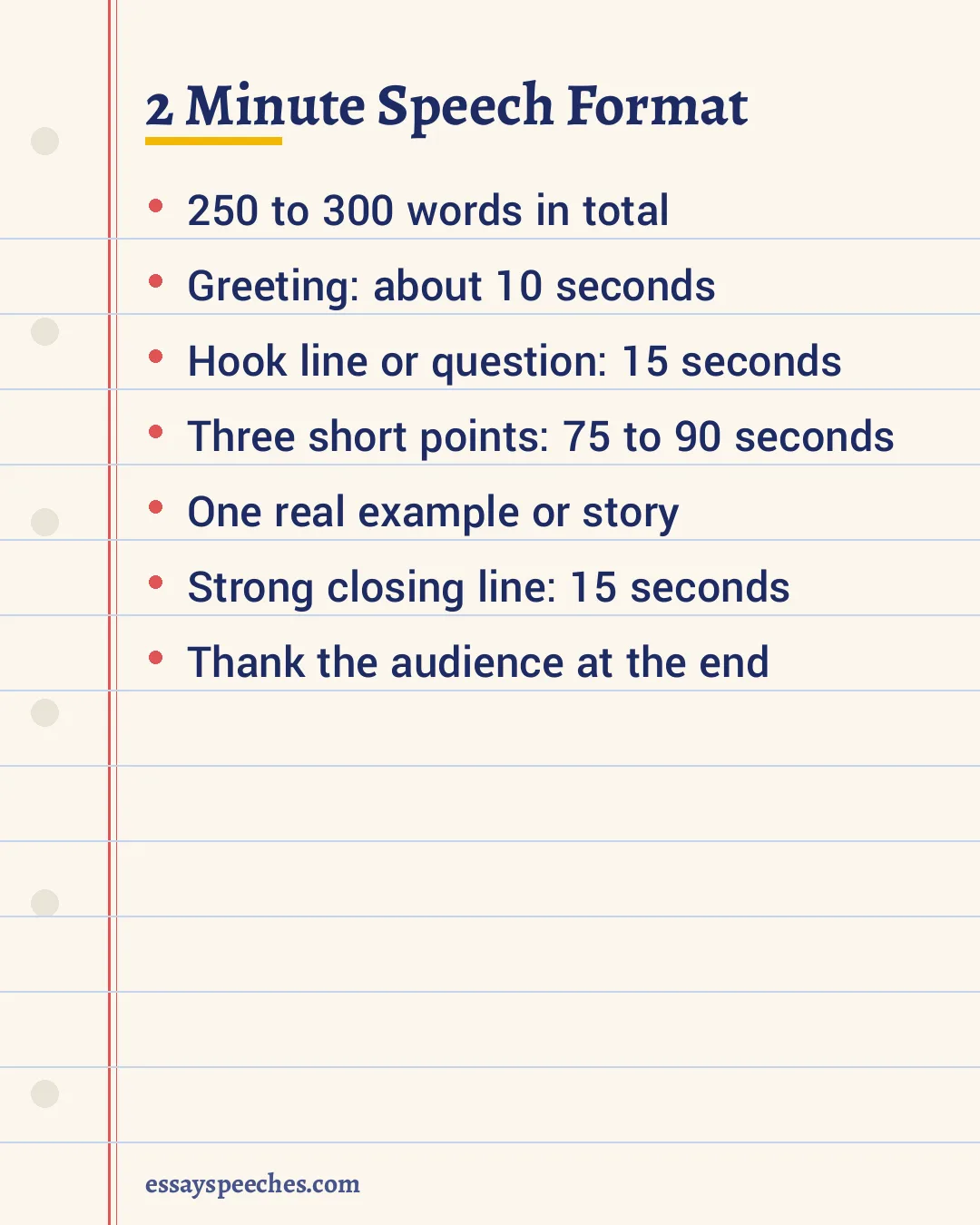
Most students speak at about 120 to 150 words a minute on stage. That means you need roughly 250 to 300 words for a 2 minute speech. For one minute, write 120 to 150 words; for five minutes, write 650 to 700 words. If you speak slowly or pause often, keep to the lower number.
Structure of a 2 minute speech
| Part | Time | What to say |
|---|---|---|
| Greeting | 10 seconds | Principal, teachers, friends |
| Opening | 15 seconds | A question, a short scene or a surprising fact |
| Body | 75 to 90 seconds | Two or three points, each with one example |
| Closing | 15 seconds | One memorable line and a thank you |
What is an extempore speech?
Extempore speech meaning: a speech given on a topic you receive on the spot, usually with one or two minutes to think. You cannot learn it by heart, so you need a quick plan. Try the What, Why, How method:
- What is the topic about? Say it in one simple line.
- Why does it matter? Give one reason and one example.
- How can we act on it? End with a suggestion for the audience.
Other extempore tips: write three keywords on your palm card, not full sentences; begin speaking only after you have decided your last line; if your mind goes blank, repeat your main idea in different words and move to the next point.
Before you go on stage
- Practise with a timer at least three times.
- Mark pauses with a slash in your notes.
- Look at three parts of the audience: left, centre and right.
For more ideas, see our speech topics list and the guide to speech writing. Ready 2 minute speeches on other topics are on the discipline, value of time and success pages.
2 Minute Speech on Rani Lakshmibai
Good morning to our respected Principal, teachers and my dear friends.
Imagine a young queen on horseback, her little son tied safely to her back, a sword in her hand, riding through the night to escape an enemy army. This is not a scene from a film. It really happened, and the queen was Rani Lakshmibai of Jhansi.
She was born in Varanasi and her childhood name was Manikarnika, though everyone lovingly called her Manu. Unlike most girls of her time, she learnt horse riding, sword fighting and archery. She was later married to Raja Gangadhar Rao, the ruler of Jhansi, and became Rani Lakshmibai.
After the Raja died in 1853, the British refused to accept her adopted son as the heir and decided to take over Jhansi. The Rani firmly refused to give up her kingdom. During the great revolt of 1857, she prepared her army, trained women soldiers and defended the fort of Jhansi bravely.
When the fort fell, she did not surrender. She escaped, joined other leaders of the revolt, and fought on at Kalpi and Gwalior. In June 1858, she died on the battlefield near Gwalior, still fighting for her land. She was only in her twenties.
Why do we still remember her? Because she showed that courage has nothing to do with age or gender. The famous Hindi poem by Subhadra Kumari Chauhan still tells every child how bravely the Rani of Jhansi fought.
Friends, we may never ride into battle, but we face our own small battles every day. Let us face them the way she did: with courage and without giving up.
Thank you.
Short Speech on Savitribai Phule in English
Good morning to our respected Principal, dear teachers and my friends.
Every morning, thousands of girls across India pick up their school bags and walk to class. Have you ever wondered who opened that door for them? Today I want to speak about Savitribai Phule, who is remembered as India's first woman teacher.
Savitribai was born on 3 January 1831 in Naigaon village of Satara district in Maharashtra. She was married very young to Jyotirao Phule, who believed that every person deserved education. He taught her to read and write, and she went on to train as a teacher.
In 1848, the couple started a school for girls in Pune. In those days, many people thought that educating girls was wrong. When Savitribai walked to school, some people threw mud and stones at her. She did not stop. She simply carried an extra sari in her bag, changed at school, and began teaching.
Over the years, the Phules opened more schools for girls and for children from communities who were not allowed to study. Savitribai also cared for widows, opposed caste discrimination and wrote poems in Marathi to spread her ideas.
In 1897, when plague spread in Pune, she nursed sick people with her own hands. She caught the disease herself and passed away the same year.
Friends, Savitribai teaches us that one brave teacher can change a whole society. Whenever we feel bored of studies, let us remember the woman who was attacked just for teaching girls to read.
Let us respect our right to education and help others share it. Thank you.
2 Minute Speech on Freedom Fighters in English
Respected Principal, our teachers and all my friends, a very good morning to you.
When we hear the words freedom fighter, a few famous names come to mind at once. But India's freedom was won by lakhs of ordinary people too, farmers, students, women and tribal leaders whose names we rarely read. This morning I want to remember a few of them.
Birsa Munda was a young tribal leader from the forests of present-day Jharkhand. He fought to protect the land and rights of his people against British rule and outside landlords. He died in prison when he was only about twenty-five, yet tribal communities still honour him as a hero.
In the hills of present-day Andhra Pradesh, Alluri Sitarama Raju led the forest tribes in a rebellion against the British in the early 1920s. With bows, arrows and great courage, his small band troubled a powerful army for nearly two years.
During the Quit India Movement of 1942, Matangini Hazra, a woman in her seventies, led a procession in Tamluk in Bengal. She was shot by the police but held the national flag high until her last breath. In the same year, Kanaklata Barua, a seventeen-year-old girl from Assam, was shot while trying to raise the flag at a police station.
What do these stories tell us? That freedom did not come easily, and that courage can be found in every age, every region and every community.
Friends, the best way to thank our freedom fighters is to be honest, responsible citizens who protect what they won for us.
Thank you. Jai Hind.
2 Minute Speech on Leadership
A very good morning to our Principal, our teachers and my fellow students.
When I say the word leader, what picture comes to your mind? Perhaps a person standing on a stage, giving orders, wearing a badge. But I believe the truest leaders in our school are often the ones without any badge at all.
Think of the student who notices a new classmate eating lunch alone and goes to sit with him. Think of the girl who picks up the litter after a function without being told. Think of the captain who passes the ball to a teammate instead of taking the shot for herself. That is leadership.
So what makes a good leader? First, a good leader listens. Before deciding anything, she hears what everyone in the team thinks. Second, a good leader sets an example. If the class monitor wants silence, he must be quiet first. Third, a good leader takes the blame when things go wrong and shares the credit when things go right.
Leadership is not about being the loudest voice. It is about making the people around you better. A leader who makes everyone else feel small is only a boss. A leader who helps others grow is someone people will follow happily.
The good news is that leadership can be learnt. You can practise it in your group project, on the sports field, at home with your younger brother, and even in a bus queue.
Friends, do not wait for a badge to become a leader. Start today, in small ways. Lead by your actions, and others will follow.
Thank you.
2 Min Speech on Technology in Our Lives
Good morning, respected Principal, dear teachers and friends.
Close your eyes for a moment and think about your morning. An alarm woke you, a geyser heated your water, a scooter or a bus brought you here, and someone at home perhaps paid the milk bill with a phone. Before eight o'clock, technology had already helped you a dozen times.
Technology simply means using knowledge to make tools that solve problems. The wheel was technology once. So were the printing press and the electric bulb. Today we have satellites that forecast cyclones, machines that scan the human body, and online classes that reach children in faraway villages.
Farmers check weather updates and crop prices on their phones. Doctors in big cities can guide doctors in small towns through video calls. Students can watch a science experiment that their school laboratory does not have. Clearly, technology has made life faster, safer and more connected.
But every tool has two sides. The same phone that helps us learn can also steal hours of our sleep. Too much screen time hurts our eyes, our posture and our friendships. Cyber fraud and fake news spread as quickly as useful information.
So the real question is not whether technology is good or bad. The question is: are we using it, or is it using us?
Let us make a simple promise. We will use technology to learn, create and help others, and we will switch it off when it is time to play, read or talk to our families.
Technology should be our servant, never our master. Thank you.
2 Minute Speech About Life
Respected Principal ma'am, teachers and dear classmates, good morning.
Life does not come with a textbook, a syllabus or an answer key. It is the only exam where the questions change every day and nobody gets the same paper. So how do we prepare for it? I would like to share three small lessons that life teaches all of us.
The first lesson is that failure is not the end. Every one of us has lost a match, forgotten a line on stage or scored less than we hoped. These moments hurt, but they also show us what to work on. A seed has to break open before it can grow.
The second lesson is that people matter more than things. A new phone becomes old in a year. But the friend who shared his tiffin when you forgot yours, or the grandmother who waited at the gate every evening, stays in your heart forever. Spend time with the people you love while you can.
The third lesson is that small habits build a big life. Waking up on time, keeping your promises, saying sorry when you are wrong and thank you when someone helps: these may look ordinary, but together they shape the person you become.
Life will not always be easy. There will be rainy days, long queues and difficult exams. But there will also be sunsets, festivals, good books and laughter with friends.
So let us not wait for a perfect day to be happy. Let us live each ordinary day with gratitude, effort and kindness.
Life is short, so make it meaningful. Thank you.
Short Speech on Election: Why Every Vote Counts
Good morning to the Principal, all the teachers and my fellow students.
In a few years, most of us sitting here will turn eighteen. On that day, we will receive one of the most powerful gifts a citizen can have: the right to vote. Today I want to talk about elections and why every single vote counts.
India is the largest democracy in the world. Here, the people choose who will make laws and run the government, at the level of the village, the state and the country. This choice is made through free and fair elections, conducted by the Election Commission of India, which was set up on 25 January 1950. That is why 25 January is now observed as National Voters' Day.
From the very first general elections, every adult citizen, rich or poor, man or woman, was given an equal vote. The voting age was later lowered from 21 to 18, so that young people could have their say too.
Yet on election day, many people stay at home, thinking that one vote will not change anything. That is a mistake. Elections have been won and lost by a handful of votes. When we do not vote, we let others decide our future.
A good voter does three things. She registers on time, she learns about the candidates and their work, and she votes freely without taking money, gifts or pressure from anyone.
Friends, the ink mark on a voter's finger is a badge of responsibility. Let us wear it proudly when our turn comes, and encourage our families to vote today.
Thank you.
Short Speech on the State of Maharashtra (Maharashtra Day)
Respected Principal sir, teachers and my dear friends, namaskar and good morning.
Every year on 1 May, flags go up in schools and offices across Maharashtra, and parades are held in Mumbai. This day is Maharashtra Day, and it marks the birth of our state on 1 May 1960.
Before that date, the old Bombay State included people who spoke Marathi and people who spoke Gujarati. Many people wanted a separate state for Marathi speakers, and the Samyukta Maharashtra movement worked for it for years. Some of its members gave their lives, and Hutatma Chowk in Mumbai stands in their memory. Finally, Bombay State was divided, and Maharashtra and Gujarat were both formed on the same day.
Maharashtra is a land of great variety. It has the green Sahyadri hills, the long Konkan coast, and the cotton fields of Vidarbha. Its capital, Mumbai, is the country's busiest business city, while Nagpur serves as its second capital.
The state is famous for forts linked with Chhatrapati Shivaji Maharaj, such as Raigad, his capital, and Sinhagad. The ancient rock-cut caves of Ajanta and Ellora draw visitors from all over the world. Warli paintings, lavani dance, puran poli and vada pav are all part of its rich culture.
Maharashtra is also the land of great reformers like Jyotirao and Savitribai Phule, who fought for education and equality.
Friends, whether we were born here or came here from another state, Maharashtra welcomes all of us. Let us keep it clean, respect its language and culture, and work to make it even better.
Thank you. Jai Maharashtra.
2 Minute Speech in Hindi: सच्ची मित्रता पर भाषण
आदरणीय प्रधानाचार्य जी, सभी शिक्षकगण और मेरे प्यारे साथियों, सुप्रभात।
आज मैं आपके सामने एक ऐसे रिश्ते के बारे में बोलने आई हूँ जिसे हम खुद चुनते हैं। माता-पिता, भाई-बहन और रिश्तेदार हमें जन्म से मिलते हैं, पर दोस्त हम अपने दिल से बनाते हैं। आज मेरा विषय है, सच्ची मित्रता।
सच्चा मित्र कौन होता है? वह नहीं जो केवल जन्मदिन की पार्टी में आए, बल्कि वह जो बीमारी के दिनों में आपकी छूटी हुई कॉपी पूरी करवाए। वह नहीं जो हर बात में हाँ में हाँ मिलाए, बल्कि वह जो गलती करने पर प्यार से टोक दे।
हमारे इतिहास और लोककथाओं में ऐसी अनेक मित्रताओं की कहानियाँ हैं जिनमें एक दोस्त ने दूसरे के लिए अपना सुख छोड़ दिया। ये कहानियाँ बताती हैं कि मित्रता में अमीरी और गरीबी का कोई मोल नहीं होता।
आजकल हमारे फ़ोन में सैकड़ों दोस्त होते हैं, पर मुसीबत में साथ देने वाले दो या तीन ही निकलते हैं। इसलिए दोस्तों की गिनती पर नहीं, उनकी सच्चाई पर ध्यान दीजिए।
अच्छा मित्र पाने का सबसे आसान रास्ता है, खुद एक अच्छा मित्र बनना। अपने दोस्त की बात ध्यान से सुनिए, उसकी सफलता पर खुश होइए और उसकी पीठ पीछे बुराई मत कीजिए। झगड़ा हो जाए तो पहले माफ़ी माँगने में शर्म मत कीजिए।
साथियों, अच्छी किताबें और अच्छे दोस्त जीवन को सुंदर बना देते हैं। आइए, हम सब ऐसे मित्र बनें जिन पर कोई भी आँख बंद करके भरोसा कर सके।
धन्यवाद।
1 Minute Speech on Respect
Good morning, everyone. Respected Principal, teachers and friends.
Today I will speak on a small word with a big meaning: respect.
Respect means treating others the way we want to be treated. We show respect when we greet our elders, listen when a teacher is speaking, and wait for our turn in the line.
Respect is not only for older people. The bus driver, the school guard, the person who cleans our classroom and the new child in class all deserve it too. Even animals, plants and public property need our respect.
Respect is like an echo in the hills. When we give it freely, it always comes back to us, even louder.
So let us use kind words, say please and thank you, and never laugh at anyone's mistakes.
Thank you.
60 Short 2 Minute Speech Topics and Extempore Speech Topics for Students
Use these 2 minute speech topics for the morning assembly, class activities and extempore competitions. Easier topics come first.
- My favourite season
- A day without electricity
- If I were the class monitor
- My favourite cartoon character
- The joy of reading
- Why I love my grandparents
- Kindness to animals
- My dream holiday
- Why we should eat healthy food
- Good manners make a good person
- Importance of sleep
- Morning walk and its benefits
- The best gift I ever received
- Why we must keep our classroom clean
- Road safety rules for children
- My role model
- A good habit I want to build
- Sharing is caring
- The importance of games and sports
- Why I like my school library
- Is homework necessary?
- Online classes versus classroom learning
- Should mobile phones be allowed in school?
- Fast food: tasty but harmful
- The power of a smile
- Learning from mistakes
- Hard work beats talent
- Courage in everyday life
- My idea of a perfect school
- Respect for elders
- Self confidence
- Teamwork
- Peer pressure
- Plastic: friend or enemy?
- Saving electricity at home
- Cleanliness begins at home
- Unity in diversity
- Our national flag
- Life lessons from a tree
- Kindness costs nothing
- Gender equality
- Cyber safety for teenagers
- Fake news and how to spot it
- The value of money
- Stress during exams
- Importance of voting
- Traffic rules save lives
- Waste segregation
- Water: our most precious resource
- If I could change one thing in India
- Dreams and goals
- Patience
- Gratitude
- Honesty in small things
- Should students do part-time work?
- Sports or studies: which is more important?
- A world without books
- The role of youth in nation building
- Friendship in the age of screens
- Life is a journey, not a race
2 Minute Speech Topics in Hindi: 2 मिनट भाषण के विषय
- सच्ची मित्रता
- बड़ों का सम्मान
- मेरा प्रिय त्योहार
- पुस्तकें हमारी सबसे अच्छी मित्र
- सड़क सुरक्षा
- स्वच्छता का महत्व
- मोबाइल फ़ोन के लाभ और हानि
- परिश्रम का फल
- राष्ट्रीय एकता
- बेटियों की शिक्षा
- योग और स्वास्थ्य
- पेड़ लगाओ, जीवन बचाओ
Tips to Give a Great 2 Minute Speech
- Pick a topic you can explain with one example from your own life. Personal stories are easier to remember than facts.
- Start with a question or a scene, such as "Close your eyes and imagine...", to catch attention in the first ten seconds.
- Keep only two or three points. In two minutes, more points means each one gets too little time.
- Use short sentences and pause after each important line, so the audience can follow you.
- Time yourself at home. Aim for one minute fifty seconds, because nerves can make you slow down on stage.
- For an extempore speech, decide your closing line before you begin, so you always know where you are heading.
- End with one clear message or promise and a simple thank you.
Questions students ask
How many words is a 2 minute speech?
A 2 minute speech is usually 250 to 300 words. Most students speak about 120 to 150 words a minute, so if you speak slowly or take long pauses, keep closer to 250 words.
What is an extempore speech?
An extempore speech is a short speech on a topic given to you on the spot, with only a minute or two to prepare. You plan a few key points quickly and speak naturally instead of reciting a memorised text.
What are good 1 minute speech topics for students?
Simple topics work best for a one minute speech: respect, kindness, my best habit, why I love books, importance of sleep, or good manners. Choose a topic where one example and one message are enough.
How do I prepare a 2 minute speech in Hindi?
Follow the same plan as in English: greeting, a short opening, two or three points and a closing line. Use simple words that you can pronounce easily, and practise aloud with a timer, just like the Hindi sample on this page.
How is a 5 minute speech different from a 2 minute speech?
Five minutes gives you room for 650 to 700 words, enough to include four or five points, a longer story and a few facts. A 2 minute speech must stay focused on one idea with fewer examples.
Every essay and speech on this page is written and checked by the Essay Speeches team. Spotted a mistake? Tell us. How we write.