
Essay on Holi for Students (10 Lines, Short and Long Essays)
This essay on Holi collection covers the festival of colours for every class, from the first years of school up to class 10. Inside are two sets of 10 lines, a Holi paragraph in English, essays at five lengths from 100 up to 500 words, and a Holi speech for the school assembly.
Little children can begin with the first set of lines, and older students can go straight to the 300 or 500 word essay. Before a test, jot down three or four Holi details you love, such as the bonfire, gujiya or a water balloon fight, and build your answer around them. Hindi medium students will find a full Holi par nibandh on our Hindi page.
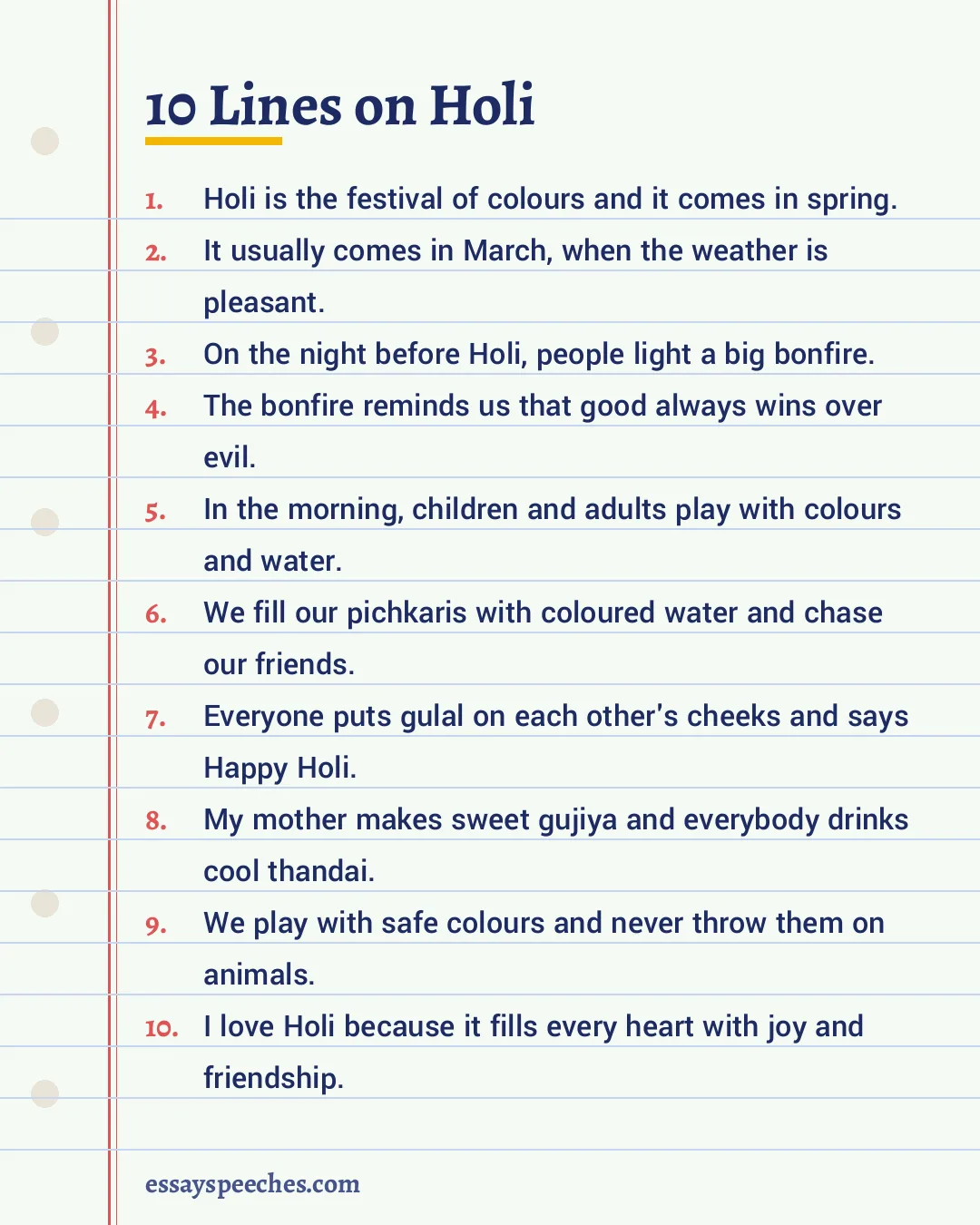
10 Lines on Holi
- Holi is the festival of colours and it comes in spring.
- It usually comes in March, when the weather is pleasant.
- On the night before Holi, people light a big bonfire.
- The bonfire reminds us that good always wins over evil.
- In the morning, children and adults play with colours and water.
- We fill our pichkaris with coloured water and chase our friends.
- Everyone puts gulal on each other's cheeks and says Happy Holi.
- My mother makes sweet gujiya and everybody drinks cool thandai.
- We play with safe colours and never throw them on animals.
- I love Holi because it fills every heart with joy and friendship.
10 Lines on Holi for Class 5 (Set 2)
- Holi is a Hindu festival celebrated with great joy all over India and in Nepal.
- Its date comes from the Hindu calendar: the full moon night of Phalgun, in early spring.
- The festival welcomes spring and celebrates the new wheat crop that is ready for harvest.
- On the first evening, people gather around the Holi bonfire and sing folk songs.
- The bonfire stands for burning away evil, pride and bad thoughts.
- The next day, called Dhulandi or Rangwali Holi, is the day of colours.
- Streets fill with people smeared in pink, green, yellow and blue gulal.
- Homes prepare gujiya, malpua, dahi bhalla and glasses of chilled thandai.
- People forget old quarrels, hug each other and begin their friendships afresh.
- We should use herbal colours, save water and keep pets safely indoors.
Holi Essay in English 100 Words
Every spring, the whole of India turns bright and colourful for Holi. It is a Hindu festival that comes on the full moon day of Phalgun. On the night before, families and neighbours gather around the Holi bonfire and sing songs. The bonfire teaches us that good wins over evil.
The next morning, children run out with pichkaris, balloons and packets of gulal. Friends and relatives smear colour on one another and laugh together. Later, we bathe, wear clean clothes and visit our relatives. Mothers serve gujiya, namkeen and thandai to guests. Holi teaches us to forget anger and live with love.
Essay on Holi in 150 Words (Class 3 to 5)
Holi is one of the happiest festivals of India. Called the festival of colours, it falls in March on the full moon of Phalgun. It marks the end of winter and the arrival of spring, when fields of wheat and mustard are ready for harvest.
The celebration lasts two days. On the first night, people light the Holi bonfire in an open ground. They walk around it, offer new grain and pray for a good year. The fire reminds everyone that truth and goodness win in the end.
On the second day, the streets come alive. Children spray coloured water from pichkaris, and elders gently apply dry gulal on the foreheads of friends. Drums beat and people dance to Holi songs. In the afternoon, families share gujiya, mathri and thandai.
I like Holi because rich and poor, young and old, all look the same under the colours.
Paragraph on Holi in English
The festival of Holi brings the first real burst of colour after the grey days of winter. Celebrated across India in the month of Phalgun, it begins with a bonfire on the full moon night, where people sing and pray for an end to evil. The morning after is pure fun. Neighbours come out with buckets of water, balloons and plates of red, green and yellow powder. Nobody minds getting wet, and nobody is treated as a stranger. Old quarrels end with a hug and a sweet. In the evening, homes fill with the smell of fresh gujiya and visitors arrive with greetings. Holi reminds us that joy grows when it is shared, and that a little colour can bring hearts closer.
Holi Festival Essay in 200 Words
India is a land of many festivals, and Holi is perhaps the most cheerful of them all. It is celebrated on the full moon day of Phalgun, which usually falls in March. Holi is also a spring festival, as it comes when the cold has gone and the rabi crops are turning golden in the fields.
The festival begins with the Holi bonfire. For days before, children collect dry wood and cow-dung cakes from the neighbourhood. On the evening of the full moon, the pile is lit, and people circle it with folded hands. Many roast green wheat or gram in the fire and share it as a blessing for a good harvest.
The next morning is the day of colours. Groups of friends move from house to house, smearing gulal and shouting greetings. Dholak beats fill the lanes, and old folk songs called phag are sung in villages. By noon, everyone is wet, tired and smiling.
Holi teaches us equality and forgiveness. On this day, we should also be careful: use natural colours, avoid wasting water and never force colour on someone who does not want it.
Holi Essay in English 300 Words
When the winter chill fades and trees put out fresh leaves, Indians get ready for Holi, the festival of colours. Celebrated on the full moon day of Phalgun, it is among the oldest festivals of the country and is enjoyed in villages and cities alike. It is also celebrated in Nepal and by Indian communities in countries such as Mauritius, Fiji, Guyana and Suriname.
Holi has a deep meaning. It is linked to an old legend in which faith and goodness survived a fire meant to destroy them. This is why the festival begins with the Holi bonfire, where people symbolically burn away jealousy, anger and pride. For farmers, Holi also celebrates the ripening of the winter crop, so it is a festival of thanksgiving too.
The day of colours is full of energy. Children lie in wait with water balloons, while adults greet one another with a touch of gulal and a warm hug. Kitchens are busy for days before, preparing gujiya stuffed with khoya and dry fruits, crisp papdi, dahi vada and pots of thandai flavoured with almonds and saffron. In the evening, people put on new clothes and visit relatives and neighbours.
Holi is a great leveller. For one day, differences of age, wealth and position disappear under the same colours. Even people who have not spoken for months shake hands and start again. That is the true spirit of the festival.
Sadly, some people spoil Holi by using harmful chemical colours, wasting water or troubling stray animals. As responsible citizens, we should choose colours made from flowers and turmeric, play with limited water and respect those who wish to stay dry. A Holi that is safe for everyone is the happiest Holi of all.
Long Essay on Holi in 500 Words
Introduction
Of all the seasons in India, spring is the most cheerful, and Holi is the festival that announces its arrival. Known as the festival of colours, Holi is celebrated on the full moon day, or Purnima, of the Hindu month of Phalgun, which usually falls in March. Nature itself seems to join in, with mango trees in bloom, palash flowers glowing orange and fields of wheat swaying in the breeze.
The Meaning of Holi
Holi carries a simple but powerful message: goodness survives, and evil destroys itself. This idea comes from an old legend in the Puranas, in which a young boy's firm faith protected him from a fire lit to harm him. To remember this, people light a community bonfire on the eve of the festival. It reminds us that pride and cruelty cannot last.
The festival also has a strong link with farming. In the north, the rabi crop of wheat, gram and barley is almost ready by Phalgun. Farmers roast the new grain in the bonfire and share it, thanking nature for a good season.
How Holi Is Celebrated
Preparations start a week in advance. Markets fill with heaps of gulal, pichkaris of every shape and sweet shops piled with gujiya. On the night of Purnima, the whole locality gathers around the fire, sings folk songs and exchanges good wishes.
The next morning, called Dhulandi in many places, the real fun begins. Friends arrive at the door with colour on their hands and mischief in their eyes. Buckets of coloured water are poured, drums are played and people dance in the streets. In the afternoon, everyone washes off the colours, puts on fresh clothes and visits elders to seek their blessings. Plates of gujiya, malpua, namak pare and dahi bhalla are passed around.
Holi Across India
Every region adds its own flavour. Barsana in Uttar Pradesh is famous for Lathmar Holi, where women playfully strike men with sticks while the men protect themselves with shields. In West Bengal, the day is marked as Dol Jatra, and at Santiniketan, Rabindranath Tagore began the Basanta Utsav, where students in yellow clothes welcome spring with songs and dance. Punjab celebrates Hola Mohalla, a festival of martial skills, around the same time.
A Safe and Green Holi
Holi is joyful only when it hurts no one. Chemical colours can harm the skin, eyes and hair, so it is wiser to use herbal gulal made from flowers, beetroot, turmeric and spinach. Water is precious as summer approaches, so a dry Holi is a sensible choice. We should never throw colour on stray dogs, cows or birds, and we must respect people who do not wish to play.
Conclusion
Holi is more than a day of fun. It teaches us to forgive, to share and to treat everyone as equal. When we hug a friend we had quarrelled with, or offer a sweet to a neighbour we hardly know, we live the real message of Holi. Let us celebrate it with love, care and responsibility, so that its colours stay bright in our hearts all year.
Speech on Holi for Students (2 Minutes)
Good morning to our respected Principal, teachers and my dear friends.
Today I am going to speak on a festival that every child waits for: Holi, the festival of colours. Can you imagine a day when the whole country forgets its worries and simply plays? That day is Holi.
Holi is celebrated on the full moon day of Phalgun, when winter says goodbye and spring arrives. The night before, people light the Holi bonfire. Standing around its flames, we remember that goodness always wins and that anger, jealousy and pride must be burnt away.
Then comes the morning we all love. Friends knock on our doors with hands full of gulal. Water balloons fly, pichkaris spray pink and green, and drums call everyone out to dance. Grandmothers laugh, little children squeal, and for a few hours, nobody cares about wet hair or stained clothes.
And what about the food? Soft gujiya, crunchy namkeen and cool thandai make Holi taste as sweet as it looks.
But friends, Holi is not only about fun. It is a festival of forgiveness. It is the day to walk up to a friend you had a fight with and say, let us start again. It is also a festival of equality, because under the colours, every face looks the same.
So let us promise to celebrate it wisely. Let us use safe, natural colours, save water and keep animals away from paint. Let us never force colour on anyone who says no.
Remember, the brightest colour of Holi is not red or green. It is the colour of love.
Thank you.
How to Write an Essay on Holi
- Start with a fresh opening line, such as a picture of spring or the sound of drums, instead of a plain definition.
- Cover the basic facts: Holi falls on the full moon of Phalgun, usually in March, and is celebrated over two days.
- Explain the meaning: the Holi bonfire stands for the victory of good over evil, and the colours stand for joy, spring and equality.
- Add details your teacher will enjoy reading: gulal, pichkaris, water balloons, gujiya, thandai, dholak beats and folk songs.
- Longer Holi essays read better with short headings; a good set is Introduction, Meaning, Celebration, Safe Holi and Conclusion.
- Include a line on a safe and eco-friendly Holi: natural colours, saving water and care for animals.
- End with a message, for example how Holi teaches forgiveness, rather than repeating your first paragraph.
Need this topic in Hindi? Read: Holi Par Nibandh: होली पर निबंध हिंदी में (10 पंक्तियाँ और निबंध)
Questions students ask
When is Holi celebrated?
Holi is celebrated on the full moon day of the Hindu month of Phalgun, which usually falls in March. The Holi bonfire is lit on the evening of the full moon, and colours are played the next morning.
Why is Holi called the festival of colours?
On the main day of Holi, people throw gulal and coloured water on one another. The bright colours celebrate the arrival of spring, when flowers bloom everywhere. They also show that everyone is equal, since every face looks alike once it is covered in colour.
How do I write 10 lines on Holi for class 1 or 2?
Small children should write lines of 8 to 12 easy words each. One line each on the month of Holi, the bonfire, colours, pichkaris, gujiya and your favourite part is enough. The first set of lines on this page was written with the youngest learners in mind.
What is the message of Holi?
Holi teaches that good wins over evil and that we should forgive and forget. It brings friends, families and neighbours together and removes differences of rich and poor, young and old.
How can we celebrate a safe and eco-friendly Holi?
Use herbal colours made from flowers, turmeric or beetroot, and avoid chemical paints and glitter. Play a dry Holi or use only a little water. Do not throw colour on animals, protect your eyes, and never force anyone to play.
Every essay and speech on this page is written and checked by the Essay Speeches team. Spotted a mistake? Tell us. How we write.