
Environment Essay for Students (10 Lines, Short and Long Essays)
This environment essay page collects writing on the air, water, soil, forests and living things that keep us alive, sized for every class. It opens with two sets of 10 lines for younger children. After them come a short essay on environment in 100 words, an essay on environment in 150 words, a paragraph on nature, a nature essay of 200 words, a save environment essay, a long essay of 500 words, a paragraph on World Environment Day and two speeches, including an Earth Day speech.
Pick by your class and the word limit your teacher gave. Mark two or three facts you like, such as the Chipko movement or the date of World Environment Day, and build your own version around them. For a Hindi version of this topic, see our paryavaran par nibandh page.
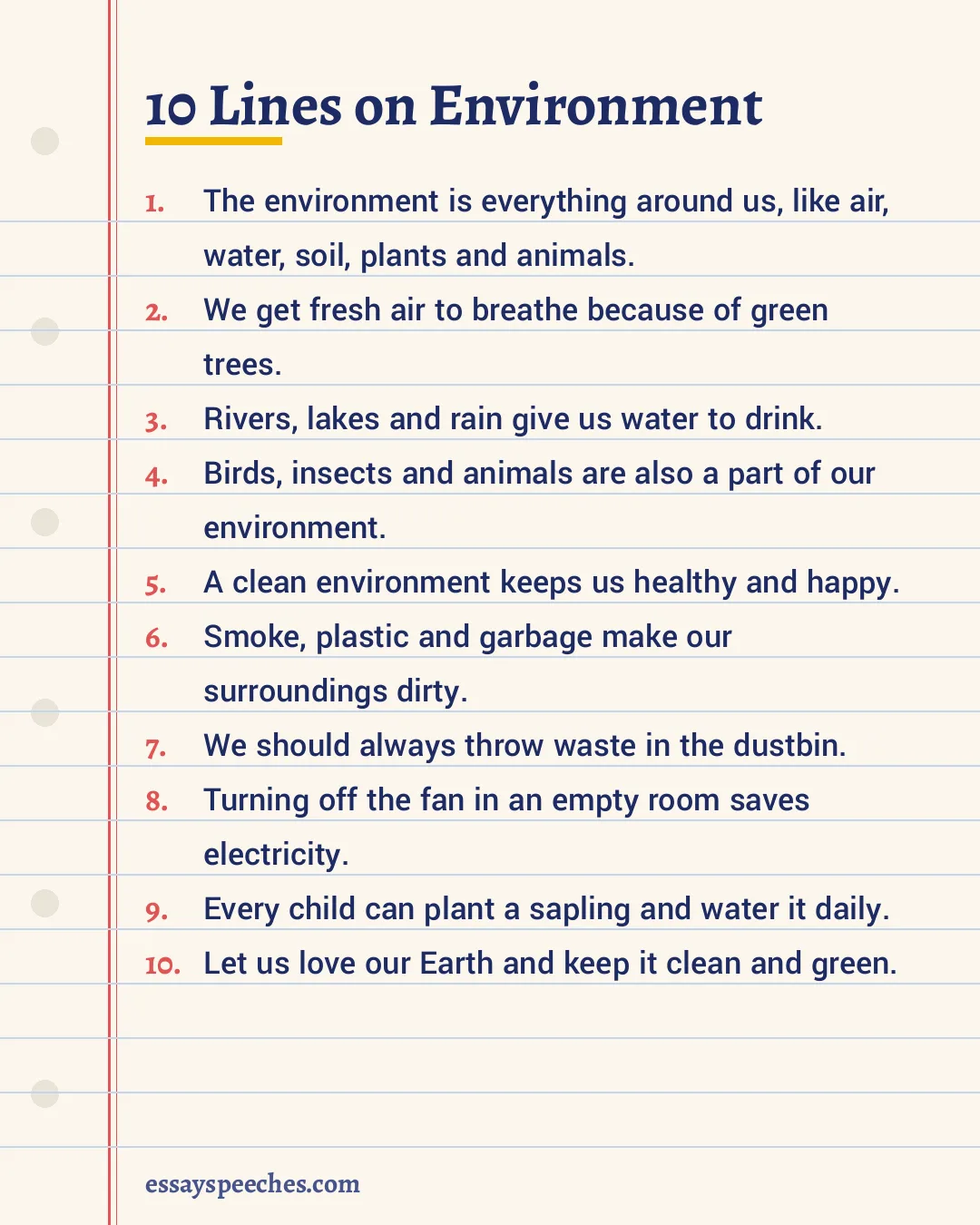
10 Lines on Environment
- The environment is everything around us, like air, water, soil, plants and animals.
- We get fresh air to breathe because of green trees.
- Rivers, lakes and rain give us water to drink.
- Birds, insects and animals are also a part of our environment.
- A clean environment keeps us healthy and happy.
- Smoke, plastic and garbage make our surroundings dirty.
- We should always throw waste in the dustbin.
- Turning off the fan in an empty room saves electricity.
- Every child can plant a sapling and water it daily.
- Let us love our Earth and keep it clean and green.
10 Lines on Environment for Class 5 (Set 2)
- Our environment is made of living things, like plants and animals, and non-living things, like air, water and soil.
- Each part of the environment depends on the others, just like the links of a chain.
- Forests give us oxygen, wood, fruits and medicines, and they also help bring rain.
- Factories, vehicles and the burning of waste fill the air with harmful smoke.
- Plastic bags block drains and harm cows, fish and birds that swallow them.
- Cutting too many trees leads to soil erosion, floods and hotter summers.
- World Environment Day is observed on 5 June every year to spread awareness.
- We can help by using cloth bags, saving water and cycling for short trips.
- Keeping wet and dry waste in separate bins at home makes recycling easier.
- A healthy environment today means a safe future for the children of tomorrow.
Short Essay on Environment in 100 Words
Look around you. The air you breathe, the water you drink, the trees in your park and the birds on your roof together make up the environment. Nature gives us everything we need to live and asks for very little in return.
Sadly, people have not always been kind to it. Smoke from vehicles, heaps of plastic and the cutting of forests have made our air and water dirty. Many animals have lost their homes.
We can change this with small habits. Plant trees, carry a cloth bag, close dripping taps and keep your street clean. A clean environment means a healthy life.
Essay on Environment 150 Words
The word environment means our surroundings. It includes the land we walk on, the air around us, the water in rivers and seas, and all the plants, animals and people on Earth. Each of these needs the others. Trees give oxygen, rain fills rivers, and rivers water the fields that feed us.
Over the years, human activity has disturbed this balance. Cities have grown, forests have shrunk, and factories release smoke and harmful gases. Garbage and sewage are dumped into rivers. As a result, we face dirty air, a shortage of clean water, rising heat and the loss of many wild animals and birds.
Protecting the environment is the duty of every citizen. Children can start at home by saving electricity, sorting waste, avoiding plastic and planting saplings on their birthdays. Schools can run cleanliness drives and nature clubs. When each of us does a little, the Earth stays green for all.
Paragraph on Nature
Early in the morning, when the sky turns pink and sparrows begin to chirp, nature shows its gentlest face. Nature is the world that was not made by human hands: mountains and valleys, forests and fields, the sun, the moon and the changing seasons. It feeds us with grain and fruit, cools us with shade and refreshes us with rain. A walk in a garden or beside a river calms the mind better than any screen. Poets and painters have always found ideas in nature, and scientists still learn from it every day. Yet we often take it for granted. If we wish to keep enjoying its beauty, we must protect trees, respect animals and never litter in parks, hills or beaches.
Nature Essay in English 200 Words (The Beauty of Nature)
India is blessed with nature in every shape. In the north stand the snowy Himalayas, in the south lie long sandy beaches, the west has the Thar Desert and the east has thick green forests. Few countries hold so many landscapes in one land.
The beauty of nature changes with every season. Spring brings yellow mustard fields and fresh leaves. Summer gives us mangoes and long, bright days. The monsoon turns brown hills green and fills ponds with the croaking of frogs. Winter wraps the mornings in fog and covers the mountains in snow.
Nature is not only beautiful but also generous. It gives us food, water, wood, cotton and medicine. Bees carry pollen from flower to flower, earthworms make the soil rich, and forests soak up rain like a sponge.
However, careless human actions are spoiling this gift. Hills are cut for roads, lakes are filled for buildings, and plastic floats in our rivers. We must learn to live with nature, not against it. Visiting a park, growing a small kitchen garden or simply watching the sunset can remind us how precious our natural world is.
Essay on Save Environment in 300 Words
A family that keeps its home spotless but throws its garbage on the street has not really understood cleanliness. The same is true of our planet. The Earth is the only home we have, and saving the environment means looking after it as carefully as we look after our own rooms.
The main threats today are pollution, deforestation and the wasteful use of resources. Smoke from vehicles, power plants and burning crop stubble makes the air in many cities unsafe to breathe in winter. Untreated sewage and factory waste poison rivers. Forests are cleared for farms, mines and roads, and animals such as tigers and elephants lose their homes. Burning coal and petrol also adds greenhouse gases to the air, which is warming the Earth and making the weather more extreme.
India has a long tradition of caring for nature. In the 1970s, hill villagers in what is now Uttarakhand started the Chipko movement, in which women clung to trees so that contractors could not fell them. In many villages, groves of trees have been protected by the community for generations. These examples show that ordinary people can make a real difference.
What can we do? Students can follow the three Rs: reduce, reuse and recycle. Carry a steel bottle instead of buying plastic ones. Use both sides of a page. Switch off appliances when they are not in use. Walk, cycle or take public transport for short trips. Celebrate festivals without loud crackers and plastic decorations. At school, a nature club can plant trees, make compost from canteen waste and spread awareness in the neighbourhood.
Saving the environment is not a task for the government alone. It begins with the choices each of us makes every day. If we protect nature, nature will protect us.
Environment Essay in English: Long Essay in 500 Words
Introduction
Every living thing on Earth, from the smallest ant to the largest whale, depends on its surroundings for survival. These surroundings, made up of air, water, land, sunlight and other living beings, are called the environment. Humans are one part of this web of life, not its masters. Yet in the last two centuries, our actions have changed the environment faster than ever before. Today, protecting it has become one of the most urgent tasks before humankind.
Why the Environment Matters
The environment has a natural part and a human-made part. The natural environment includes the atmosphere, water bodies, soil, forests and wildlife, while the human-made environment includes our homes, roads, farms and cities. A healthy natural environment supplies clean air, fresh water, fertile soil and a stable climate. It also gives us food, fibre, fuel and medicines. When one part is harmed, the damage spreads to all. Cutting forests on hill slopes, for instance, leads to landslides, silt in rivers and floods in the plains below.
Major Environmental Problems
Air pollution is a serious concern in many Indian cities, especially in winter, when smoke and dust hang low over the ground. Water pollution affects rivers and lakes that receive sewage and industrial waste. Plastic clogs drains, chokes animals and breaks into tiny pieces that enter our food. The loss of forests and wetlands has pushed many plants and animals towards extinction.
Above all, the burning of coal, oil and gas releases carbon dioxide and causes global warming. Its effects can be seen in melting glaciers, rising sea levels, longer heatwaves and unpredictable rainfall. Farmers suffer when the monsoon fails, and coastal families lose their homes to stronger cyclones. The poorest people, who did the least to cause the problem, often suffer the most.
Steps to Protect the Environment
Laws and policies help. India passed the Wildlife Protection Act in 1972 and the Environment Protection Act in 1986, and our national parks and sanctuaries shelter forests and wildlife. Clean energy from the sun and the wind is spreading across the country. World Environment Day on 5 June and Earth Day on 22 April remind people everywhere of their duty towards nature.
Individual action matters just as much. We can save electricity and water, separate waste at home, refuse single-use plastic, repair things instead of throwing them away and choose to walk or cycle. Planting native trees such as neem, peepal and banyan gives shade to people and shelter to birds for many decades. Small actions, repeated by millions of people, add up to a large change.
Conclusion
We do not own the Earth only for ourselves. We hold it in trust for the children who will come after us. If we keep wasting its riches, they will be left with dirty air, dry rivers and empty forests. But if we live simply and wisely, the planet can heal. Protecting the environment is therefore not a choice but a responsibility, and it begins with each one of us.
Paragraph on World Environment Day (5 June)
Every year on 5 June, people across the globe pause to think about the health of our planet. This day is World Environment Day. The United Nations chose this date because its first major conference on the human environment opened in Stockholm on 5 June 1972. Since then, the day has grown into a worldwide movement. Each year, one environmental problem is picked as the theme, such as plastic pollution or saving land from turning into desert. In Indian schools, students plant saplings, make posters, hold quiz contests and take a pledge to protect nature. Some clean up parks and riverbanks, while others collect old newspapers for recycling. The real message of the day is that caring for the Earth must not last for one day only but become part of our daily life.
Speech on Environment for Students (2 Minutes)
Good morning to our respected Principal, teachers and my dear friends.
Today my topic is something we cannot live without for even a minute: our environment.
Close your eyes for a moment and think of your favourite place in nature. Perhaps it is a beach, a hill, a mango orchard in your grandparents' village or simply the neem tree outside our classroom. Now imagine that place covered in smoke and plastic. How would you feel?
Sadly, this is already happening in many parts of our country. Our rivers carry garbage instead of fish. Many of our cities are wrapped in smog every winter. Summers are growing hotter, and the rain no longer comes on time. The little sparrow that once nested in every courtyard is now a rare sight in many towns.
Who is responsible for this? Not someone far away. It is all of us, through the plastic bags we throw away, the taps we leave running and the fans that keep spinning in empty rooms.
But friends, if we are part of the problem, we can also be part of the solution. Let us carry a cloth bag and a steel bottle. Let us switch off the lights we do not need. Let us walk or cycle for short distances. Let us plant one tree on every birthday and look after it until it grows tall. Let us say no to noisy crackers and yes to clean celebrations.
The Earth has looked after us for thousands of years. Now it is our turn to look after the Earth.
Thank you.
Earth Day Speech in English (1 Minute Speech on Environment)
Good morning to our honourable Principal, respected teachers and all my friends.
Every year on 22 April, people all over the world celebrate Earth Day. On this day, we promise to take good care of our planet.
The Earth gives us so much. It gives us fresh air, clean water, sweet fruits and pretty flowers. It is home to lions, elephants, peacocks and tiny butterflies. But we often hurt the Earth. We throw garbage on the road, waste water and cut down trees.
Friends, we may be small, but we can do big things. We can switch off lights, close taps tightly and use both sides of our notebook pages. We can plant a tree and water it every day.
Do you want to live on a clean and green planet? Then let us make the Earth smile again.
Thank you.
How to Write an Environment Essay
- Open with a picture the reader can see, such as a smoky street or a quiet forest, instead of a dictionary definition.
- Explain what the environment is: air, water, land, plants, animals and people, all depending on one another.
- Name the main problems clearly: air and water pollution, plastic waste, cutting of forests and global warming.
- Add Indian examples to make your essay stand out, like the Chipko movement, winter smog in cities or tree planting drives in schools.
- Long answers of 300 to 500 words read better when split under headings, for example Why It Matters, Main Problems and What We Can Do, between an introduction and a conclusion.
- Give practical solutions a student can follow: the three Rs, saving water and power, cloth bags and planting trees.
- End with a strong message or a promise, not a repeat of your first paragraph.
Need this topic in Hindi? Read: Paryavaran Par Nibandh: पर्यावरण पर निबंध हिंदी में (10 पंक्तियाँ, निबंध और भाषण)
Questions students ask
What is the environment in simple words?
The environment is everything around us that affects our life. It includes air, water, soil, sunlight, plants, animals and people. All these parts depend on one another, so harming one part harms the others too.
When is World Environment Day celebrated?
World Environment Day is celebrated every year on 5 June. The United Nations chose this date because its conference on the human environment opened in Stockholm on 5 June 1972. Schools mark the day with tree planting, posters, quizzes and pledges.
When is Earth Day, and how is it different from World Environment Day?
Earth Day is observed on 22 April. It began in the United States in 1970 and is now marked around the world. Both days share the same goal, which is to make people care for the planet, but World Environment Day is led by the United Nations.
How can students help save the environment?
Students can save water and electricity, carry cloth bags and steel bottles, sort waste at home and avoid single-use plastic. They can plant and look after trees, walk or cycle for short trips and encourage their families to do the same.
Where can I find an environment essay in Hindi?
For Hindi, open our paryavaran par nibandh page. It has 10 lines, essays from 100 to 500 words and an environment day speech in Hindi, all written separately for Hindi medium students.
Every essay and speech on this page is written and checked by the Essay Speeches team. Spotted a mistake? Tell us. How we write.