
Swami Vivekananda Speech and Essay for Students
This Swami Vivekananda speech page has everything a student needs for National Youth Day on 12 January, a school assembly or an essay competition. You will find a 1 minute speech, a 2 minute speech in English, a long Swami Vivekananda Jayanti speech, a principal's speech, an easy account of his Chicago speech of 1893, 10 lines, a paragraph, a 150 word essay, a longer essay and 10 lines in Hindi.
Choose whichever piece fits your class and the time you are given. Learn the main dates first: born on 12 January 1863, the Chicago address on 11 September 1893, and his passing on 4 July 1902. Then practise the speech aloud and add a line or two of your own about what his life teaches you.
Short Speech on Swami Vivekananda (1 Minute)
Good morning to our respected Principal, teachers and my dear friends.
Today I will tell you about a great son of India, Swami Vivekananda. He was born on 12 January 1863 in Calcutta, which we now call Kolkata. As a child, his name was Narendranath, and his family called him Naren.
Naren was a brave and curious boy. He loved to read, play games and ask questions. When he grew up, he became a monk and travelled all over India on foot.
In 1893, he went to Chicago in America and gave a famous speech. He made India proud in front of the whole world.
Swami Vivekananda told young people to be strong, fearless and kind. He asked us to help the poor and to believe in ourselves.
His birthday is celebrated as National Youth Day. Let us walk on his path and make India proud.
Thank you.
Swami Vivekananda Speech in English (2 Minutes)
A very good morning to our respected Principal, my teachers and all my friends.
Today we remember a man who woke up a whole nation with his words: Swami Vivekananda. His birthday, 12 January, is celebrated across India as National Youth Day. Why do the young people of India honour a monk who lived more than a hundred years ago? Because his message was meant especially for them.
Swami Vivekananda was born as Narendranath Datta in Calcutta in 1863. He was a bright student who loved philosophy, music and sports. He asked hard questions and never accepted an answer without thinking about it. Guided by a wise teacher, he chose a life of service and became a monk.
For several years he walked across India, from the Himalayas to Kanyakumari. He saw great poverty, and it moved him deeply. He felt that India could rise again only if its people became educated, confident and united.
In 1893, he travelled to Chicago to speak at the World's Parliament of Religions. When he began with the words Sisters and Brothers of America, the hall rose in applause. He spoke about tolerance and respect for every faith, and the world began to see India in a new light.
Friends, his advice to us was simple. Believe in yourself. Build a strong body and a strong mind. Serve those who are weaker than you. Never be afraid.
He passed away in 1902, only 39 years old, but his ideas are still alive in every classroom and every young heart.
Let us live by his famous call to rise, wake up and never stop until we reach our goal.
Thank you.
Swami Vivekananda Jayanti Speech for National Youth Day (Long)
Good morning to our respected Principal, honoured guests, teachers and my dear fellow students.
Today is 12 January, the birth anniversary of Swami Vivekananda, which our country celebrates as National Youth Day. The day has been observed since 1985 to remind young Indians of a man who believed that the future of the nation lay in their hands.
Swami Vivekananda was born Narendranath Datta in Calcutta on 12 January 1863. His father was a well-known lawyer, and his home was full of books, music and lively debate. Young Naren was a fine student, a good singer and a keen sportsman. Above all, he had a restless mind that wanted answers to the deepest questions of life.
That search led him to a teacher at Dakshineswar whose simple wisdom changed the course of his life. After his teacher passed away, Narendranath became a monk and set out to know his own country. For years he wandered across India with very few belongings. He stayed in poor huts and royal palaces alike, and everywhere he saw a land of great heritage held back by poverty, ignorance and a lack of self-belief.
In September 1893, he reached Chicago for the World's Parliament of Religions. His opening words won the hearts of thousands of listeners. In a short address, he spoke of tolerance, of respecting every path, and of ending hatred between people of different beliefs. Almost overnight, an unknown young monk from India became famous across America.
After lecturing in America and England for some years, he came home to a hero's welcome. The mission he founded in 1897 still runs schools, hospitals and relief work during floods and famines. For him, serving the hungry, the sick and the poor was the noblest duty of all.
What would he say to us if he stood here today? I believe he would say three things. First, believe in yourself, because without self-belief no real progress is possible. Second, let education build character. He described education as the manifestation of the perfection already in man, not a pile of facts stuffed into the brain. Third, be strong in body and spirit, fearless and ready to work for others.
Swami Vivekananda left this world on 4 July 1902, when he was only 39. Yet in that short life he gave India a new confidence that inspired many freedom fighters after him.
Friends, the best way to honour him is not by garlanding his picture once a year. It is by becoming the kind of young person he dreamed of: honest, brave and useful to society. We can start small, by helping a neighbour in need or teaching a younger child to read.
If each of us lights one lamp of courage, the whole country will shine.
Thank you.
Principal's Speech on National Youth Day (Swami Vivekananda Jayanti)
Good morning, dear students, my respected colleagues and members of staff.
Every year on 12 January, we pause to remember Swami Vivekananda, and every year I find something new in his life to share with you. This morning, I want to talk about one word that he used again and again: strength.
When Swamiji spoke of strength, he did not mean only muscles. He meant the strength to tell the truth when lying is easier. He meant the strength to keep studying after a poor result. He meant the strength to stand up for a classmate who is being teased. A strong person, in his view, could control anger, keep promises and work without fear.
Dear students, you live in a world full of distractions. Phones buzz all day, and opinions reach you from every side. In such a time, his advice to build concentration is more useful than ever. He believed that a focused mind could achieve almost anything. Try it yourself. Put away every distraction for just thirty minutes and give your full attention to one chapter. You will be surprised by what you can do.
Swamiji also taught that education is incomplete without service. So I invite each class to take up one small act of service this month. You could teach a younger child to read, help our gardeners care for the plants, or collect old books for a library in a nearby village.
I would also like to thank the students who prepared today's assembly. Your songs, your speeches and the quotations on the notice board show that his ideas have reached your hearts.
Let us not leave his message on this stage. Let us carry it into our classrooms, our playgrounds and our homes.
I wish all of you a happy National Youth Day.
Thank you.
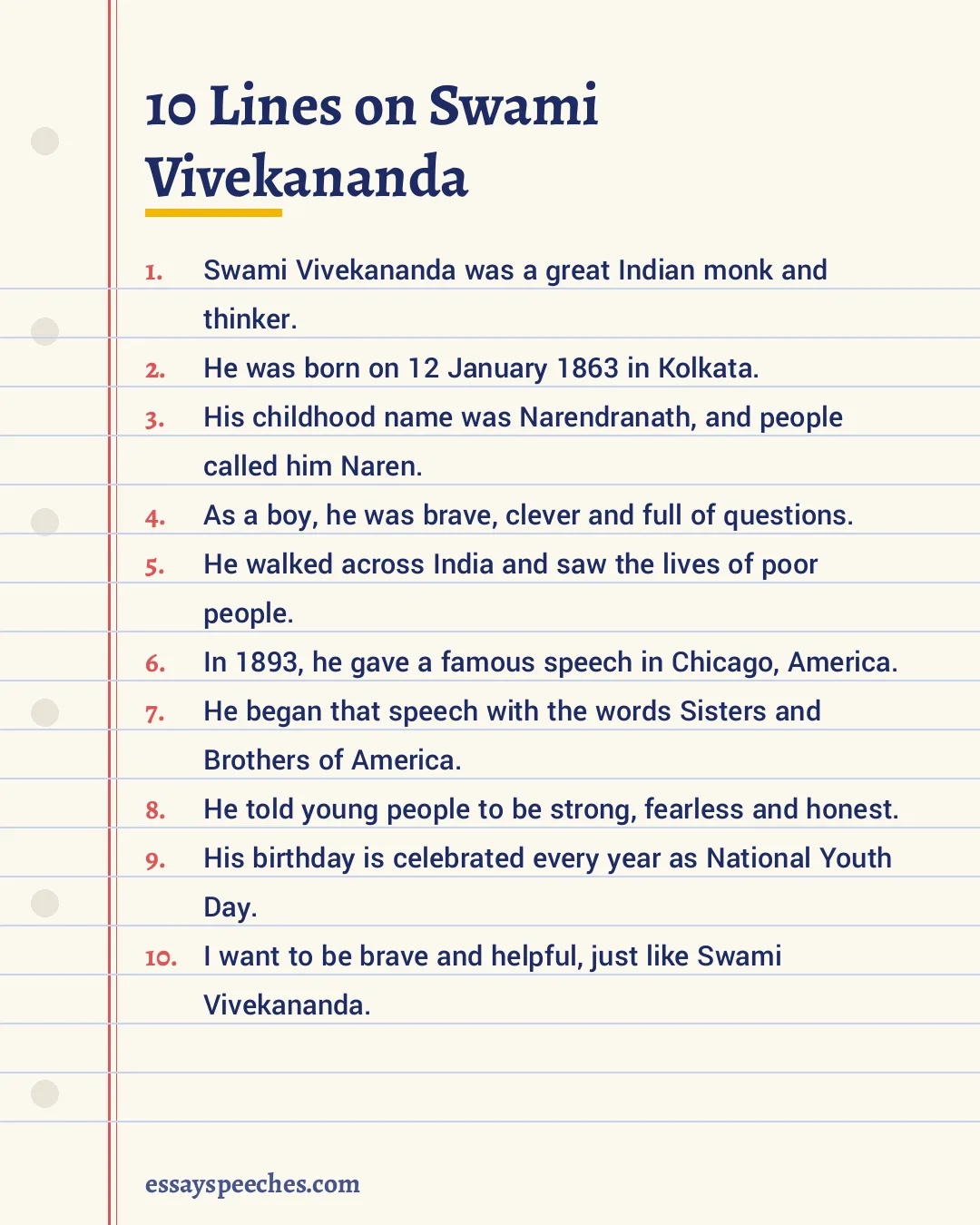
10 Lines on Swami Vivekananda
- Swami Vivekananda was a great Indian monk and thinker.
- He was born on 12 January 1863 in Kolkata.
- His childhood name was Narendranath, and people called him Naren.
- As a boy, he was brave, clever and full of questions.
- He walked across India and saw the lives of poor people.
- In 1893, he gave a famous speech in Chicago, America.
- He began that speech with the words Sisters and Brothers of America.
- He told young people to be strong, fearless and honest.
- His birthday is celebrated every year as National Youth Day.
- I want to be brave and helpful, just like Swami Vivekananda.
Swami Vivekananda Paragraph
Few Indians have inspired young people as deeply as Swami Vivekananda. Born Narendranath Datta in Calcutta in 1863, he grew into a thoughtful young man who questioned everything. He chose the life of a monk and travelled the length of India on foot, sharing the hardships of ordinary villagers. His address at Chicago in 1893 introduced Indian thought to the West and made him known around the world. He taught that every person has great strength within, and that serving the poor is the truest duty of an educated person. The mission he founded in 1897 carries on this service even today. Though he lived only 39 years, his message of courage, self-confidence and service still guides millions of students.
Swami Vivekananda Essay in English 150 Words
Swami Vivekananda is remembered as one of the finest minds India has produced. He was born on 12 January 1863 in Calcutta, and his parents named him Narendranath Datta. From childhood, he was fearless, kind to the needy and eager to learn.
As a college student, he read widely and kept looking for answers about the meaning of life. His search led him to a wise teacher who guided him towards a life of service. After becoming a monk, he travelled through every part of India and saw the suffering of the poor.
In 1893, he represented India at the World's Parliament of Religions in Chicago. His speech on tolerance and brotherhood won great praise.
The mission he founded in 1897 still serves people through schools, hospitals and relief work. He died in 1902, aged only 39. His birthday is now observed as National Youth Day.
Swami Vivekananda Chicago Speech 1893: What He Said
On 11 September 1893, the World's Parliament of Religions opened in Chicago, in the United States. It brought together speakers from many faiths and countries. Among them was a young monk from India in an ochre robe and turban, almost unknown to the audience. He had reached America after a long sea journey and had arrived without a formal letter of invitation, but well-wishers he met there helped him get a place among the speakers.
When his turn came, Swami Vivekananda addressed the gathering as Sisters and Brothers of America. Those warm, simple words touched the listeners so deeply that the crowd stood and applauded for a long time before he could continue. He spoke as if he were talking to his own family.
The speech itself was short. He thanked the audience on behalf of India's ancient tradition and said he was proud to belong to a nation that had sheltered people driven out of other lands. He compared different faiths to streams that rise in different places but all flow into the same sea. Above all, he hoped the gathering would mark the end of fanaticism, bigotry and persecution.
The address made him famous across America. Newspapers praised him, and he was invited to lecture in many cities. For Indians living under colonial rule, it was a moment of great pride, and the speech is still remembered as a lesson in tolerance.
Essay on Swami Vivekananda (400 Words)
Introduction
Some lives are short but leave a light that lasts for generations. Swami Vivekananda lived for less than forty years, yet he changed how India saw itself and how the world saw India. A monk, thinker, speaker and patriot, he is honoured every year on National Youth Day.
Early Life and Education
Narendranath Datta was born into a respected family of Calcutta. His father, Vishwanath Datta, was a lawyer at the Calcutta High Court, and his mother was a wise and strong-willed woman who told him stories of courage and duty. Naren studied at Presidency College and later at the General Assembly's Institution, now the Scottish Church College. He read Western philosophy, history and science, sang well and enjoyed physical exercise.
The Wandering Monk
His questions about truth and purpose led him to a teacher at Dakshineswar near Calcutta, who taught him to see every human being as worthy of love and service. After becoming a monk, he spent years travelling on foot across the country. At Kanyakumari, at the southern tip of India, he sat on a rock in the sea and thought deeply about the nation's future. The Vivekananda Rock Memorial stands there today and draws thousands of visitors. These journeys showed him both the hunger of the villages and the hidden strength of ordinary Indians.
Chicago and After
His address at the World's Parliament of Religions in Chicago in 1893 made him a celebrated figure in the West. He lectured widely in America and England, answering questions about India with patience and humour, before returning home in 1897. The mission he founded in 1897 later made its headquarters at Belur Math, on the banks of the Hooghly near Calcutta.
His Message for the Youth
He asked young Indians to build self-confidence, physical strength and good character. He believed the country could not progress while its poor and its women were denied education. Service to others, for him, was the highest purpose of an educated life. He wanted schools that taught self-reliance and practical skills along with books, so that young people could earn with dignity and help their villages.
Conclusion
Swami Vivekananda died at Belur Math on 4 July 1902. Leaders of the freedom struggle, including Subhas Chandra Bose, drew inspiration from his writings. His words still remind every young Indian that fearlessness, hard work and compassion can transform both a person and a nation.
Swami Vivekananda Essay in Hindi: स्वामी विवेकानंद पर 10 पंक्तियाँ
- स्वामी विवेकानंद भारत के महान विचारक और संन्यासी थे।
- उनका जन्म 12 जनवरी 1863 को कोलकाता में हुआ था।
- बचपन में उनका नाम नरेंद्रनाथ दत्त था।
- वे पढ़ाई, संगीत और खेलकूद तीनों में आगे रहते थे।
- उन्होंने पैदल घूमकर पूरे भारत को करीब से देखा।
- सन 1893 में उन्होंने शिकागो में एक प्रसिद्ध भाषण दिया।
- उन्होंने दुनिया को सहनशीलता और भाईचारे का संदेश दिया।
- वे युवाओं से कहते थे कि निडर बनो और खुद पर विश्वास रखो।
- उनका जन्मदिन हर साल राष्ट्रीय युवा दिवस के रूप में मनाया जाता है।
- हमें उनके आदर्शों पर चलकर देश की सेवा करनी चाहिए।
How to Give a Great Swami Vivekananda Speech
- Learn the four key dates by heart: 12 January 1863, 11 September 1893, 1897 for the mission he founded and 4 July 1902.
- Open with National Youth Day or with the famous greeting Sisters and Brothers of America, said slowly and warmly.
- In the body, cover three things: his early life, the Chicago address and his message for young people.
- Explain his ideas in your own words, such as self-belief, strength of character and service to the poor, instead of piling up quotations.
- Pause after each date and each question so that listeners can follow, and keep your voice steady and confident.
- Add one line on what you will do differently after learning about him; this makes the speech personal.
- Close with a short call to action and then thank the audience.
Questions students ask
Why is 12 January celebrated as National Youth Day?
Swami Vivekananda was born on 12 January 1863. Because his message was addressed especially to young people, India has observed his birthday as National Youth Day since 1985. Schools and colleges hold speeches, essay competitions and service activities on this day.
What did Swami Vivekananda say in his Chicago speech of 1893?
He greeted the audience as Sisters and Brothers of America and received a long ovation. In a short address, he spoke about tolerance, respect for all faiths and India's tradition of giving shelter to the persecuted. He hoped the gathering would end fanaticism and hatred.
What was Swami Vivekananda's real name?
His name at birth was Narendranath Datta, and his family called him Naren. He took the name Vivekananda after becoming a monk.
What are the main teachings of Swami Vivekananda for students?
He asked students to believe in themselves, build a strong body and mind, and gain an education that builds character. He also taught that serving the poor and needy is the noblest duty of an educated person.
How do I write a 150 word essay on Swami Vivekananda?
Write four short paragraphs: his birth and childhood, his life as a monk, the Chicago speech of 1893, and the mission he founded in 1897 along with National Youth Day. Keep sentences simple and use the correct dates.
Every essay and speech on this page is written and checked by the Essay Speeches team. Spotted a mistake? Tell us. How we write.