
Social Media Essay for Students (10 Lines, Short and Long Essays)
This social media essay page gives students ready pieces on a topic that comes up in almost every exam and debate. You will find two sets of 10 lines, a 100 words essay on social media, an impact of social media essay in 150 words, a paragraph on social media, an advantages and disadvantages of social media essay, an essay on its impact on students, a long essay of 500 words, a 2 minute speech on social media and 10 lines in Hindi.
Start with the piece meant for your class. As you read, make two columns in your notebook, one for benefits and one for harms, and build your answer from those notes, adding something you have seen at home or among friends.
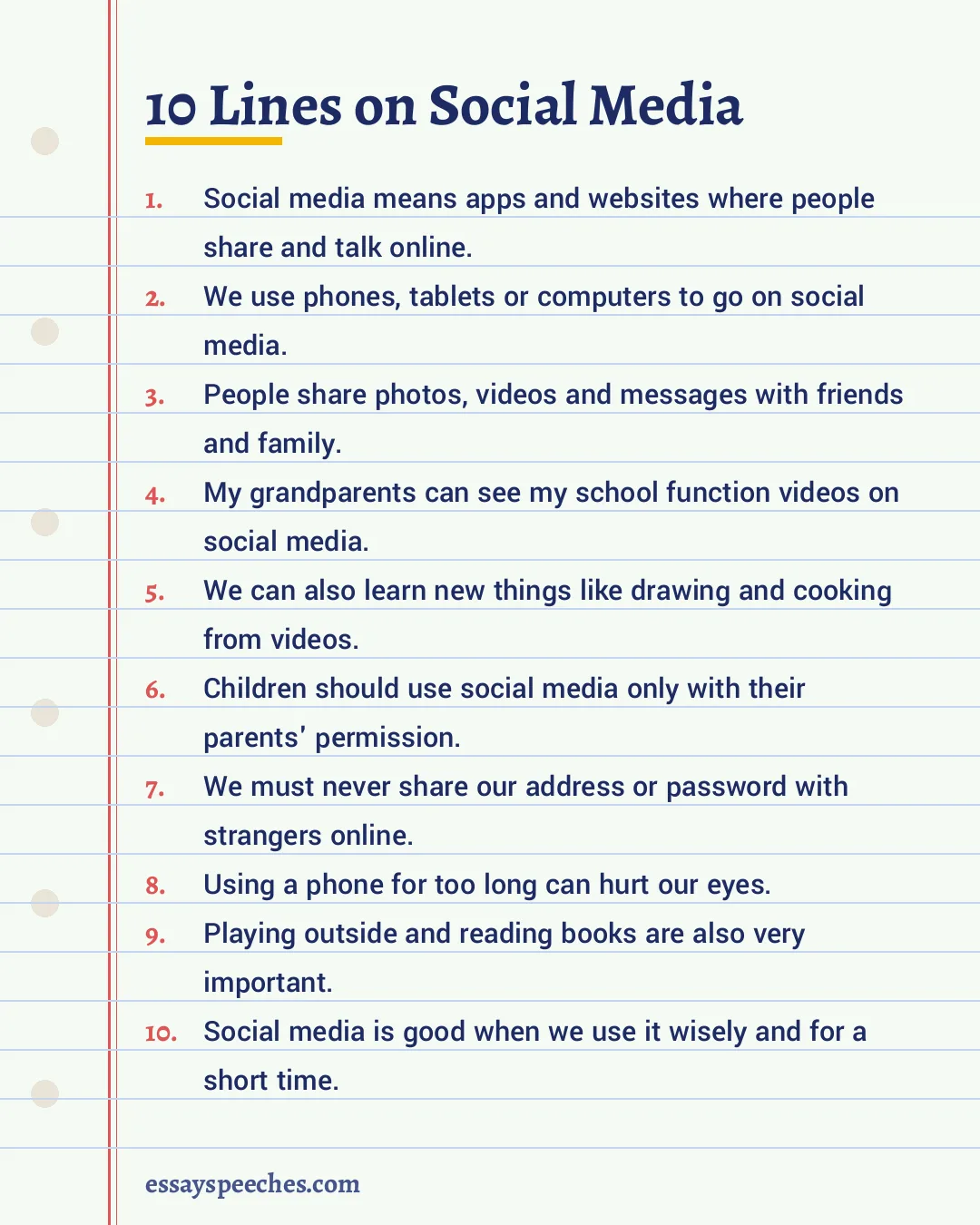
10 Lines on Social Media
- Social media means apps and websites where people share and talk online.
- We use phones, tablets or computers to go on social media.
- People share photos, videos and messages with friends and family.
- My grandparents can see my school function videos on social media.
- We can also learn new things like drawing and cooking from videos.
- Children should use social media only with their parents' permission.
- We must never share our address or password with strangers online.
- Using a phone for too long can hurt our eyes.
- Playing outside and reading books are also very important.
- Social media is good when we use it wisely and for a short time.
10 Lines on Social Media for Class 6 (Set 2)
- Social media is a group of online platforms where users create, share and react to posts.
- Photo-sharing apps, video apps and messaging apps are the most common types of social media.
- It helps families living in different cities and countries stay in touch every day.
- Students can watch science experiments, maths lessons and language tutorials for free.
- During floods and other disasters, social media helps spread news and calls for help quickly.
- However, fake news and rumours also spread fast, so we must check facts before forwarding.
- Spending hours scrolling can reduce sleep, distract us from studies and make us feel lonely.
- Cyberbullying, or hurting someone with mean comments online, is a serious problem.
- We should keep our accounts private and report anything that makes us uncomfortable.
- Used with balance and good manners, social media can be a useful friend, not a master.
100 Words Essay on Social Media
A few taps on a phone and we can see what our cousin abroad ate for dinner. This is the power of social media. It is a set of online platforms where people post photos, videos and messages and connect with others.
Social media has many uses. It keeps families in touch, helps students learn from free videos and spreads useful news quickly.
But it also has a darker side. Too much screen time harms our eyes, sleep and studies, and false news can mislead us. We should use social media for a limited time and always think before we post.
Impact of Social Media on Youth Essay 150 Words
Young people are the biggest users of social media. For many teenagers, the first thing they check in the morning and the last thing they see at night is their phone. Naturally, this has a strong impact on their lives.
On the positive side, social media gives youth a stage. A teenager can share a song, a painting or a science project and receive praise from people far away. Many young people learn skills, follow news and find groups that share their hobbies.
On the negative side, endless scrolling eats into time for sleep, study and exercise. Seeing only the happy, edited moments of others can make teenagers feel that their own lives are dull. Some face cruel comments or pressure to collect likes.
Social media is neither a boon nor a bane by itself. Its effect depends on how wisely young people use it.
Paragraph on Social Media
Walk into any bus, waiting room or college canteen and you will see heads bent over glowing screens. Most of these people are on social media, the online world where users share pictures, short videos, opinions and news. It has made the world smaller. A small baker in a town can now find buyers across the state, and a student in a village can join an online quiz with students from big cities. At the same time, it has created new worries. Rumours travel faster than facts, and many people feel restless if they have not checked their phone for a while. Social media is a powerful tool, and like any tool, it helps those who control it and harms those who let it control them.
Advantages and Disadvantages of Social Media Essay (250 Words)
Not so long ago, sharing a holiday photo meant getting a print made at a studio and posting it to relatives. Today, it takes a second. Social media has changed the way we talk, learn, shop and even think. Like every invention, it brings both gifts and dangers.
The advantages are many. Social media connects people across distances, so a soldier posted far away can video-call his children every evening. It is a huge library of free learning, from guitar lessons to board exam revision. Small businesses, artists and farmers use it to reach customers without spending much. During emergencies, it spreads information about blood donors, relief camps and missing persons within minutes. It also gives ordinary citizens a voice to raise local problems.
The disadvantages are just as real. Many users, especially children, spend hours scrolling and lose sleep and concentration. Fake news and edited videos can create fear and even violence. Cyberbullying and online fraud have become common. Sharing too much personal information can put our safety at risk. Constant comparison with the polished lives of others can cause stress and low self-esteem.
The answer is not to run away from social media but to use it wisely. Set a time limit, follow pages that teach something useful, check facts before sharing and keep your accounts private. When we stay in control, social media becomes a blessing rather than a burden.
Impact of Social Media on Students Essay in 300 Words
Ask a class of teenagers how they spent their evening and many will mention a video they watched or a post they shared. Social media has become a part of student life, and its impact can be seen in the classroom, at home and on the playground.
Used well, social media is a great study partner. Students can watch a difficult chemistry reaction explained step by step, join online study groups before exams and follow pages that share daily general knowledge. Shy students often find the confidence to express their ideas through writing or art online. School clubs use messaging groups to share notices, homework and match schedules quickly.
However, the harmful effects are hard to ignore. The biggest is distraction. A student who opens a phone to check one message often looks up an hour later, with the homework still unfinished. Late-night scrolling leads to tired mornings and poor attention in class. Some students start judging their worth by the number of likes they get, which leads to anxiety. Others become victims of cyberbullying, which can hurt as deeply as bullying in the corridor. Copying answers from online sources also weakens real learning.
Parents and teachers can help by talking openly about online life instead of simply banning phones. Simple rules work well: no phones at the dinner table, no screens for an hour before sleep and study time kept free from notifications. Students themselves must learn to unfollow pages that make them feel bad and to report anyone who harasses them.
Social media can either sharpen a student's mind or scatter it. The difference lies in self-control. A student who uses it as a tool, and not as a habit, will enjoy its benefits without paying its price.
Long Essay on Social Media in 500 Words
Introduction
Human beings have always wanted to share stories. Long ago, people gathered around a fire or under a village tree to exchange news. Later came letters, newspapers, the telephone and television. Social media is the latest and fastest step in this journey. It refers to online platforms where users create and share content, such as text, photos and videos, and interact with one another through likes, comments and messages. Today, photo-sharing apps, video apps and messaging apps are used by people of every age, from schoolchildren to grandparents.
Advantages of Social Media
The greatest gift of social media is connection. Families separated by distance can share daily moments, and old school friends can find each other after decades. It has also opened the doors of learning. Free lessons, lectures and tutorials are available on almost every subject, which is a blessing for students in places with few coaching centres or libraries.
Social media has given a voice to ordinary people. A citizen can post a photo of a broken road or an overflowing drain and draw the attention of local authorities. Artists, home cooks, craftsmen and small shopkeepers can show their work to thousands without spending on advertisements. During floods and other disasters, volunteers use it to share information about shelters, food and medical help.
Disadvantages of Social Media
The same speed that spreads useful news also spreads lies. Fake messages, edited videos and rumours can cause panic, hatred and sometimes violence before the truth catches up. Many apps are designed to keep users scrolling, so people lose hours without noticing. This affects sleep, health and studies.
Mental health is another worry, especially for teenagers. Social media shows mostly the best moments of other people's lives, and constant comparison can lead to loneliness and low self-esteem. Cyberbullying, online fraud and misuse of personal photos are real dangers. Privacy is also at risk, as many users share details like their location and school without thinking.
Using Social Media Wisely
Social media is like fire: it can cook our food or burn our house. The key is responsible use. Users should limit their screen time, keep accounts private and never share passwords or personal details. Before forwarding any message, they should check whether it comes from a reliable source. Most apps also have a minimum age for users, and children should respect it. Parents and teachers can guide young users through open conversation rather than fear.
Conclusion
Social media is neither a hero nor a villain. It is a mirror that reflects how we choose to use it. If we use it to learn, to connect and to help others, it can make the world kinder and more informed. If we let it rule our time and thoughts, it can make us anxious and divided. The choice, finally, is in our own hands.
Speech on Social Media for Students (2 Minutes)
Good morning to our respected Principal, teachers and my dear friends.
Today I want to talk about something that is probably in your pocket or school bag right now. No, not your tiffin. I am talking about social media.
Let me ask you a question. How many of you checked your phone before brushing your teeth this morning? Do not worry, you are not alone. Social media has become a part of our daily routine, as normal as breakfast.
And it has done wonderful things for us. It lets us chat with grandparents in another city. It teaches us coding, cooking and calculus for free. It helps a student artist find an audience and a small shop find customers. In times of trouble, it helps people find blood donors and missing children within hours.
But friends, every coin has two sides. The same screen that teaches us can also trap us. We sit down to watch one video and get up after two hours. We compare our ordinary days with the perfect pictures of others and feel that we are not good enough. False news spreads faster than the truth, and unkind comments can break someone's heart.
So what should we do? Should we throw our phones away? Of course not. We should simply become the masters of social media, not its servants. Set a time limit. Think before you post. Check before you forward. Be kind in the comments, because there is a real person on the other side.
Remember, friends, a phone is smart only when the person using it is smarter.
Thank you.
10 Lines on Social Media in Hindi: सोशल मीडिया पर 10 पंक्तियाँ
- सोशल मीडिया ऐसे ऑनलाइन मंच हैं जहाँ लोग फ़ोटो, वीडियो और संदेश साझा करते हैं।
- इसकी मदद से दूर रहने वाले रिश्तेदार और दोस्त रोज़ एक-दूसरे से जुड़े रहते हैं।
- विद्यार्थी इस पर पढ़ाई से जुड़े कई उपयोगी वीडियो मुफ़्त में देख सकते हैं।
- आपदा के समय सोशल मीडिया से मदद की ख़बर बहुत जल्दी फैलती है।
- छोटे दुकानदार और कलाकार भी इसके ज़रिए अपना काम लोगों तक पहुँचाते हैं।
- लेकिन इस पर झूठी ख़बरें और अफ़वाहें भी तेज़ी से फैलती हैं।
- ज़्यादा देर तक फ़ोन चलाने से आँखों, नींद और पढ़ाई पर बुरा असर पड़ता है।
- हमें अपना पता, पासवर्ड या निजी जानकारी किसी अजनबी को नहीं देनी चाहिए।
- कोई भी संदेश आगे भेजने से पहले उसकी सच्चाई जाँच लेनी चाहिए।
- सोशल मीडिया का समझदारी से और सीमित समय तक उपयोग ही सही है।
How to Write a Social Media Essay
- Begin with a scene everyone knows, such as heads bent over phones in a bus, instead of a textbook definition.
- Define social media in one simple line: online platforms where people create, share and react to content.
- Give both sides. Teachers reward a balanced essay that covers advantages and disadvantages of social media with real examples.
- Use general terms like photo-sharing apps, video apps and messaging apps rather than naming companies.
- For an essay on the impact of social media on youth or students, discuss studies, sleep, mental health and cyberbullying.
- Answers of 250 words and above look organised when divided into parts like Advantages, Disadvantages and Safe Use, with a clear opening and ending.
- End with your own view, for example that social media is a boon when we control it and a bane when it controls us.
Questions students ask
What is social media in simple words?
Social media means online apps and websites where people share photos, videos, messages and opinions, and react to what others share. Photo-sharing apps, video apps and messaging apps are common examples.
Is social media a boon or a bane?
It is both, depending on how it is used. It is a boon when it helps us learn, stay in touch and get help in emergencies. It becomes a bane when it wastes time, spreads fake news, or harms our sleep and mental health.
What are good debate points on social media?
For the motion, you can speak about connection with family, free learning, support for small businesses and quick help in disasters. Against the motion, you can speak about addiction, fake news, cyberbullying, loss of privacy and stress from comparison. Always back each point with a simple example.
How does social media affect students?
It can help students revise, join study groups and discover new hobbies. Too much use, however, leads to distraction, late nights, lower marks and anxiety about likes and comments. Setting a daily time limit helps students enjoy the benefits without the harm.
How can children stay safe on social media?
Children should use social media only with their parents' knowledge and respect the minimum age set by apps. They should keep accounts private, never share passwords, addresses or school details with strangers, and tell an adult if anyone troubles them online.
Every essay and speech on this page is written and checked by the Essay Speeches team. Spotted a mistake? Tell us. How we write.